The style notebook
Celine Resort 2026 Silk Scarf Necklines: Dress and Jacket Outfit Ideas
Celine Resort 2026 silk-scarf neckline dresses: choose plain camel, ivory or black jackets, control hem clearance and let the scarf be the single flourish.
For Celine Resort 2026, the question is not whether a scarf belongs near the collar, but how much jacket to put around a dress that already carries its own silk at the neckline. The collection report notes that Celine integrated silk scarves into dress necklines, and that same report lists camel, ivory and black coats alongside many jacket iterations in grass green, scarlet, beige and black. The useful answer: choose a jacket that is plain at the neck, hemmed to a deliberate point against the dress, and coloured either to recede behind the scarf or to change its register. This guide treats the integrated-scarf dress as the lead piece and Celine Resort 2026 as the reference point.
Start with the scarf as garment, not as accessory
A dress with a built-in silk scarf neckline is a complete idea. The scarf is already doing the work that a necklace, a brooch or a tied carré might otherwise do, so the jacket's job is to frame it rather than compete with it. In practice, that means a plain coat or jacket with a clean neckline, no scarf of its own, no contrast collar and no hardware near the throat. Let the dress's silk sit against skin or against the jacket's plain lapel, and keep the space around it quiet.
This is the key distinction from placing a scarf on the body. When you tie a scarf yourself, you can move it, loosen it or remove it. When the scarf is part of the dress, the neckline is fixed, so the jacket must adapt to it. Avoid anything that folds, wraps or buttons high enough to crush the scarf's drape.
Jacket shapes that keep the neckline singular
The most reliable jacket is one with a simple, open front and a neckline that stays below the scarf's knot or fold. Think of a straight-cut jacket worn open, a collarless jacket in a plain wool, or a softly tailored coat with a single-breasted closure. The point is not a specific designer silhouette but a principle: the jacket should create a vertical frame, not a second focal point.
- Collarless jacket: keeps the throat clear and lets the scarf read as the only detail above the chest.
- Single-breasted coat worn open: creates two plain vertical lines that draw the eye down rather than across.
- Straight-cut jacket with a low break: avoids a lapel that points directly at the scarf.
- Short boxy jacket: works best when the dress beneath is narrow and the scarf sits high; the jacket hem should not cut across the scarf's lower edge.
Skip double-breasted fronts with wide, high lapels if the scarf is large or draped. Skip anything with a built-in hood, a funnel neck or a scarf collar. Those details may be handsome on their own, but they compete with the dress's neckline rather than support it.
Hem clearance: closed, open and halfway
The hem decision is as important as the jacket shape. With a closed jacket, the dress becomes a skirt below the jacket hem, so the scarf is the only visible detail above the waist. That works when the dress is relatively plain below the neckline and the jacket is long enough to create a clean line. A closed jacket that ends at the hip or mid-thigh will make the scarf feel like the top half's only event.
With an open jacket, the dress's front is visible, so the scarf and the dress body need to relate. If the dress has a strong vertical line, let the jacket hang open and keep the hem shorter than the dress or noticeably longer. Avoid a jacket hem that lands exactly at the same level as a dress detail, such as a seam or a pocket, because it creates a busy horizontal break.
For a mid-length coat, check the clearance in a mirror while walking. The coat should not swing open to reveal a second patterned area right beneath the scarf. If the dress is plain below the neckline, a longer coat can work well. If the dress has its own texture or print, keep the jacket shorter or wear it closed.
Plain camel, ivory and black as the supporting cast
The report lists camel, ivory and black coats, and these are the most straightforward partners for a scarf-neckline dress. Camel and ivory warm the face and let a silk scarf read as a softer, more tonal detail. Black frames the scarf sharply and makes the neckline the brightest point in the outfit. In both cases, the jacket stays quiet because its colour is doing the supporting work, not the talking.
My styling interpretation: choose camel when the scarf has warm tones, ivory when it has pale or cool tones, and black when you want the scarf to look deliberate and graphic. These are not rules, but they help the neckline remain the single flourish. If the scarf is multicoloured, a plain black or ivory jacket will usually keep the outfit from looking fragmented.
Scarlet and grass green jackets change the register
The collection report also notes jacket iterations in grass green, scarlet and beige. A scarlet or grass green jacket is not a neutral frame; it becomes a second colour statement. That can be useful when the scarf is small or tonal, because the jacket supplies the contrast the outfit needs. But when the scarf is already vivid, a scarlet or green jacket may split attention.
A practical way to use these colours is to keep the jacket's neckline extremely plain. No contrast stitching, no metal buttons near the collar, no scarf of its own. Let the colour be the only extra idea, and keep the dress underneath simple. If you want the scarf to remain the hero, choose beige instead of scarlet or green; beige is closer to the camel family and keeps the palette calm. If you want the jacket to lead, wear the scarf-neckline dress in a quieter tone so the two do not fight.
Keep jewellery off the scarf and settle the shoes
With a built-in scarf neckline, jewellery at the throat is redundant. Leave the neck bare apart from the silk, and if you want metal, choose small earrings or a bracelet rather than a necklace. This keeps the scarf as the single flourish and avoids the look of a scarf competing with a chain.
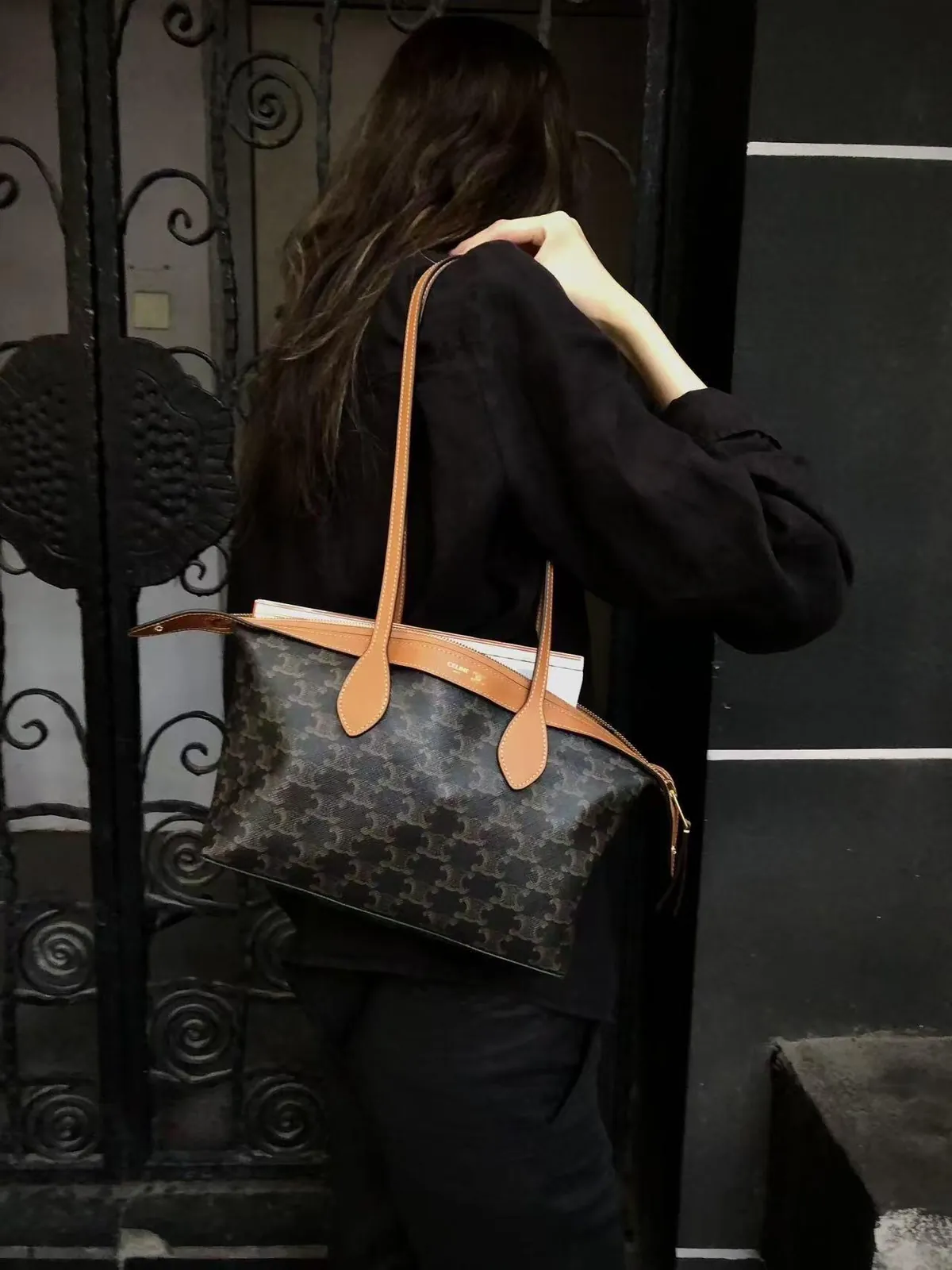
For shoes, the report mentions soft, glove-like jazz pumps and tight, slick wrestling-boot high-tops. My interpretation is that a low, plain pump keeps the outfit ladylike and lets the scarf remain the focal point, while a high-top boot adds a sharper, more contemporary contrast. Either works if the jacket hem is clear of the boot shaft and the scarf is not overwhelmed by too many competing textures. The existing same-brand wardrobe reference, Outfit reference for Celine Triomphe Canvas Bag: Outfit Ideas, is a separate wardrobe image and can serve as a general reminder of how Celine accessories sit alongside plain clothing; it is not a photograph of this collection.
For more ways to build around plain outerwear and a single focal point, see Celine Fall 2026 Peacoats and Cropped Kick-Flare Trousers and Celine Spring 2026 Silk Scarves: Shoulder Bag and Trouser Outfit Ideas. For a contrast in scarf styling, Burberry Knight Tassel Long Scarf shows how a scarf worn on the body differs from one built into a neckline.