The style notebook
Chanel Spring-Summer 2026 Maxi Flap Bags: East-West Denim and Goatskin Outfit Ideas
Chanel Spring-Summer 2026 east-west Maxi Flap: how its 4.9 × 12.2 × 2.8 inch shape changes jackets and trousers, plus denim, goatskin and calfskin choices.
A Chanel Spring-Summer 2026 east-west Maxi Flap changes a jacket-and-trouser outfit less through its size than through its ratio: 4.9 inches tall against 12.2 inches wide and 2.8 inches deep. That is a long, shallow rectangle, so it reads as a horizontal line at the hip or under the arm, not as a compact square flap. PurseBop's Anna McWhirter, writing on 16 January 2026, reports the seasonal Maxi Flap is dramatically elongated, takes design cues from the Spring-Summer 2015 Coco Top Handle, and comes with a flap-front CC turn-lock, a top handle for hand carry, and a long detachable chain shoulder strap with a leather section. Those are her reported design points; the outfit reasoning below is my styling interpretation.
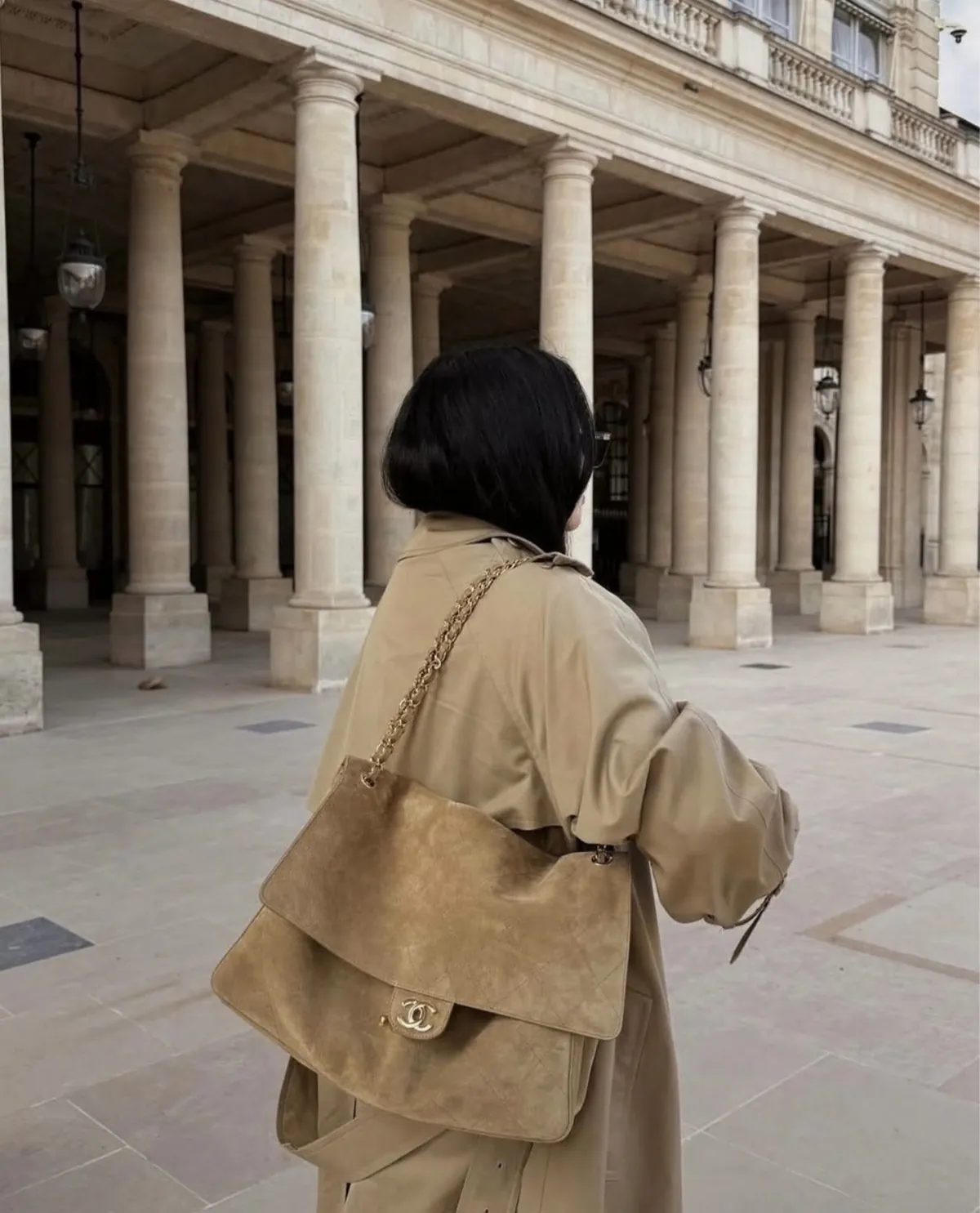
The featured image is an existing Chanel wardrobe reference, separate from the Spring-Summer 2026 looks discussed here.
Make the jacket end where the bag begins
The bag's width is fixed. What you control is the hem above it. A cropped jacket that stops at the natural waist leaves the whole horizontal span of the bag visible against the trouser, and the two shapes stay separate: a short vertical block above, a long flat rectangle below. A hip-length jacket drops over the same zone and the flap's top edge disappears under the cloth, so the bag reads as a wide strip emerging from under a coat. Neither is wrong, but they are different outfits.
A boxy, slightly short jacket in a matte cloth suits the flat front best. The CC turn-lock is the only hardware at the centre of a long, quiet surface, and a clean jacket front does not compete with it. Where the jacket carries its own hardware, pockets or a strong shoulder line, the bag's turn-lock becomes one more metal point in a busy upper half. I would keep the jacket plain and let the hardware sit low and alone.
Straight trousers, and why a belt changes the line
Because the bag is only 2.8 inches deep, it lies close to the body when carried on the shoulder, and its lower edge cuts across the waist or upper hip. A straight-leg trouser keeps one clean vertical below that cut. A wide-leg trouser can work, but the horizontal bag plus a wide horizontal hem leaves the leg with no clear direction; a tapered or pleated shape is a more deliberate contrast.
The belt is the interesting variable. A belted waist places a second horizontal line just above the bag, which can look like a frame around the carry point, or it can double the horizontal emphasis and shorten the torso. If the waist is already marked by a jacket seam or a high-rise trouser, skip the belt. If the outfit is a simple straight tunic or an unstructured jacket, one narrow belt gives the bag a line to sit under rather than float across.
Denim, chevron goatskin or grained calfskin: how much texture to echo
The three finishes ask for different amounts of surrounding texture.
- Black quilted washed denim. The most casual of the three. A washed finish already carries variation in tone, so the clothing can stay smooth and untextured: a fine wool trouser, a cotton shirt, a plain knit. Adding more washed or faded cloth turns the outfit into a double-denim story, which is a choice rather than a default. If you want that, keep the two washes close in depth so the bag does not look like an accident.
- Dark Brown chevron-quilted goatskin. The chevron runs a diagonal across a wide surface, so the bag supplies its own pattern. The jacket and trousers should then be plain in weave, with the brown echoed in a shoe, a knit or a bag-adjacent accessory rather than in a second chevron or a herringbone. This is the finish where a plain wool suit looks most deliberate.
- Black quilted grained calfskin. The middle option. Grained leather has visible surface, but it is quieter than chevron and dressier than washed denim. It sits comfortably with smooth tailoring and also with a crisp cotton shirt and straight trousers.
All three are described as accented with gold-tone hardware, which is the constant across the finishes. The finish decides texture; the hardware decides whether the outfit wants warm metal elsewhere.
Top handle or shoulder chain
The top handle makes the bag a hand-carried object held away from the body, and that changes the jacket more than the bag. A sleeve that ends cleanly at the wrist, or a bracelet-length sleeve, keeps the handle clear. A cuff that bunches at the wrist crowds the top handle and hides the ladylike proportion McWhirter describes.
The long detachable chain with a leather section places the bag at the side or under the arm, where its 12.2-inch width lies across the torso. In that position the jacket's side seam and the bag's lower edge are the two lines a reader sees first. A single-breasted jacket with a clean side seam works better here than a double-breasted front with overlapping edges at the same level.
For the denim finish, I would lean on the chain and a plain jacket, since the cloth is doing the casual work. For the chevron goatskin, the top handle keeps the pattern visible and stops the diagonal from being crushed against the body. Those are styling preferences, not claims about how the bag carries.
What to leave out
A second long horizontal element near the bag — a wide belt, a long tunic hem, a low-slung scarf — crowds the one line the east-west shape is built to make. The same applies to a second quilted or chevron surface at the same height. One textured element, one horizontal, one hardware story: the bag's proportions do the rest. For a different approach to the same Maxi Flap family, the plain tailoring guide covers the softer, squarer reading, and the Preppy Coco colour guide is the place to go if the decision is shade rather than proportion.