The style notebook
Dior Small Saddle Bag: Equestrian Shape Day Outfit Ideas
How plain should daytime clothing be around the Dior Small Saddle Bag? Keep tailoring and knits quiet so its equestrian curves and Newspaper print lead.
With the Dior Small Saddle Bag, the rest of a daytime outfit should be plainer than you think. The bag already carries two statements at once: the equestrian curves inherited from the 1999 Saddle, and the black-and-white Newspaper print. Harper's Bazaar's Barry Samaha, writing on 23 November 2026, describes the Dior Small Saddle Bag as taking its shape from the equestrian world, with an asymmetrical flap that recalls a saddle and D-shaped hardware that references a stirrup clasp. This version pairs the archival black-and-white Newspaper motif with calfskin and silver-finish hardware. He places it in the "Best for Making a Statement" slot and says the print makes the curved silhouette stand out, so the bag can anchor an outfit rather than simply complement it. My reading of that role: give the bag a quiet, well-cut base and let it hold the graphic note alone.
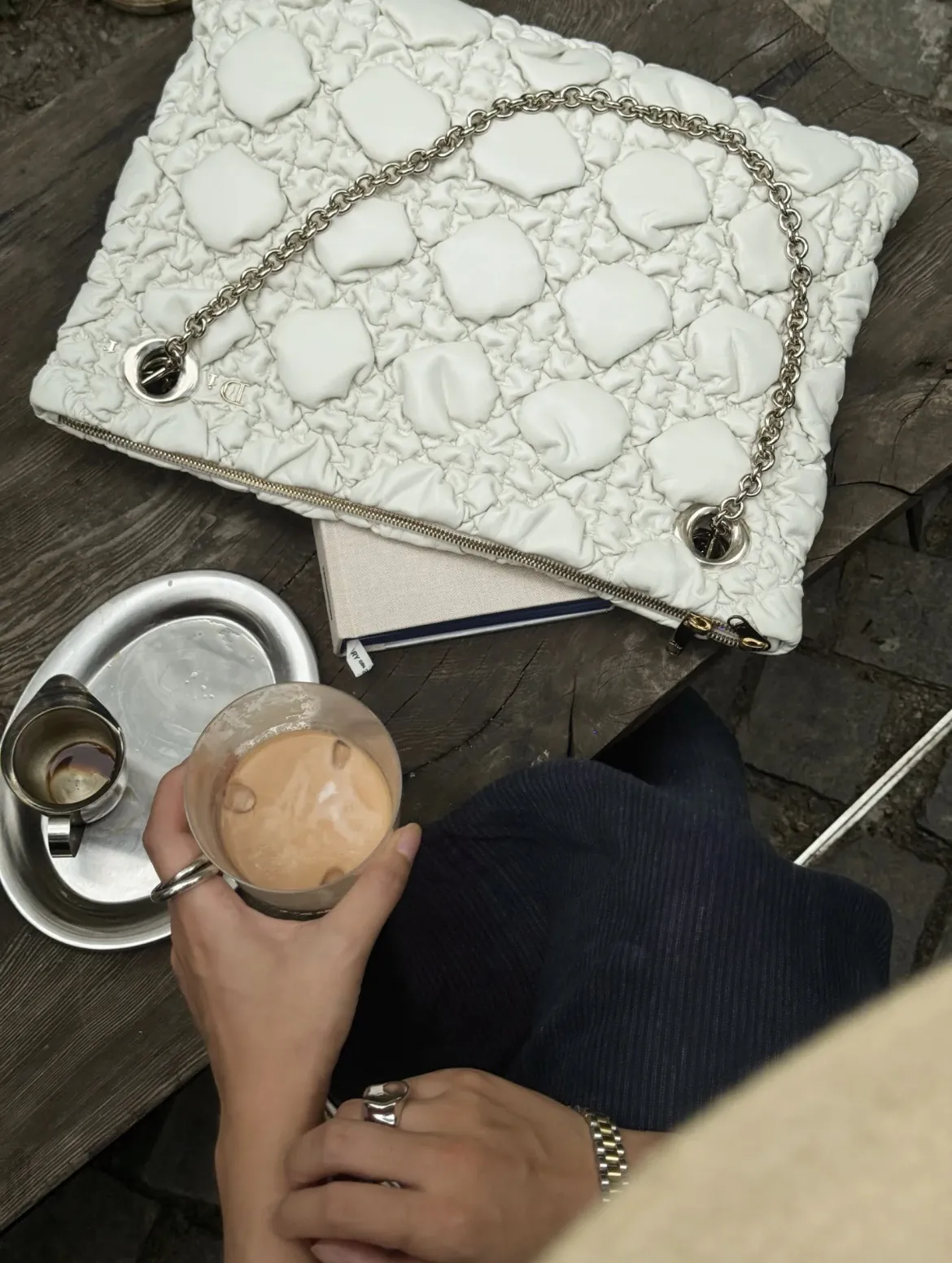
The featured image is an existing Dior wardrobe reference, separate from the Dior Small Saddle Bag looks discussed here.
The equestrian references below come from that report. The outfit choices are styling judgement, not claims about fit, capacity or how the bag carries in practice.
Plain tailoring beats a plain T-shirt here
Everyday simplicity does not have to mean a white tee. A straight-leg trouser in a solid neutral and a white shirt is Samaha's own suggestion for a sharper everyday take, finished with loafers. I would take that further toward tailoring: a soft blazer, a straight trouser and a plain shirt give the Saddle a structure to sit against without adding a second focal point. The bag's asymmetry is easier to read when the clothing around it is symmetrical and uncomplicated.
A simple knit base works too, but the shirt-and-trouser route is the cleaner first answer. A plain base still has to look deliberate: loose jersey can make the printed bag look like the only considered thing in the outfit, while crisp cotton, a defined trouser crease or a light jacket shell keeps the base from reading as an afterthought.
Keep the neckline and sleeves clear
The Saddle's asymmetrical flap and D-stirrup sit near the front of the body. A neckline that adds another angled line competes with them. Wide scoop necks, soft boat necks and simple open collars keep the area quiet. Deep V-necks, sharp pointed collars and large lapels all introduce points that echo the flap without adding anything useful.
Sleeves work best when they stay close and clean: a set-in sleeve, a simple shirt cuff, a knit that ends at the wrist. Voluminous sleeves, fluted cuffs or statement shoulders distract from the hardware and curve. Keep that rule whether the look is a shirt or a fine knit.
A solid dress is the fastest answer
Samaha suggests pairing the bag with a solid-colour dress to let the pattern take centre stage. That is the lowest-effort version of the plain-base idea, and it works because a single-colour dress removes the decisions a top-and-trouser outfit demands. A shift, a simple sheath or a straight midi keeps the silhouette clean, and the printed Saddle supplies all the visual interest.
Where I would choose differently: if the dress is heavily textured, ruffled or patterned, the print and the curve lose their clarity. A dress with a strong asymmetric hem or an oversized bow repeats the bag's design logic rather than supporting it.
Belts, jewellery and shoes should recede
A belt at the waist adds a horizontal line and, if it has a showy buckle, a second piece of hardware near the one on the bag. Leave it off or keep it narrow and plain. Jewellery near the neck and wrist should stay small; the silver-finish D-stirrup is the metal moment in the look.
Shoes can stay simple leather loafers, as Samaha suggests, or a plain flat or low shoe in the same family as the outfit's solid colours. My preference is to let the shoes pick up one of the outfit's neutrals rather than a second graphic. The Newspaper print gives the bag a distinct point of view; the surrounding clothes do not need one of their own.