The style notebook
Hermès Adage Ring: Double-Finger Ring Outfit Ideas
How to wear the Hermès Adage Double Ring: open cuffs that show the hand, and where a second ring belongs without crowding two fingers.
The Hermès Adage Double Ring asks you to dress a hand, not a wrist. A first-person PurseBop account published on 20 July 2024 notes that the piece spans two fingers; that is enough to change how you choose a cuff and a second ring. Everything below about proportions, sleeve clearing and ring placement is my own styling reading of that two-finger span, not a claim about fit, comfort or how the piece sits on your hand.
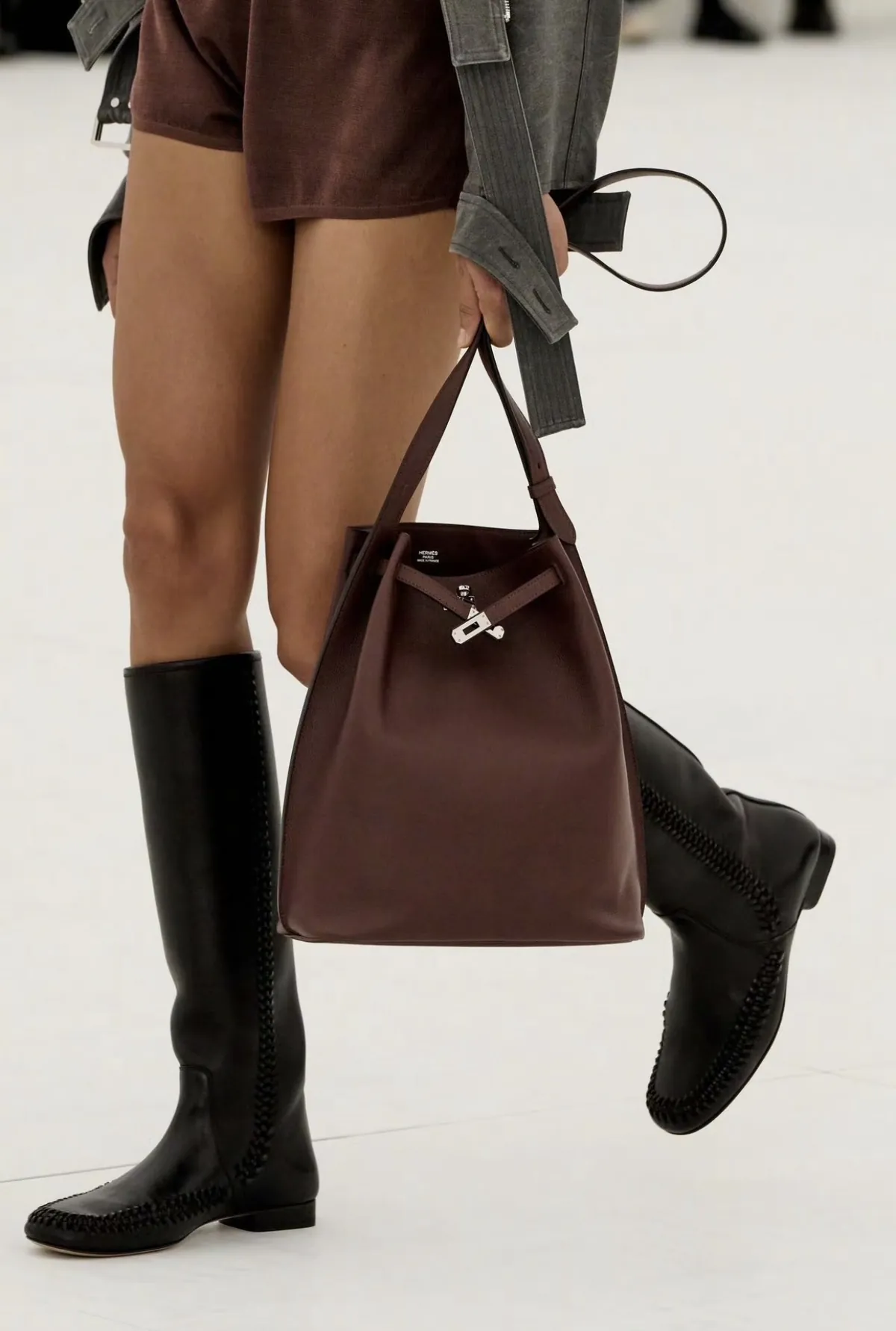
The featured image is an existing Hermès wardrobe reference, separate from the Adage looks discussed here.
An open cuff that leaves the hand exposed
The two-finger span closes off part of the back of the hand, so a cuff that also sits low and wide can make the wrist and hand read as one broad mass. I would reach for a cuff that ends above the wrist bone, or a hinged or open design whose gap faces the thumb side. That gap keeps a strip of skin between cuff and ring, and the gap itself becomes a deliberate opening rather than an accident.
Bracelets that fall freely onto the back of the hand are the least useful choice here. Every time the wrist drops, they land on the fingers the ring already occupies, and the outfit gains noise without gaining structure. If you want a bracelet, a thin chain worn high on the wrist or a fitted bangle that stays put is the calmer companion.
Check a cuff while the hand is doing something, not while it hangs still. Open and close the hand, rotate the wrist, push a sleeve back. A cuff that lifts or rotates during those movements is the one that will interfere. That is a test to run in front of a mirror or with a shop assistant; it is not a prediction about any specific cuff.
Which sleeve length keeps the ring legible
The point of a two-finger ring is that it occupies a wider strip of the hand than a single band, so a sleeve that stops at the wrist bone frames it better than one that reaches the knuckles. A bracelet-length sleeve, a three-quarter sleeve or a pushed-up knit gives the ring its own small stage.
Full-length sleeves are not excluded. If the cuff of a jacket or coat sits cleanly at the wrist and does not bunch, the ring appears below it as a single metal accent. The risk is a cuff that crushes down over the back of the hand, which crowds the same area the ring uses. My preference is to roll or push a sleeve back by a few centimetres so the hand is entirely clear.
Texture matters less than line here. A plain wool, a fine knit or a smooth leather sleeve all work. What I would avoid is a heavily ruffled or flared cuff that spills over the wrist, because it duplicates the ring's width with fabric.
Where a second ring can go
The two-finger span uses two adjacent fingers on one hand. That leaves the other fingers on that hand, and the whole other hand, available. The simplest answer to the question of where another ring goes is the opposite hand. A single band on the other hand balances the composition and keeps each hand with one clear idea.
If you would rather keep both rings on the same hand, place the second ring on a finger that is not adjacent to the two the Double Ring occupies, and give it a different width. A thin band on the little finger reads as a quiet echo; a second wide band reads as competition. I would not stack a third piece onto the two occupied fingers, because the span already carries the visual weight.
Try the arrangement with the hand relaxed and then with it closed, as you would hold a glass or a strap. Rings that meet or overlap when the hand closes are the ones to separate. Again, that is a test you run, not a guarantee about any configuration.
Double ring or single band
A single band sits on one finger and leaves the hand comparatively open. It works with almost any cuff, because there is no second finger involved and no wide span to protect. The Adage Double Ring changes the brief: it wants a clear hand and a restrained wrist, and it rewards a second ring placed deliberately rather than gathered around it.
Choose the double ring when you want the hand to carry the jewellery idea and are willing to keep the wrist quiet. Choose a single band when you want to wear a prominent cuff, a full set of bracelets or several rings without planning the hand. The two are not a hierarchy; they are different amounts of occupied space.
For a different approach to stacking Hermès rings with a diamond eternity band, see the Chaîne d'Ancre ring guide; the principle of giving each hand one clear idea carries over, even though the ring shapes differ.