The style notebook
Hermès Arçon Bags: Slim versus Original Size Carry Outfit Ideas
Compare Hermès Arçon Original and Slim by carry role: roomy flat hobo versus thinner body, strap range, front zip and the clothing lines that keep each visible.
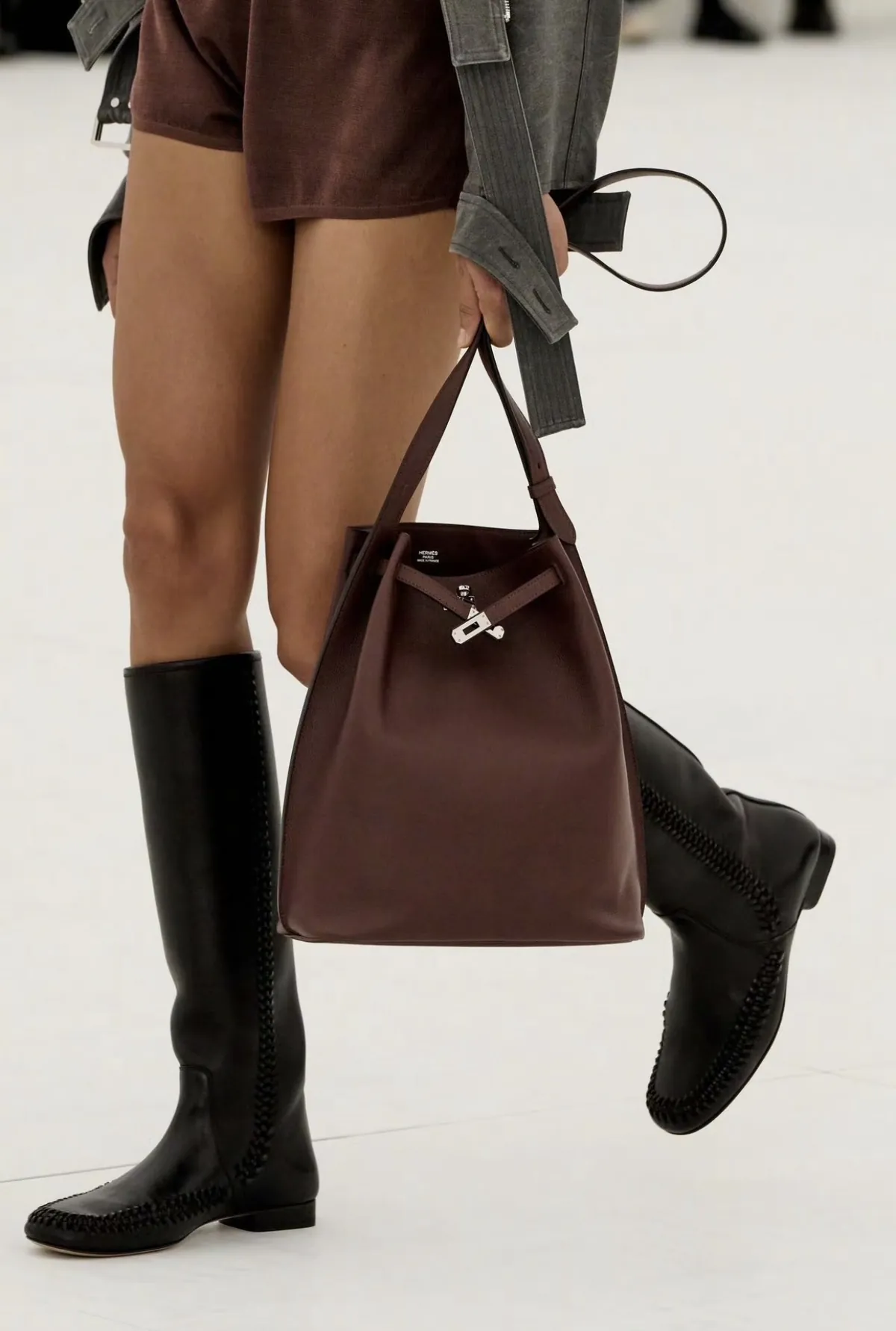
The Hermès Arçon decision changes as soon as you say what you need the bag to hold. The Original’s reported 35 x 28 x 5 cm footprint, its unlined construction and its wide adjustable shoulder strap with Etriviere buckle make it a bag for days with an iPad, a notebook and a front zip pocket serving as the quick-access zone. The new Slim size answers a different question: what happens to the same hobo silhouette when the body is thinner?
The featured image is an existing Hermès wardrobe reference, separate from the Arçon looks discussed here.
Anna McWhirter’s PurseBop report, published 17 October 2024, supplies the size and strap facts. She describes the Arçon as a curvaceous hobo that lies flat against the body, launched in Spring/Summer 2023 and shown again on the Spring/Summer 2024 runway before a new size appeared at the Spring/Summer 2025 Objects Presentations. The original measures 35 x 28 x 5 cm. The strap adjusts from 41 to 69 cm with an Etriviere buckle detail, and McWhirter notes that some wearers may be able to use it crossbody because of that length. Her account also records the unlined, lightweight construction and the front zip pocket that stretches almost half the bag’s width.
The Slim’s own proportions are not given in the report, so treat its thinner profile as a design direction rather than a measured reduction. What the report does support is that the silhouette stays hobo-shaped while the depth changes. That is the useful starting point for styling: the Original reads as a working bag that happens to lie flat, while the Slim reads as a flat bag that happens to work.
When the Original earns its place
The Original is the Arçon to take when the day runs from a train to a desk to a lunch and the bag has to absorb the transitions. The reported iPad and notebook capacity gives it a role that most hobo shapes avoid, and the front zip pocket – with its near-half-width span – is the part of the design that makes the bag practical rather than merely soft. Because the pocket sits on the front face, it becomes the visual centre of the bag when you wear it on the shoulder: a horizontal line across a curved body.
Dress for that line. A straight-cut blazer, a plain crewneck knit or a long shirt worn open gives the bag a clean plane to sit against, and the pocket reads as intentional rather than crowded. Avoid a cropped jacket that ends exactly where the bag’s top edge falls; the mismatch cuts the hobo curve in half. A longer coat that clears the bag entirely lets the Arçon’s own curve do the work.
The strap range is the other reason the Original suits a varied wardrobe. With the buckle set short, it sits high under the arm; set longer, some wearers may find enough length for crossbody. McWhirter’s “some may be able to” is the honest qualifier – the strap’s reach depends on the wearer, so a crossbody plan is a fit question to check in person rather than a guarantee.
What the Slim changes in the outfit
A thinner body shifts the bag from a carried object to a worn one. The Slim is the version to choose when the outfit is the point and the bag should disappear into the line of the body. That pushes the clothing decision toward fabrics with a clean surface: fine wool trousers, a narrow silk skirt, a close-fitting knit dress. The flatter profile keeps the bag from breaking the vertical line at the hip.
What the Slim gives up is the depth that makes the Original a working bag. A thinner body reads as an evening or social shape, so pair it with outfits that do not depend on the bag for structure. If your day involves a laptop or a folder, the Slim is the wrong companion; if your day involves a phone, a card case and a metro pass, the thinness is the feature, not the compromise.
On the shoulder, the Slim’s flatter body sits closer to the torso, which makes a fitted sleeve more forgiving than a voluminous one. A dropped-shoulder knit or an oversized coat will swallow the bag; a set-in sleeve and a defined waist keep it visible at the side.
Strap, pocket and colour decisions
- Strap length first. Set the Etriviere buckle before you decide on the outfit. A shorter setting pairs with a tailored jacket and a high hip line; a longer setting pairs with a straight trouser and a longer coat. Treat crossbody as a personal fit check, not a feature.
- The front zip is the styling anchor. On the Original it spans a large share of the width and will be the first thing the eye finds. Keep the rest of the outfit’s front quiet: no large belt buckle, no busy print across the torso.
- Neutral palette, one accent. The report lists Gold, Étoupe, Origan and Noir as the common shades, with Rouge Sellier and Bleu Glacier added for winter, plus H Canvas and Swift combinations in Écru with Beige and Gold or Écru with Noir. A neutral Arçon lets the hobo curve and buckle speak; a Rouge Sellier or Bleu Glacier version needs a quieter outfit around it.
- Unlined means shape from the wearer. The Original’s unlined construction is a design fact, not a promise about how it will hold up. Style it with clothes that give it a defined body to rest against rather than loose layers that let it slide.
The choice in one line
Take the Original when the bag has to carry the day and the outfit has to give it a clean plane to lie against. Take the Slim when the outfit carries the day and the bag only has to follow the body’s line. The pocket, the buckle and the hobo curve are shared; the decision is how much the bag is allowed to do.
For a wardrobe built around mini bags and a lighter carry, the Hermès toile and leather mini bags guide shows how smaller Arçon-adjacent shapes change the outfit; for a structured work bag with visible pockets, the HAC utility pocket guide is the better comparison.