The style notebook
Hermès Bijou de Sac Charm on Handbags: Outfit Ideas
How the Hermès Bijou de Sac charm can stay the focal point on a carried bag: quiet sleeve, coat and bag surfaces, hand carry, and when one charm is enough.
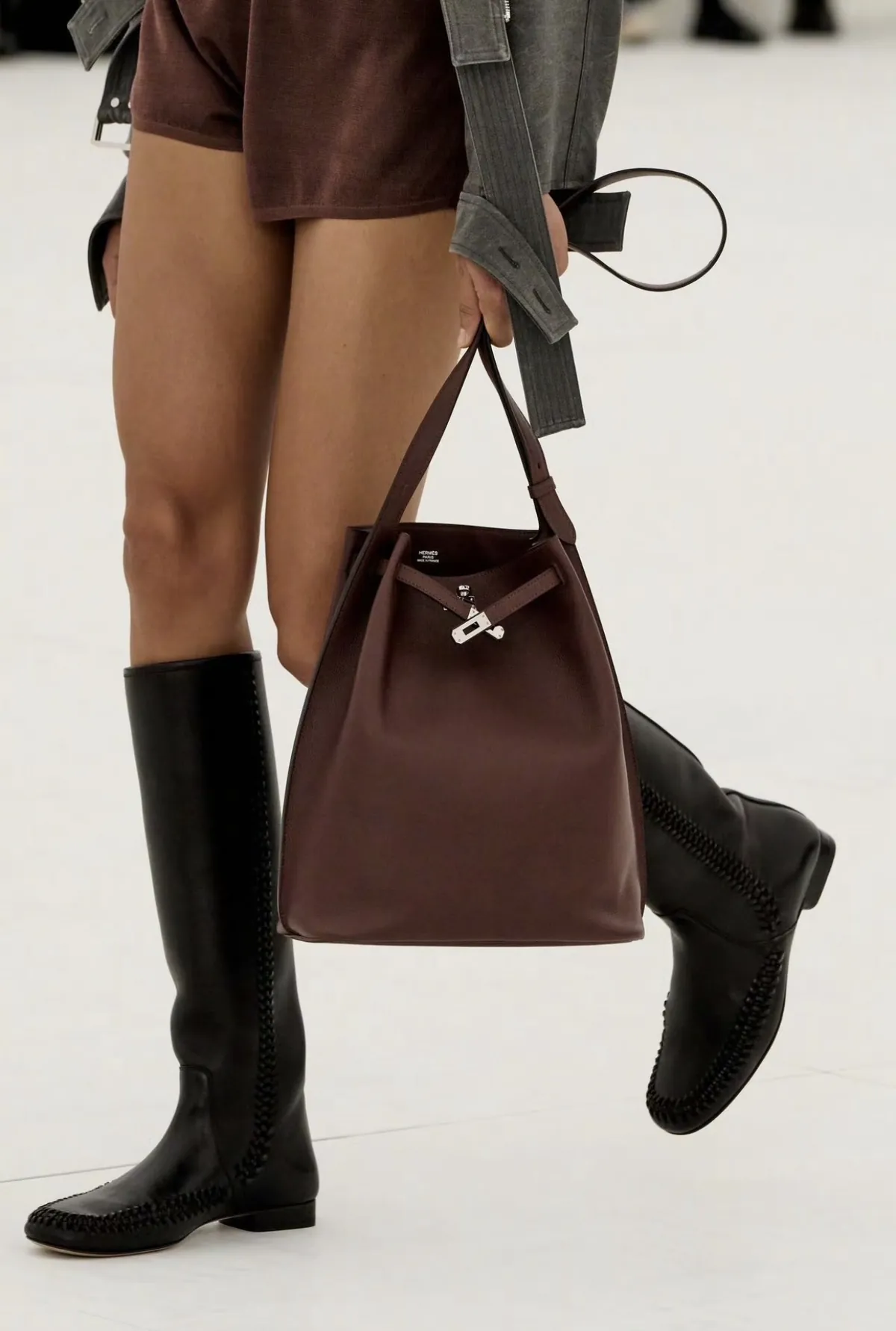
The Hermès Bijou de Sac charm works best as the outfit's single piece of jewellery, and the fastest way to keep it there is to carry a bag with a plain body, in a hand, against a sleeve and coat that add no second story at the same height. PurseBop's Grace Chung, writing on 7 March 2026 about the Autumn-Winter 2026 presentation in Paris, reports that Hermès signature detailing moved beyond the familiar handbag charms into more inventive applications, and that the newly introduced Bijou de Sac charm made an appearance on select pieces. That report establishes the charm's presence; it does not describe its form, size or fittings. Everything below about clothing, bag surfaces and carry is my own styling reading of that one fact.
The featured image is an existing Hermès wardrobe reference, separate from the Bijou de Sac looks discussed here.
Make the bag body the quiet frame
A charm hangs against the bag, so the bag's surface is the backdrop it is read on. The cleanest backgrounds are smooth leather with few visible seams and hardware limited to a clasp or a single ring. Quilted, studded, heavily stitched or multi-buckle bags create a pattern behind the charm, and the eye cannot separate the added piece from the bag's own detailing. On those bags, leave the Bijou de Sac off and let the construction be the interest.
A monogram or allover-print canvas raises the same problem in a different way. The charm has to compete with a repeating motif, and even a bold charm loses definition. Plain leather in black, brown, taupe or cream is the most accommodating frame, and it will also make the charm easier to spot when the bag sits at your side. If your only bag is patterned, the charm can still work — but give it the one plain side of the outfit and expect it to read as texture rather than as a hero piece.
Sleeve and coat surfaces at charm height
The charm usually sits near the wrist or forearm when the bag is held, so the fabric beside it matters as much as the bag itself. A close-fitting knit sleeve, a plain shirt cuff or a smooth wool coat sleeve gives the charm a flat, quiet neighbour. Dropped, flared or bell sleeves, tiered cuffs, lace, ruffles, fringe and heavy ribbing all create movement in the same zone, and the charm stops being a distinct object.
Hardware at the wrist is the other obvious rival. A chunky bracelet, a stack of bangles, a large watch face or a statement ring on the carrying hand will split attention with the charm. My preference is to keep the carrying arm almost bare — a slim watch or nothing — and move any jewellery that matters to the other hand or the neck. The Farandole placement guide makes the same argument for one metal point at a time, and it applies directly here.
Coat and jacket lengths matter in one practical way. A cropped jacket ends well above the bag, leaving the charm fully visible; a long coat can cover the bag and the charm when it hangs open at the side. Neither is wrong, but if you want the charm seen, choose the shorter layer or carry the bag on the side the coat falls away from.
Hand carry keeps the charm in view
A charm attached near a handle needs the bag to be held low and forward for the pendant to hang free. Held in the hand at your side, the charm reads clearly against the plain bag body. Tucked under the arm, or pushed up on a short shoulder strap, it can flatten against the sleeve or disappear into the coat. For occasions where the charm is the point, hand carry is the cleaner choice; a shoulder carry is fine when the charm is supporting a larger look rather than headlining it.
Two small habits help. Keep the bag's own strap or chain from crossing the charm. And check how the charm sits when you set the bag down or put it on a chair — a charm that swings or tangles will look busy even in the calmest outfit. Trying it with your own garments and your usual everyday items will show whether the position suits how you actually carry a bag.
When one charm is enough
Charm-heavy dressing is its own style, and it is a different decision from this one. If a bag already carries several charms, a twilly, a bag cover or a padlock, adding the Bijou de Sac makes the bag the focal point of a crowded cluster. The useful rule is to reduce to a single attached piece. Take off the bag's own charms or silk before adding the Bijou de Sac, and leave the clothing plain so the single detail has somewhere to be seen.
A charm-led outfit also removes the need for other accessory gestures: a printed scarf at the neck, an oversized belt buckle, a novelty necklace. The Kelly Doll Picto guide deals with the same question for a charm bag, while the animal-charm comparison is useful if you are choosing which charm to carry rather than how to frame it. My answer for the Bijou de Sac is steady: plain bag, quiet sleeve, bare carrying wrist, one charm.