The style notebook
Hermès Double Longe Bucket Bag: Oversized Clasp Outfit Ideas
Hermès Double Longe outfit guide: set the shoulder strap first, then pick necklines and outerwear that leave the oversized lead-rope clasp visible.
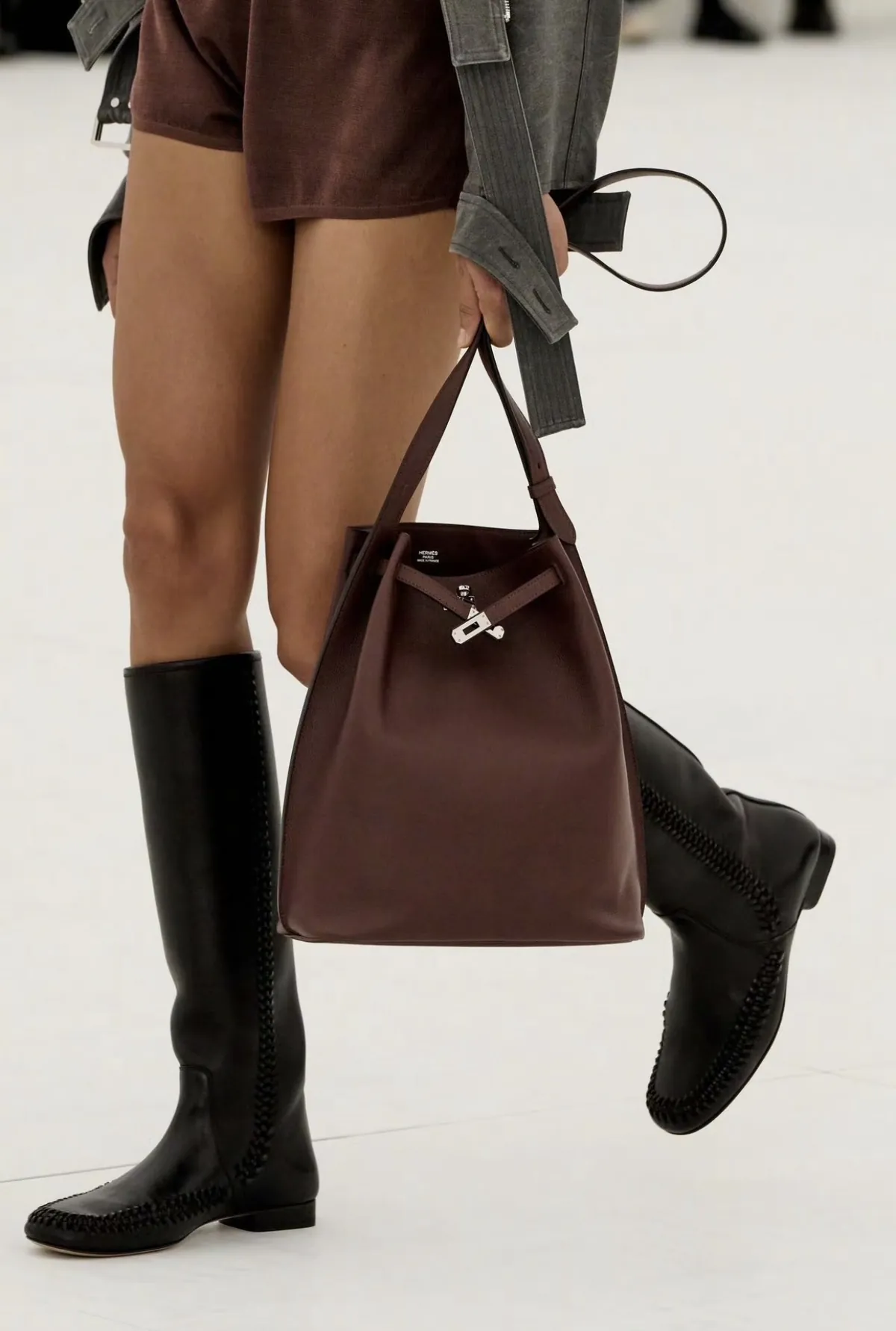
For the Hermès Double Longe worn on the shoulder, the neckline that gives the clasp the most room is a plain crew or narrow boat neck that stays close to the collarbone, paired with a shoulder seam that sits cleanly on the shoulder itself. The point of the bag is its oversized lobster clasp, described in PurseBop's 8 March 2025 Fall-Winter 2025 report by Anna McWhirter as similar to the hardware on a horse lead rope. That hardware needs a quiet field around it, so the strap length is the first decision and the collar is the second. Everything below about how to dress around it is my own styling reading; the report supplies the design facts, not a prescription for clothing.
The featured image is an existing Hermès wardrobe reference, separate from the Double Longe looks discussed here.
Why the strap comes before the collar
McWhirter reports that the Double Longe is styled slung casually over the shoulder, that it has a rectangular structured base close in shape to the Picotin's, and that it carries a double-length leather shoulder strap adjustable to a single long length. That adjustability is the useful lever: where the strap settles determines whether the clasp lands high near the collarbone or lower against the chest or upper arm. A short or doubled setting keeps the hardware up near the face, so a high, plain neckline frames it cleanly. A single long length drops the clasp lower, where a wider neckline or an open shirt collar gives it air rather than crowding it. Decide the strap setting against the coat or knit you actually plan to wear, then choose the collar to suit that position.
Necklines that leave the clasp visible
Because the clasp is a chunky, rounded piece of hardware rather than a flat plaque, it reads best against an unbroken surface. My preference is a fine-gauge crew neck, a narrow ribbed turtleneck that sits flat, or a simple shirt buttoned to a normal point. What I would avoid at the neck is a second piece of metal or a competing knot: a heavy pendant, a large brooch, or a bulky scarf tied high all occupy the same zone the clasp wants. A silk scarf is fine if it is knotted low and small, so the lead-rope hardware still has clear space. Where the strap falls long, an open collar or a soft V gives the clasp a cleaner drop.
Shoulder lines and outerwear
The report describes the collection as built on tailored shoulders and layered outerwear. That matters here: a structured shoulder seam gives the strap a defined place to sit rather than sliding across a soft, unstructured knit. If you wear a coat, a close, narrow lapel or a collarless style keeps the shoulder field tidy, so the clasp is not competing with wide notch corners or epaulettes. Where a coat has a fuller shoulder, I would carry the strap doubled and shorter so the hardware sits above the coat's shoulder line rather than being buried under a lapel. The bag's structured rectangular base is a separate, calmer element; the clasp is the statement, so the coat should not add a second one at the same point. For a plain tailored frame that supports this idea, see the Besace Attelée shoulder-carry guide.
Where a different bag is the better answer
If your wardrobe is built on oversized scarves, statement collars or heavy shoulder jewellery, the Double Longe's clasp will fight that zone all day. In that case the plainer Della Cavalleria, which McWhirter reports was styled hand-held or clutched close to the body, keeps hardware away from the neck and shoulder entirely. The Double Longe earns its place for a reader who dresses in clean knits and narrow-lapel coats and wants one piece of equestrian hardware to do the talking. Once the strap length is set and the neckline left plain, the lead-rope clasp reads as the deliberate detail rather than an accident of layering.