The style notebook
Hermès Equestrian Jacket versus Trench Coat: Outerwear Choice Outfit Ideas
Choosing between the Hermès Equestrian Jacket and Trench Coat for a plain trouser wardrobe: how each outerwear piece changes the trouser line.
A note on length and fit
The PurseBop report names the Hermès Equestrian Jacket and Trench Coat. Use the hip-length jacket and below-the-knee trench here as examples. On the garment you’re considering, check where the hem falls, how the shoulders sit and whether it has a belt.
Try it with the trousers you wear most. See where a short jacket falls against the waistband. In a longer trench, walk and sit with it closed to see how the layers move together.
Anchor a plain trouser wardrobe with the Hermès Equestrian Jacket when you want the outfit’s top half to end decisively at the hip; choose the Trench Coat when you want a long, continuous vertical line down the legs. The jacket compresses the torso, so trousers need a clean, undisturbed line below it. The trench extends past the knee, so the trousers need to stay slim or straight enough not to pool or fight the coat hem. The supplied source is a Jan. 7, 2026 PurseBop report on U.S. Hermès price adjustments, which identifies both pieces as ready-to-wear styles; it does not describe a runway show, a collection, or the fittings of either garment, so the construction and styling calls below are my own reading of two classic outerwear shapes rather than a description of these specific Hermès pieces.
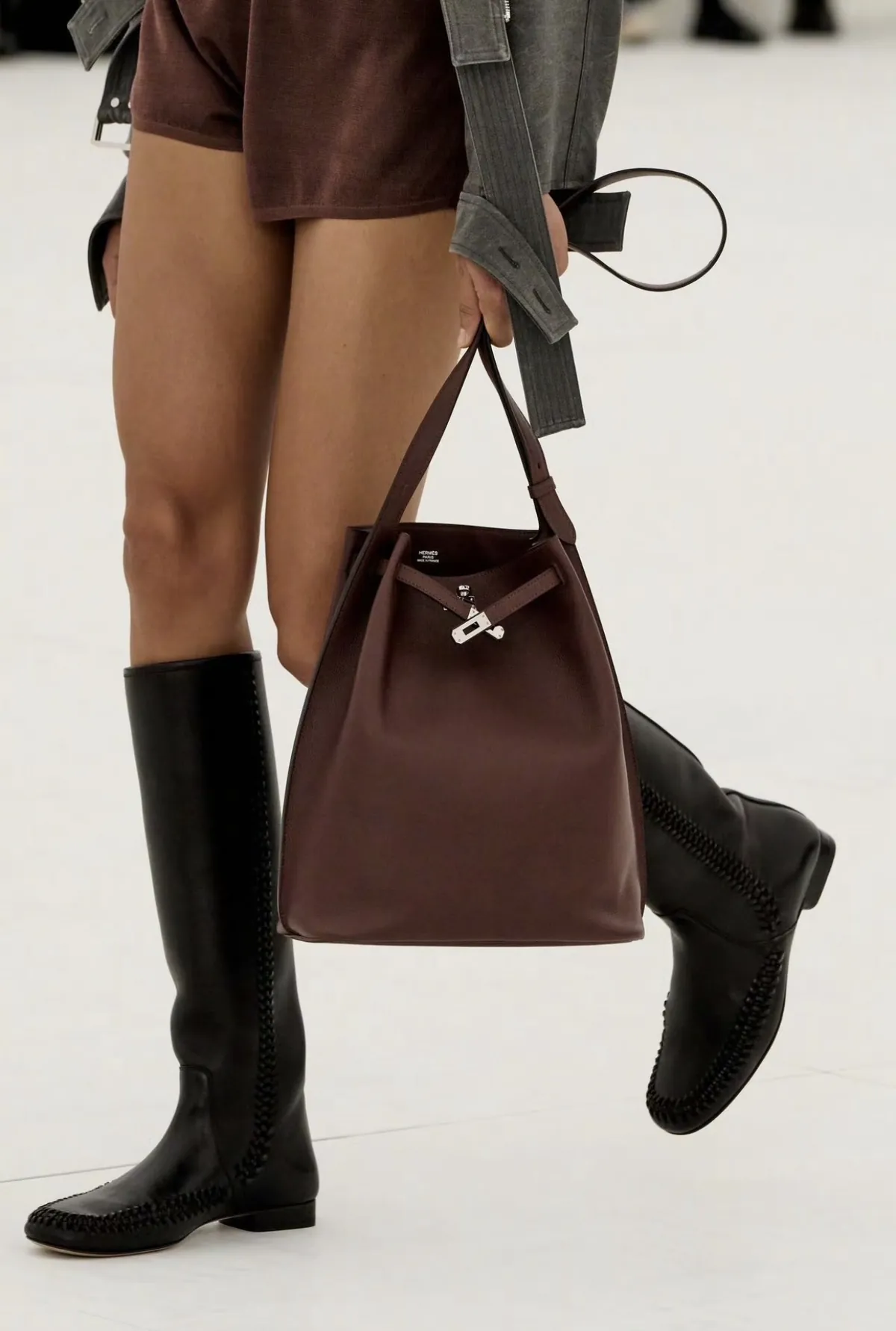
The featured image is an existing Hermès wardrobe reference, separate from the Equestrian Jacket looks discussed here.
What each outerwear piece asks of a plain trouser
The Equestrian Jacket is a short, structured riding-inspired jacket in the broad sense the name suggests: a defined shoulder, a front closure, and a hem that lands near the hip or high hip. Put it over a plain trouser and the important line is the hem. A flat-front, straight or gently tapered trouser with a crisp crease or a clean pressed line reads as the continuation of a tidy top half; a relaxed wide-leg trouser in a fluid fabric can make the jacket look like it is floating on volume. The jacket is the more matter-of-fact piece of the two, suited to a wardrobe built on grey flannel, navy wool, and dark denim. The trench is the opposite proposition. It is long, belted, and usually double-breasted, with a collar that frames the face and a hem well below the knee. Over plain trousers, it turns the whole body into one column. It asks for trousers with enough structure to hold their line under a coat, and a hem that does not bunch at the ankle. The trench also carries more visual information — belt, lapels, storm flap — so the trousers and shoes below it should be quieter than they would be under the jacket.
Collar, closure and the neckline underneath
The jacket’s closure is the detail that decides what goes under it. If it closes high with a defined collar, a crewneck or a fine roll-neck keeps the neckline simple and stops the layers competing. If it sits more open at the throat, a shirt collar shows tidily. Keep the neckline plain; the jacket’s shoulder and hem already do the work. With the trench, the lapels and collar are the event. Under a double-breasted trench, a crewneck or a narrow shirt collar stays neat; a voluminous scarf or a wide cowl can crowd the lapel line. The belt matters too. Tied at the waist, it defines the middle over a plain trouser and gives the long coat a shape; left loose, it reads more relaxed but shortens the visual leg line. My preference over plain trousers is a tied or buckled waist and a clean, uncluttered neckline, because those two decisions keep the trench from becoming a shapeless layer.
When the jacket is the better anchor
Choose the Equestrian Jacket if most of your trousers are mid-rise or high-rise and you want a top layer that does not swallow the waistband. The short hem leaves the rise and the pocket line visible, which keeps the outfit legible. It is the better piece for a wardrobe that moves between indoor and outdoor settings, because a short jacket is easier to remove and carry than a long coat. It also suits a plainer shoe: a loafer, a derby, a clean ankle boot. The jacket does not need a dramatic trouser to be interesting; it needs a trouser that holds its crease. If your trousers are mostly relaxed, wide, or drawstring-waisted, the jacket can still work, but the volume below the hem becomes the outfit’s main event, and the top half has to stay very plain to balance it.
When the trench earns the wardrobe slot
Choose the Trench Coat if you want one outer layer to unify mismatched trousers and give a plain wardrobe a recognizable silhouette. The long line covers more of the body, so the trousers only need to be neat at the hem and shoe. It is the more forgiving piece over a range of trouser widths, provided the hem is clean. The trade-off is weight and length: a long belted coat is more to manage indoors, and it makes the shoe and the ankle more visible than a short jacket does. A slim dark trouser with a polished loafer or a knee boot keeps the trench looking deliberate; a cropped or frayed trouser hem can look accidental beneath it. If your daily routine involves a lot of sitting or in-and-out movement, the jacket is simply easier. If you want a single coat to carry a whole plain-trouser rotation through cooler months, the trench does more work per wear.
Keeping bags and shoes quiet
Both pieces benefit from a restrained bag and shoe, but for different reasons. The jacket’s short hem leaves the waist and hand area open, so a small or medium shoulder bag hangs clearly against the trousers rather than tangling with the jacket. A structured top-handle bag is the more formal choice; a soft shoulder bag is the more everyday one. With the trench, the belt and lapels are already busy, so a bag worn over the shoulder can compete with the coat’s own strap-like belt. A bag carried in the hand or tucked under the arm keeps the front of the coat readable. Shoes should echo the trouser, not the coat: a plain loafer or derby under the jacket, and a polished low boot or loafer under the trench. Anything with heavy hardware, contrast stitching, or a busy print pulls attention away from the outerwear. For a related look at balancing a long coat over a restrained base, see Burberry Military Outerwear and Bridle Bag.
The decision, stated plainly
If your plain trousers are the constant and you are choosing the outer layer around them, the Equestrian Jacket is the shorter, easier, more indoor-to-outdoor piece, and the Trench Coat is the longer, more unifying, more formal one. Neither is a substitute for the other. The jacket wants a trouser that keeps its own line; the trench wants a trouser that stays quiet beneath a long, belted column. Pick by the length of coat you actually reach for, and let the trouser follow that length. For a wider wardrobe reference on outerwear over plain trousers, see Hermès Fall-Winter 2026 Men’s Outerwear.