The style notebook
Hermès Fall-Winter 2026 Chain-Belt Tailored Coats: Sharp Shoulder Outfit Ideas
How to balance sharp shoulders, coat length and waist placement on Hermès Fall-Winter 2026 chain-belt tailored coats, with the chain kept visible.
The Hermès Fall-Winter 2026 chain-belt tailored coat works when the shoulder stays the widest point and the chain sits at the natural waistline, with a coat hem that ends above or well below the chain so the belt is never buried in fabric. ELLE Japan's Elie Inoue, writing on 15 March 2026 about the Hermès Fall-Winter 2026 show, names precisely this piece — a sharp tailored coat cinched at the waist with a chain belt — as one of the examples of the house's riding DNA. That single description gives the proportion problem its terms: a structured shoulder above, a hard chain across the middle, and a length below that either frames the belt or hides it.
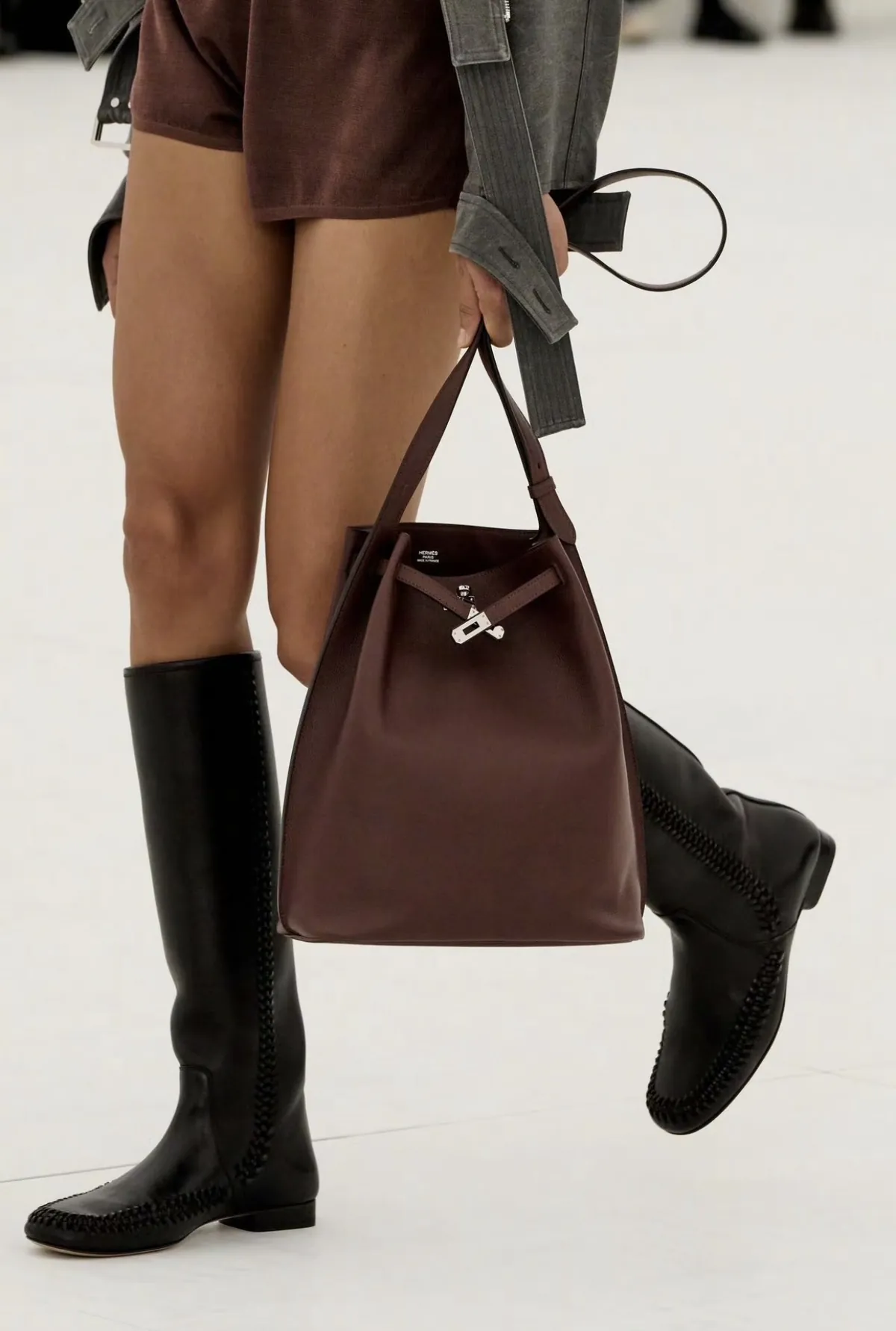
The featured image is an existing Hermès wardrobe reference, separate from the Fall-Winter 2026 looks discussed here.
Shoulder and chain: let the shoulder lead
A sharp tailored shoulder is a horizontal line, and a chain belt is a second horizontal line at the waist. When both are strong and sit close together, the torso reads as two competing bars. The coat works better when the shoulder is allowed to be the primary structure and the chain a secondary, narrower accent. In my styling reading, that means keeping everything between them quiet: a slim knit, a plain shirt with the collar sitting neatly inside the coat's own collar, no scarf bulk at the chest and no horizontal seaming or big pockets at rib height. The chain should be the only metal signal in the middle third of the outfit. If you want a necklace, it competes with the shoulder line near the face; if you want a bag on a shoulder strap, it crosses the same structured zone. A hand-carried or short-strap bag keeps the upper body clean.
Coat length: where the chain stays legible
The belt is at the waist, so the coat's hem length is the deciding measurement. A coat that ends just below the hip or at mid-thigh leaves the chain fully visible against a short run of fabric — the belt reads as a deliberate interruption near the top of a long vertical line. A long coat that falls to the knee or below also works, because the chain sits high enough to be seen above a long plain field of wool. What struggles is a hem that lands just under the waist or at the top of the hip, crowding the chain into a narrow band of fabric and shortening the visible body of the coat. My editorial judgment is to pick either clearly cropped or clearly long, and let the chain sit at the natural waist in both.
Inoue's report describes the collection's central silhouette as a body-conscious line, with short jackets paired with thigh-high boots and slim leather trousers to make a continuous, flowing shape. That context matters here: a sharp tailored coat with a chain belt is meant to be seen as one unbroken vertical, not as a top and bottom. The chain is the one horizontal note allowed to interrupt it.
What to wear underneath and below
Because the coat is doing the structural work at shoulder and waist, the layer underneath should be close to the body and free of bulk at the middle. A fine-gauge knit, a smooth shirt or a slim polo neck all keep the waist flat enough for the chain to sit against the coat rather than over a bunched sweater. The bicolour silk-lined polo neck that Inoue reports peeking out from under wool and leather coats is a useful model: a narrow, tonal layer at the neck, nothing added there.
Below the coat, the same logic applies. Slim leather trousers, as seen in the show's short-jacket looks, maintain the vertical line the chain interrupts. If you prefer a skirt, a narrow column keeps the proportion; a full skirt adds a second wide shape below the belt. The deep-slit skirt Inoue describes as evoking the motion of riding a saddle is a different proposition from the belted coat — it belongs to the equestrian story, not to the same outfit.
A close alternative
If the structured shoulder plus chain feels like one hard line too many, an unbelted sharp tailored coat lets the shoulder carry the whole look, and the waist stays a plain seam. The trade-off is that you lose the metal detail entirely. The chain-belt version earns its place when you want that single glint at the waist and are willing to keep the rest of the middle plain. The broader guide to the collection's chain belts treats the belt as a separate accessory; here the belt and coat are one garment decision, and the shoulder-to-hem balance is the thing to settle before anything else.