The style notebook
Hermès Fall-Winter 2026 Bicolour Polo Necks and Coats: Layering Outfit Ideas
Hermès Fall-Winter 2026 layering: how a silk-backed bicolour polo neck sits under wool or leather coats, with neck height and lapel-width choices.
For a Hermès Fall-Winter 2026 silk-backed bicolour polo neck under a wool or leather coat, the cleaner answer is to let the coat opening do the framing and keep the second colour confined to the neck and cuffs. A narrow, relatively high coat opening turns the polo into a deliberate vertical stripe of contrast; a wide, swinging lapel gives the same polo room to sit flat rather than compress. The choice of which bicolour face meets the coat matters less than where the seam or colour break falls relative to the collar edge.
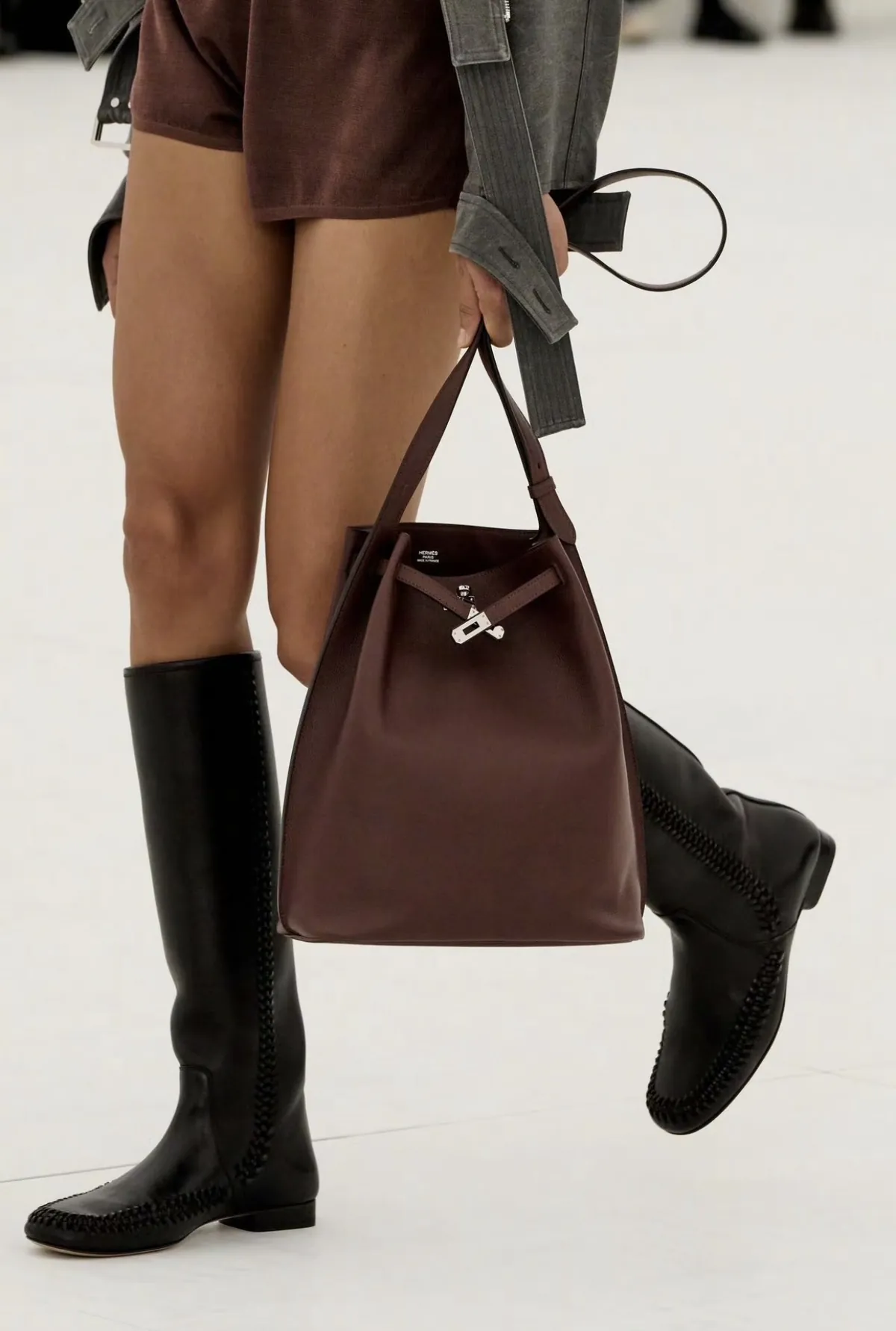
The featured image is an existing Hermès wardrobe reference, separate from the Fall-Winter 2026 looks discussed here.
ELLE Japan's 15 March 2026 show report describes a bicolour polo neck with silk inside appearing beneath wool and leather coats, worn with a mini skirt over sheer coloured tights. That is the reported construction detail: silk inside, two colours outside, worn as a layer. The styling judgements below are my own reading of how such a piece behaves under outerwear, not reported runway outfits.
Which bicolour face should meet the coat?
The useful distinction is not skin side versus coat side in the abstract; it is which colour you want to read at the neckline from a normal conversation distance. If the darker or deeper face sits outward, the polo reads as a restrained column and the second colour appears mainly as a thin edge at the collar roll and cuff. If the lighter or brighter face is outward, the neck becomes a soft glow against a dark coat and pulls the eye upward, which is helpful when the coat itself is plain black or deep brown.
Interpreting the report's silk-inside construction, the silk faces the body and the outer face is what the coat frames. That makes the outward colour the one worth choosing deliberately. For a wardrobe that already leans on dark outerwear, put the brighter two-tone face outward and let the coat supply the contrast. For a lighter-camel or taupe coat, turn the deeper face out so the neckline recedes and the coat stays the subject.
Neck height and coat opening: the real fit question
A polo neck that reaches high on the throat needs a coat whose collar sits away from it. A sharp tailored coat with a chain belt at the waist, as the report describes among the outerwear, is the disciplined partner: its front edges are comparatively straight, so the polo appears as a clean band between them rather than fighting a soft collar. Choose a polo that stops just below the jaw for this pairing, and leave the coat unfastened or fastened only at the waist so the neckline stays open.
A leather coat behaves differently. Leather holds a fold and returns to it, so a rolled polo collar that sits close to the throat can look pinched if the coat's own collar is stiff and narrow. Here a slightly shorter polo collar, one that folds rather than stands, gives the leather room. If the coat is collarless or has a minimal stand, a taller polo is the better counterweight — it supplies the neckline interest the coat intentionally omits.
Lapel width is the practical lever. Wider lapels create a longer diagonal opening; the polo should sit low enough that its collar is not swallowed, but high enough that the two-tone edge remains visible when the coat is closed at one button. Narrow lapels leave little vertical reveal, so concentrate the colour there: a single clean band at the throat, cuffs left plain or just peeking.
Wool versus leather: two different layering jobs
Wool is the more forgiving partner. It flexes over the polo, and a soft shoulder lets the knit sit without a hard ridge. This is where the bicolour can do more work: allow a little of the second colour at the cuff to show past the sleeve, which echoes the neckline and makes the pairing look chosen rather than accidental. Keep the rest of the outfit quiet — plain trousers or the sheer-tights-and-mini formula the report notes — so the two colour reveals are the only pattern.
Leather calls for restraint. The surface already carries a sheen, so a second strong colour at both neck and cuff can tip into busyness. Pick one reveal: neck only, with cuffs tucked or hidden. The report's sharper tailored coats with utility pockets and zip details suggest outerwear with its own hardware and seams; a polo that adds another visible line at the wrist competes with those.
- Dark wool coat: brighter face outward, contrast visible at neck and a sliver of cuff.
- Leather coat: deeper face outward, neck reveal only, collar kept low and soft.
- Light coat: deeper face outward, minimal cuff because the coat provides the contrast.
Where the two-tone read can go wrong
The common failure is a colour break that lands exactly at the coat's collar edge, so the change looks like a mistake rather than a design. Before committing, fasten the coat in front of a mirror and check where the polo's seam or colour change sits relative to the coat lapel — if they coincide, adjust the polo's roll or choose the other face. A second failure is a polo thick enough to bunch at the throat under a stiff collar; a thinner silk-lined knit sits flatter there, which is the practical reason the silk-inside construction suits layering.
For readers weighing how a plain coat supports a detailed layer, the guide to Hermès Fall 2026 jodhpurs, jackets and coats covers coat silhouettes, and the broader Hermès Fall-Winter 2026 jackets and skirts piece addresses boots and tights pairings. The decision here stays narrow: pick the outward face first, then match collar height and lapel openness to it. A confident answer is one reveal, clearly placed, with the coat doing the framing.