The style notebook
Hermès HAC en Selle Appliqué Saddle Bag: Outfit Ideas
Outfit ideas for the Hermès HAC en Selle saddle-appliqué bag: plain clothing that lets its geometric Togo and Barénia patchwork stay the focal point.
The Hermès HAC en Selle makes the outfit decision easy in one sense: the bag is already the loudest thing you are carrying, so the clothing should stop competing. PurseBop's Anna McWhirter, writing on 11 February 2025, describes the HAC en Selle as a recent addition slowly making its way to boutiques, inspired by Hermès' equestrian heritage, with bold geometric appliqué shapes that mimic the curved elements and design features of a saddle. She reports that the patchwork style is made from a variety of leathers, sometimes in several colours, including textured Togo and heritage Barénia. Those details, not a styling slogan, are what the clothes should answer: one plain surface, one neutral family, and no second graphic competing near the bag.
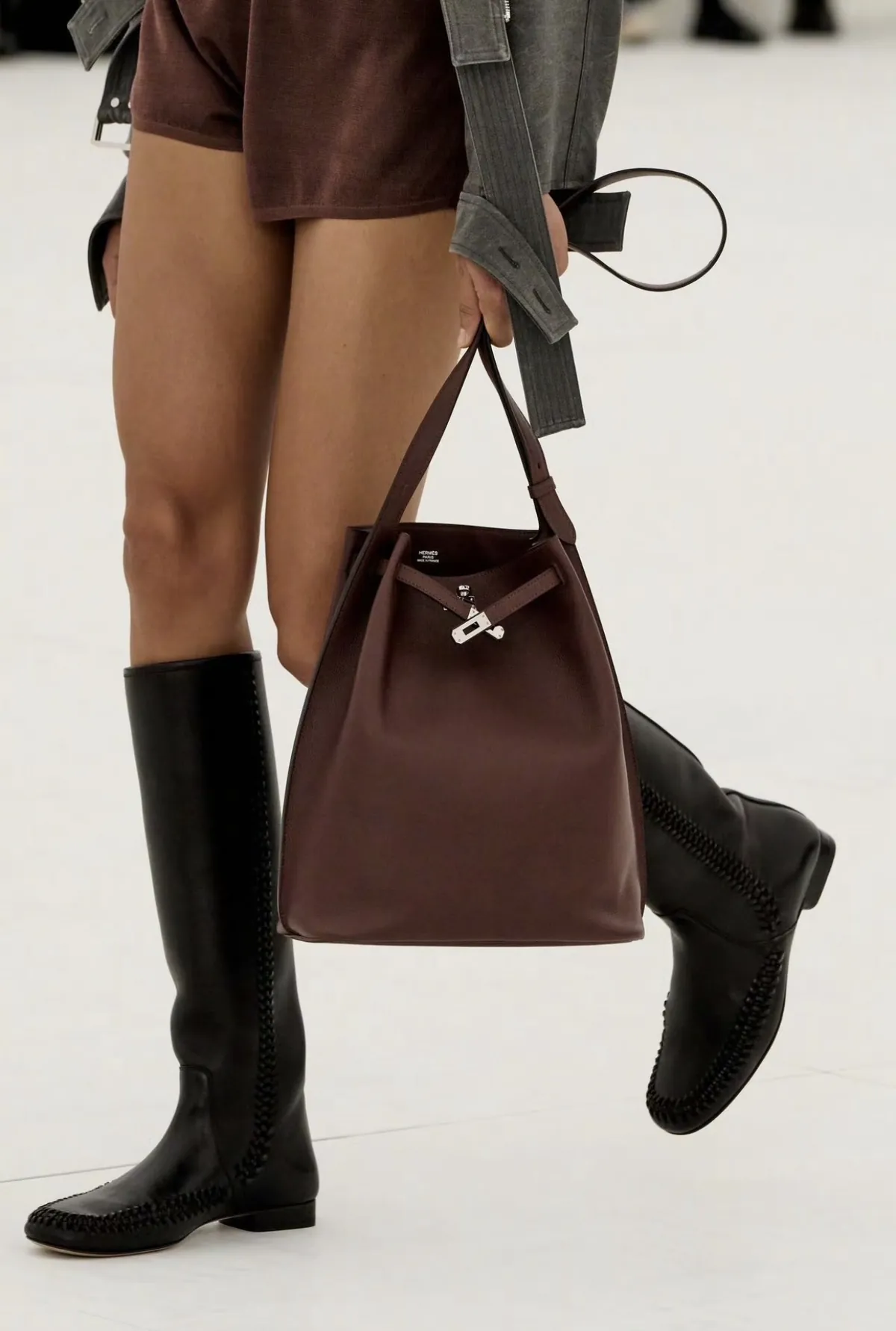
The featured image is an existing Hermès wardrobe reference, separate from the HAC en Selle looks discussed here.
Why the appliqué wants quiet clothing
The bag's visual work is done by cut shapes and mixed leathers. Where a plain HAC relies on sangles, a touret and the padlock-and-clochette cluster for its detail, the en Selle carries its interest on the body itself: curved panels laid against one another, texture against smoother heritage leather. Any clothing that repeats that idea — a bold check, a large floral print, a patchwork denim jacket — sets up a second composition a few inches from the first. The eye then has to choose. Plain tailoring lets the saddle panels read as the single deliberate graphic.
That is my reading of the design, separate from the reported construction. It is why the formulas below lean on solid colour and simple line rather than pattern.
A plain daywear formula that leaves room
A wool coat in a single neutral, a fine-gauge crewneck and straight or gently tapered trousers give the appliqué a clean field. I would keep the coat's hardware minimal — no oversized contrast buttons, no chain belt at the waist — so metal near the bag does not add a second bright note. The same logic applies in warmer weather: an unprinted cotton or linen shirt, plain wide-leg trousers and a flat shoe. If you want one texture beyond the wool or cotton, let it sit far from the bag — a suede shoe, a ribbed knit — rather than at hand or shoulder level.
Match the mixed leathers with one neutral family
Because the patchwork can combine several leathers and sometimes several colours, the clothing palette is where you simplify. Pick one family and stay inside it: warm browns, camels and creams; cool greys and off-whites; or a black-and-charcoal base. A single family keeps the bag's own colour mix as the variation the outfit is built around. Two families at once — say navy tailoring with a rust knit — start to look like a third colour story next to the bag. If you want a lift, one muted accent in a shoe or a scarf is enough.
What to leave off
Skip a second graphic strap across your body: a patterned woven strap or a logo-heavy crossbody competes with the appliqué surface at exactly the height where it should be read. Skip bold prints on the top half for the same reason. And be slow to pair the bag with another heavily detailed accessory — a studded belt, a large statement necklace — because the bag is already carrying the detail. Quiet does not mean dull; a good plain coat, a clean trouser line and one strong shoe can look considered rather than empty.
How I would decide
For a working day, I would choose solid wool tailoring and minimal metal, so the saddle panels are the one thing someone notices. For a weekend, an unprinted shirt, plain trousers and a flat shoe keep the same rule with less formality. For an evening that calls for a hand-carried bag, a plain column dress or a simple dark suit still gives the appliqué its clearest frame. The common thread is a decision, not a uniform: let the bag's geometric leather be the only bold statement, and the clothing's job is to keep the space around it calm.