The style notebook
Hermès Horizon Bespoke Bags versus Special Orders: What the Difference Means for a Bag Decision
Hermès Horizon starts from a concept with no template; Special Orders customise existing bag templates. How to decide which conversation to seek first.
The decision between an Hermès Horizon commission and a Special Order comes down to one question: do you already know the bag you want exists in Hermès's vocabulary, or is the bag you want one that doesn't yet exist? A Special Order adjusts an established template — a Birkin, a Kelly, a small leather good — within set finishes and formats. Hermès Horizon, as PurseBop's 5 November 2025 guide describes it, begins with a client's concept and no template or base model at all. If your idea is a colourway, a hardware finish or a leather change on a bag Hermès already makes, the template conversation is the honest fit. If the idea is a silhouette, an object or a construction Hermès has never made, only the Horizon route can carry it.
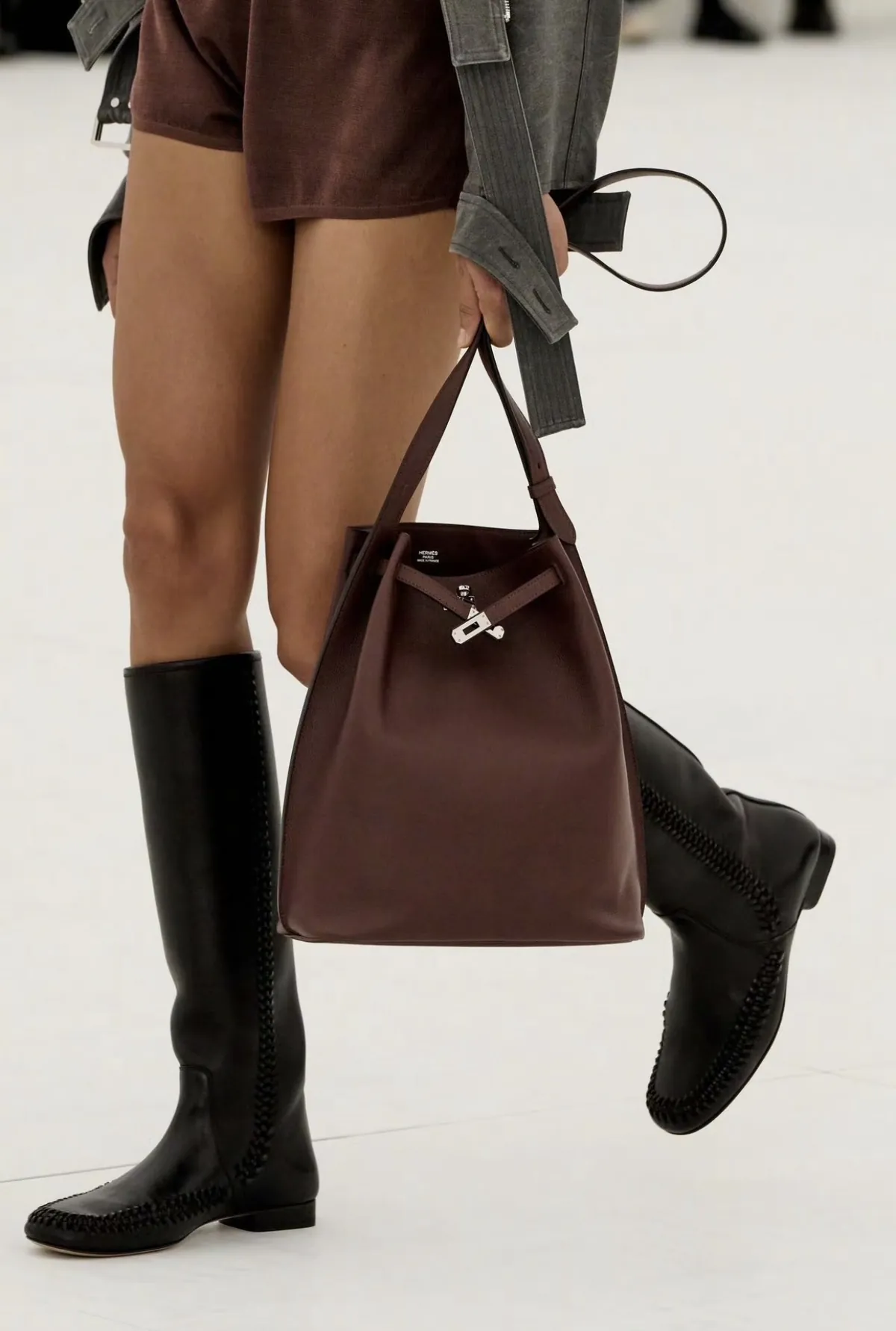
The featured image is an existing Hermès wardrobe reference, separate from the Hermès Horizon looks discussed here.
What each service actually asks of you
The PurseBop article draws the contrast plainly. Special Orders let a client “elevate classic designs that are bound to existing templates,” and the same source describes it as invitation-only and limited in materials and formats. You choose from what already exists. Horizon gives “the full range of design options, starting with a blank slate,” and the source lists its category as unlimited — bags, objects, furniture, cars, yachts — with any material and any form.
That difference changes what you bring to the first meeting. A Special Order conversation can start with a shortlist: a bag model, a leather, a colour, a stitching preference. A Horizon conversation has to start with a concept, because there is nothing to choose from until you describe something. PurseBop reports that Horizon bags grow from “in-depth conversations, detailed sketches, prototypes,” which is a design process rather than a selection process. Turning up with a colour card is under-preparing for Horizon and over-preparing for a Special Order.
The bag examples show how far Horizon can travel
The source's Horizon examples are useful because they show the range of what a from-scratch brief can become: a shiny crocodile Kelly Pochette finished with feathers, a Kelly Ado Backpack reinterpreted as a teddy bear, embroidery across the Plume and Kelly Danse, and an oversized functional padlock bag in matte crocodile. The same article notes a Birkin stripped of its flap, straps and Touret fastening and reworked with Pegasus-inspired art. Embroidery, fringing, feather accents, studded hardware and wicker are named as directions the atelier encourages.
Read those as evidence of ambition, not a menu. A Special Order keeps the bag recognisable as the model it started from; these Horizon pieces deliberately stop being standard. My reading is that this is the real dividing line for a buyer: not price or waiting, but whether you want a recognisable Hermès shape with your choices on it, or a shape that answers only to your brief.
Access and time: two different doors
Neither route is a walk-in service. PurseBop describes Special Orders as invitation-only for certain long-term clients, and puts Horizon access even further out — an invitation or recommendation, plus a detailed proposal the Horizon team reviews. The same source gives a timeline of months to years depending on scope. Treat those as the source's characterisation of the process, not a schedule you can plan a date around.
Practically, this means your first move is not choosing between the two but testing which conversation you can even open. A long-standing relationship with a boutique is the usual ground for a template order. Horizon asks for a proposal someone will read as a design brief, so the useful preparation is writing one: what the object is, what it does, why it cannot be a modified existing model, and which materials or techniques you imagine. That document serves you either way — if the answer is that your idea is really a Special Order in disguise, the brief will show it.
Which conversation to seek first
Seek the Special Order conversation first when the bag you picture is a known Hermès model in different clothes. The result stays legible, the choices are bounded and easier to specify, and the process matches the scale of the idea.
Seek the Horizon conversation first when you can name the thing Hermès does not make — a new silhouette, a functional object, a construction — and you are willing to collaborate through sketches and prototypes rather than approve a sheet of options. The article's own framing helps here: Special Order is “you choose from what already exists,” Horizon is “you invent what doesn't exist yet.” If you cannot yet say which sentence describes your idea, you are not ready for either proposal. Work out the object first, then ask which door it belongs behind.