The style notebook
Hermès Jumping Shorter Boot in Quilted Nappa: Outfit Ideas
How the Hermès Jumping Shorter Boot's 14.2-inch quilted shaft changes trouser hems and coat lengths, and when the full 16-inch Jumping Boot fits better.
The Hermès Jumping Shorter Boot is the Jumping silhouette cut down to a 14.2-inch shaft, and its quilted Nappa leather with diagonal stitching turns the lower leg into a patterned surface. That single change decides your hems: a trouser or skirt should end above the quilting or well below the boot top, not slice through the diagonal lines. If you need full knee coverage or a cleaner, unquilted panel, the classic 16-inch Jumping Boot is the better answer. Everything below about how the two lengths sit against clothing is my own styling reading, not a wear test.
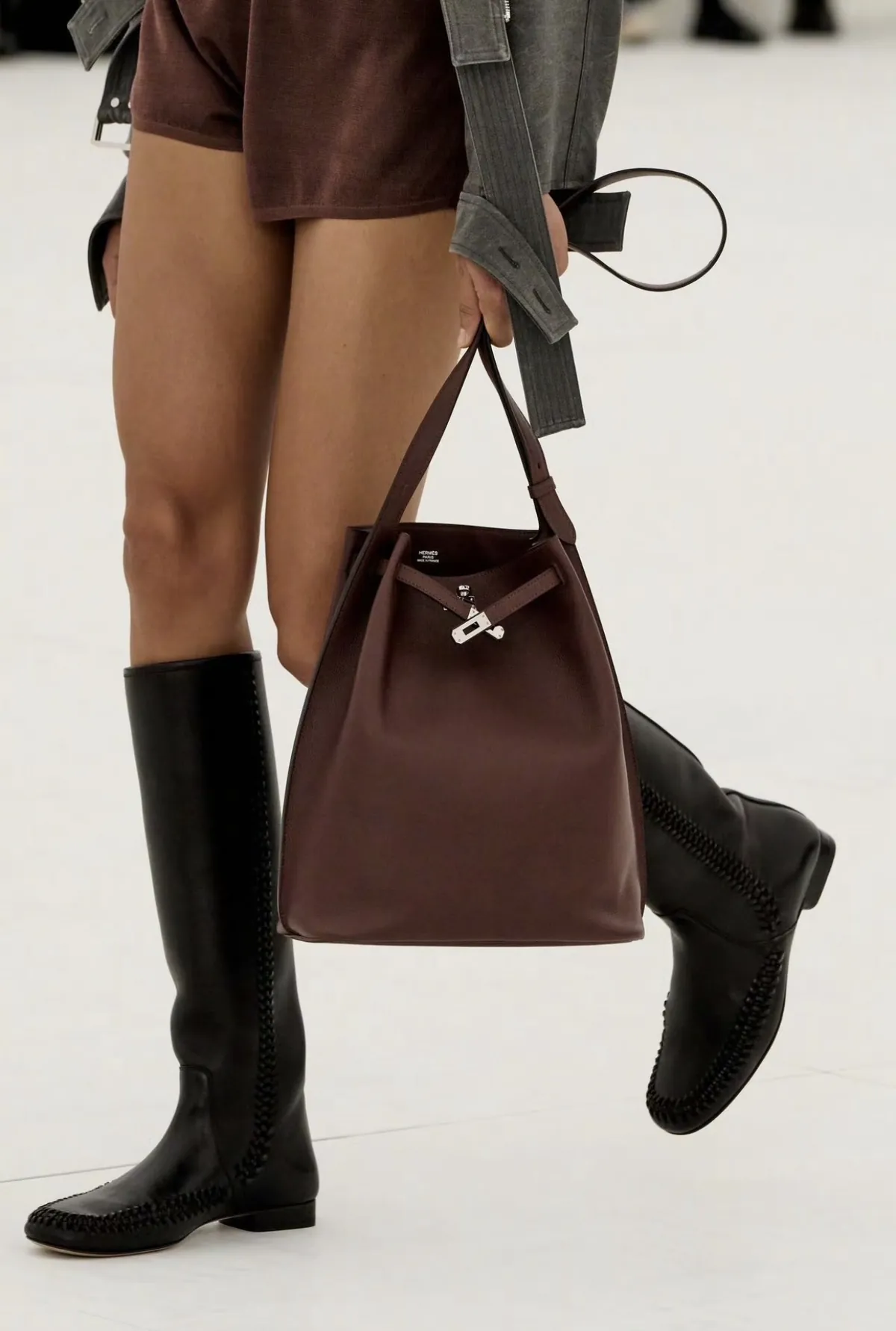
The featured image is an existing Hermès wardrobe reference, separate from the Jumping Shorter Boot looks discussed here.
Anna McWhirter's PurseBop guide, published 30 September 2026, sets out the design facts. The Jumping Boot was first introduced in 1972 alongside Hermès' debut women's shoe collection. The classic stands 16 inches tall depending on size, on a low heel of roughly 1 inch, finished with a palladium-plated Kelly buckle. The Jumping Shorter Boot keeps the same silhouette but measures 14.2 inches from sole to top and, for Fall-Winter 2026, comes in quilted Nappa leather with diagonal stitching, in Noir, Rouge H and Étoupe.
Why 14.2 inches changes the hem question
Roughly two inches of shaft is what separates the two boots, and those two inches sit exactly where a skirt hem or trouser break tends to land. The shorter boot opens up a band of leg between hem and boot top that the full 16-inch version closes. That gap is useful if you want to show the quilting, and awkward if your hems are cut for full coverage and now hover in the middle of the pattern.
The diagonal stitching is the point of this boot. Quilting reads as a directional line, and it competes with any hem that crosses it at a similar angle or busy print that echoes it. So give the panel room: a hem that clears the boot top, or one that falls far enough down to cover most of it, lets the quilt either show fully or hide fully. The worst outcome is a hem that lands an inch or two below the boot top and chops the diagonal lines in half.
Trouser and skirt hems that reveal the quilt
- Cropped and ankle-length trousers: A straight or wide-leg trouser finishing above the boot top leaves the whole quilted panel visible. This is the clearest way to make the shorter shaft an intentional choice rather than a compromise.
- Midi skirts ending at or just above the boot top: A skirt whose hem meets the top of the 14.2-inch shaft frames the boot without cutting the quilting. A knife-pleat or A-line skirt in a flat wool keeps the texture contrast in the boot.
- Full-length trousers worn over the shaft: If you prefer the boot to disappear, a wide-leg trouser that drapes past the boot top works, provided the hem clears the floor. The shorter shaft means less fabric has to fall over leather.
- Skirts that sit just below the knee: These leave a short band of quilted boot visible, which reads as a deliberate gap rather than a mistake.
What to avoid: a hem that stops a couple of inches into the quilted panel, a bootcut trouser that flares over the diagonal lines, and anything in a print that repeats the quilt's angle. The Jumping Boot height and trouser hem guide is a useful companion if you are weighing the two shaft lengths side by side.
Where a coat hem should fall
A coat that ends above the knee leaves the full shorter shaft visible and works well with cropped trousers, because the diagonal quilt becomes a mid-leg detail between coat hem and boot top. A coat that ends at the hip or mid-thigh keeps the boot as the lower half's one texture and asks less of the hem line.
Longer coats need more care. A coat whose hem lands at the same height as the boot top creates a flat horizontal line across the leg, and the quilt loses its rhythm. A maxi coat that falls well below the boot top is the better long option: the boot emerges as a single textured block, and the covered leg between them stays clean. That is the same logic behind the layering-under-a-coat approach in cooler weather.
Colour and the quilted texture
Because the quilting adds visual pattern, the rest of the outfit can stay quiet. Noir and Étoupe boots work against plain wool, matte knit or flat cord, letting the stitched diagonal be the only relief. Rouge H is the exception worth building around: it is a colour first and a texture second, so give it a neutral trouser and a coat that does not fight it. If the boot already carries a strong quilted motif, keep tights plain and avoid ribbed or cable textures that clash with the stitching.
When the full 16-inch Jumping Boot is the better choice
The shorter boot suits readers who want the Jumping line without knee coverage: cropped trousers, midi skirts and hip-length coats all work to its strengths. Choose the classic 16-inch Jumping Boot instead if your wardrobe is built around knee-length or longer skirts and full-coverage tailoring, if you want a plain rather than quilted surface, or if you wear boots under long straight trousers and want the stiffer full shaft to hold the leg line. The full boot's two extra inches close the gap the shorter version opens, which is exactly what some hems need.
For the same line with decoration of a different kind, the embroidered Jumping Boot guide shows how a pattern on a tall shaft changes hem choices. And if the boot is for evening, the crystal-detailed evening read covers a darker path.
Try it on your own hems
Before building outfits around the shorter boot, take a mirror and your three most-worn skirts and trousers. Check where each hem lands against a 14.2-inch boot top: above it, on it, or below it. The ones that clear the top or cover it entirely are your easy pairings; the ones that stop inside the quilted panel need a cuff turned, a hem taken up, or a different boot. That check tells you more about this particular boot than any general rule about shaft heights.