The style notebook
Hermès Plume Leather Choice: Epsom, Swift, Box and Chèvre Outfit Pairing
How each Hermès Plume leather surface — Epsom, Swift, Box and Chèvre — changes the clothing a plain, hardware-light Plume outfit needs.
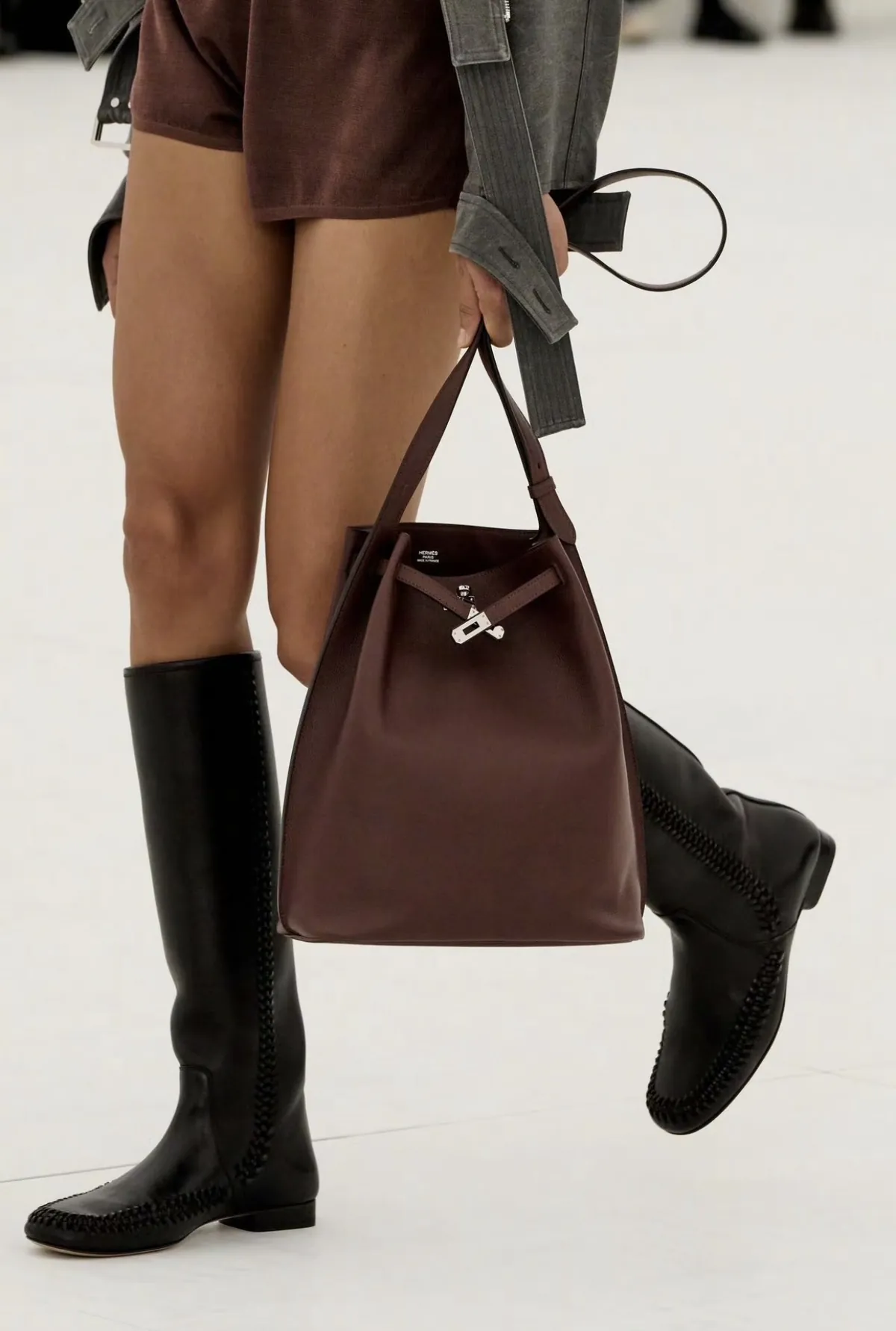
For a plain Hermès Plume outfit, the leather choice is a clothing decision before it is a leather decision. Epsom, Swift, Box and Chèvre all appear on the Plume, according to Anna McWhirter's PurseBop article "Is this the Most Underrated Hermès Bag?" (16 February 2024), which describes each as bringing "its own texture and character" to a bag she characterizes by clean lines, no overt branding or hardware, and a minimalist rectangular silhouette. Because the design gives the eye so little else to hold, the surface of the leather is the main event. Match it with cloth that either echoes that surface or stays deliberately quiet, and the bag reads as composed rather than accidental.
The featured image is an existing Hermès wardrobe reference, separate from the Plume looks discussed here.
Epsom: the crisp, formal grain
McWhirter lists Epsom first among the leathers most often seen on the Plume, and its fine, tight grain gives the bag a pressed, almost papery formality. That suits clothing with a clean finish: poplin shirts, wool trousers with a sharp crease, a single-breasted coat. My preference is to let Epsom sit against matte, smooth fabrics so the grain stays the one textured note. Where I would choose differently is with a heavily textured tweed jacket or a thick ribbed knit close to the bag — the two surfaces compete and the bag loses its quiet authority. Epsom is the leather for the reader who wants the Plume to look tailored even when the outfit is casual.
Swift: soft surface, softer clothing
Swift's character is its softness, and a soft leather rewards clothing that moves with it rather than standing stiffly beside it. Fluid trousers, a fine-gauge knit, a silk shirt, a dress with some drape — these let a Swift Plume feel of a piece with the outfit. The trap is going too soft: an entirely unstructured, slouchy look can make the structured rectangular silhouette read as an afterthought. One crisp element — a defined shoulder, a leather belt, a straight trouser — keeps the bag anchored. I reach for Swift when the Plume is the everyday bag and the wardrobe is built on comfort rather than tailoring.
Box: the polished, old-formal surface
Box calf is the most polished of the group, and a glossy surface reflects light, which makes it read more formal than the Plume's shape alone would suggest. Cloth with a dry, matte hand — flannel, heavy cotton, wool crepe — gives Box something to contrast against, and the bag becomes the one shine in the look. Pairing Box with other glossy materials, such as satin or patent, tends to flatten the effect; the bag stops standing out. For evening, I would keep the clothing matte and dark and let the Box surface be the single gleam. This is also the leather I would choose for a reader whose wardrobe is mostly plain and who wants the bag itself to supply the polish.
Chèvre: visible grain, textured cloth
Chèvre's pronounced grain gives it more visible texture than Epsom, so it pairs well with clothing that has texture of its own — a wool bouclé, a linen weave, a slubbed knit. The risk is doubling down: chunky tweed next to a strongly grained bag can look busy. My rule is one textured element near the bag, not two. Chèvre also takes color with a certain depth, which makes it a good canvas for a reader who wants a Plume that reads slightly less formal than Epsom or Box without going as soft as Swift.
What to decide first
The honest order of decision is: what does your wardrobe already look like, and which surface makes the most of it? If the answer is mostly smooth, matte tailoring, Epsom or Box fits without effort. If it is mostly soft, fluid or textured cloth, Swift or Chèvre is the more natural partner. Chamonix, which McWhirter also lists among the classic Plume leathers, and the separate Suede, Toile and Waffle Box Calf variants change the calculation again; treat them as their own choices rather than lumping them into this four-way decision.
The source facts here are about which leathers the Plume appears in and the bag's minimalist, hardware-light character; the clothing reasoning is my own reading of how surface works against cloth. One practical check before committing: try the bag against the coat or jacket you wear most, since that is the surface it will actually sit beside. Related guides on Plume handheld versus added-strap carry and Plume size carry cover the silhouette decisions that sit alongside this one.