The style notebook
Hermès Spring 2027 Deconstructed Parkas and Zipper Dresses: Layering Outfit Ideas
Hermès Spring 2027 layering: how to pair a deconstructed snap-waist parka with zipper dresses, setting one adjustable line and keeping the other fixed.
The Hermès Spring 2027 wardrobe offers two adjustable garments that can complicate a single outfit. A deconstructed parka, its top and bottom held at the waist with a row of snaps, and a dress whose leg zippers move the hem from mini to midi. The question is not whether either piece works alone; it is how to layer them without two moving horizontal lines competing for attention. My approach is simple: set one piece as the fixed line and leave the other closed or open, resisting the urge to tune both at once.
The official collection notes describe a parka deconstructed at the waist with snaps holding its top and bottom parts in place. Separate dresses are built with zippers that bisect the legs, allowing a short or longer length, while trousers use similar zippers to shift between full and slim. That is the factual starting point. The styling decisions below are mine, built around one rule: only one hem or waistline moves at a time.
Why two adjustable lines fight
A snapped parka creates a horizontal break at the waist. A zipped dress creates a horizontal break at the leg, whether that lands at the knee or lower. Worn together at their most adjusted, both lines drift toward each other. The eye reads a stack of competing breaks, and the body looks segmented rather than layered. Keeping one line fixed gives the outfit a spine. The other adjustable piece becomes a quiet secondary detail rather than a rival focal point.
This is a proportion problem, not a mechanism problem. You do not need to know exactly how a closure behaves to make a styling call. You only need to decide which garment carries the outfit's main horizontal line that day, then dress around that decision.
Formula one: parka open over a zipped dress
Here the dress holds the line. Zip the dress to the length you want and leave it there, whether that is a short version or a longer midi version. Then wear the parka open so its waist snaps stay apart and the deconstructed seam falls as a vertical break rather than a horizontal one. The open parka frames the dress instead of cutting across it, and the dress hem does the length work.
- Choose a dress length first, then build shoes around that final hem.
- Keep the parka's waist un-snapped so the two garment waists do not align into one visual stripe.
- Let the parka sit slightly back from the shoulder so the dress neckline remains visible.
- Use a simple flat or low sandal if the dress is short; a clean boot suits the longer version.
- Keep a bag close to the body so it does not add another horizontal accent at hip level.
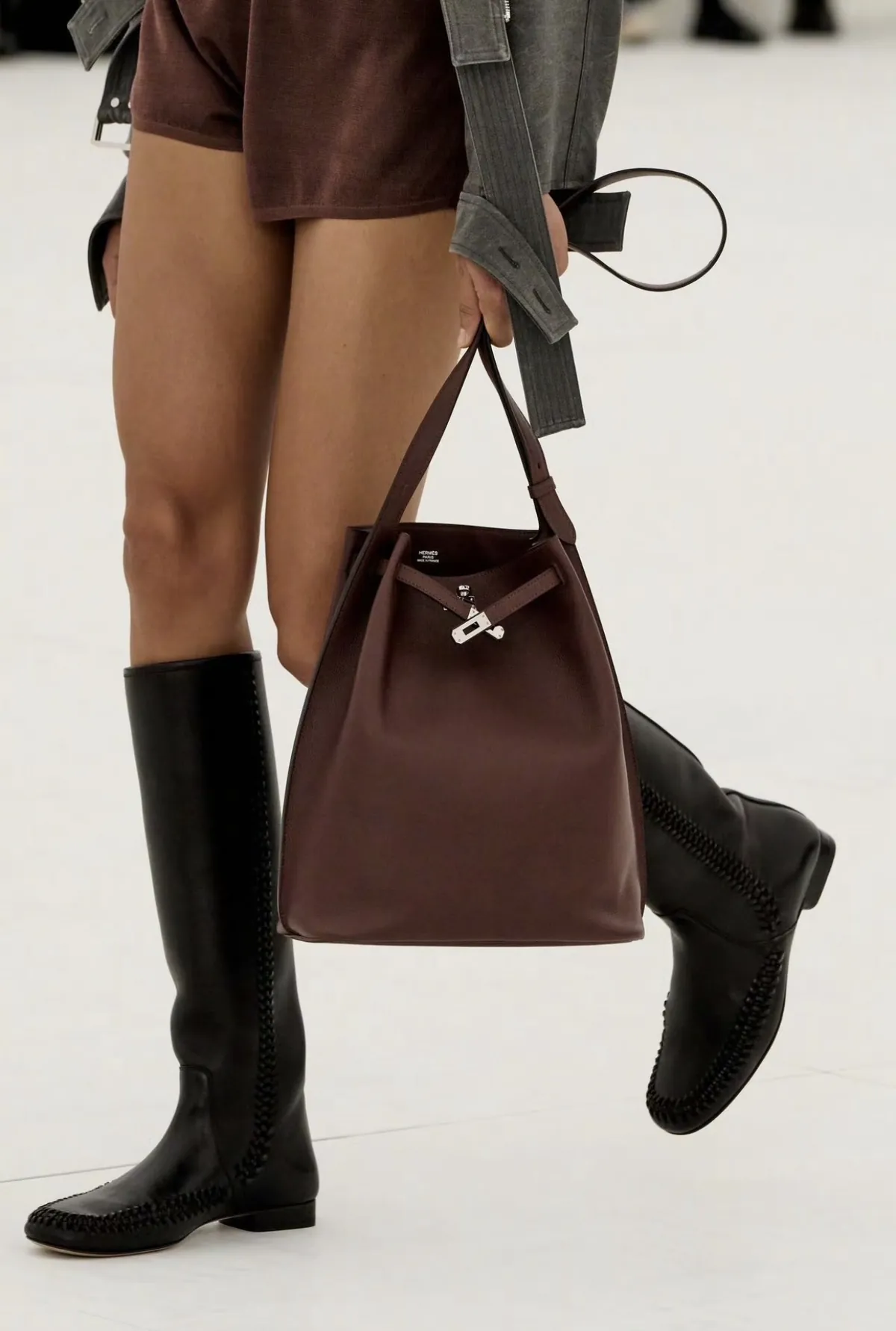
This formula works best on warm days when the parka is carried more than worn, and on in-between days when the dress alone is the outfit but the outer layer is still needed. The existing wardrobe reference, an Hermès So Kelly 22 bag, is useful here because its compact shape sits above the dress hem rather than slicing across it.
Formula two: snapped parka over full-leg trousers
Here the parka holds the line. Snap it at the waist to define the top half, then pair it with trousers set to their full-leg silhouette and leave that line fixed. Because the parka waist is the single horizontal decision, the trousers should read as one uninterrupted column from waist to shoe. The result is a cleaner, more grounded look than pairing a snapped parka with an adjustable dress.
- Fasten the parka snaps fully and check that the waistline sits where you want the outfit's visual center.
- Choose trousers at full leg and avoid re-zipping them into the slim version midday.
- Pick a shoe with a low profile so the trouser column stays prominent.
- Keep the top underneath plain and tucked, so the snapped waist reads once, not twice.
- Carry a structured bag at hand or shoulder height, away from the waistline.
This is the more practical formula for a working day or a long walk. The parka does the shaping, and the trousers supply length without adding a second hem decision.
A checklist for deciding which piece moves first
When dressing, settle the outfit in a fixed order rather than adjusting pieces interchangeably.
- Decide the desired overall length first: short, knee, or full. This tells you whether the dress or the trousers should be the length-bearing piece.
- Set the length-bearing piece and stop adjusting it.
- Add the parka and choose one state only: open with snaps apart, or fully snapped. Avoid half-snapped uncertainty.
- Check the mirror for horizontal lines; if you see two close together, relax one piece back to its base state.
- Choose shoes last, matched to the final hem or trouser break.
- Keep accessories quiet at the waist so the chosen line stays singular.
If you cannot decide, default to the dress as the length-setter and the parka open. That pairing is the easier one to wear across different temperatures.
Colour and texture choices
The collection's palette moves from creamy whites toward yellow and orange, with leather mostly kept to accents. For layering, keep the inner piece lighter than the parka if you want a soft, airy look, or use a tonal pairing in cream and sand for a quieter result. A crinkled silk-faille dress under a matte parka gives a useful texture contrast without much colour noise.
If the parka is the starred adjustable piece, let the trousers stay plain and the top simple. If the dress is the star, let the parka be the neutral frame. Either way, one adjustable element is enough.
Building the rest of the outfit
Footwear should follow the chosen formula rather than the other way around. The collection shows a flat moccasin-style boot with whipstitched details and a strappy thong sandal. The flat boot suits the full-leg trouser formula; the sandal suits the short zipped dress with an open parka. A compact shoulder bag keeps either outfit from gaining an extra horizontal interruption.
For more layering decisions from the same season, see Hermès Spring 2027 carwash-hem coats and deconstructed parkas, and for adjustable hems more broadly, read zipper dresses and trousers with adjustable length. Shoe choices for those hems are covered in adjustable hems with shoes and sandals.
The core decision stays the same: let the dress set the length while the parka stays open, or let the snapped parka set the waist while the trousers hold full length. One moving line, one fixed line, and the outfit reads clearly.