The style notebook
Hermès Kelly Danse Bags: Crossbody versus Belt-Bag Carry Outfit Ideas
Hermès Kelly Danse carry guide: when crossbody or belt-bag wear works with coats, waists and layering, plus when the strap comes off for a clutch.
Twice through, and the bag sits at the front of the waist
The belt-bag route on the Hermès Kelly Danse takes the strap through the D-rings, around the waist, then through a second loop before the buckle goes in. One pass would leave a single band of strap circling you; the double pass is what gives the waist carry its doubled band and lets the buckle close against two thicknesses of strap rather than one. Anna McWhirter's PurseBop report of 21 October 2023 lists that second loop as part of the belt-bag method, separate from the crossbody instruction, which buckles at the first hole after a single pass through the D-rings.
The D-rings sit at the back of the bag, so looping through them twice turns the hardware side toward your body and leaves the Kelly touret front facing out. That is the placement that makes sense: the bag reads as a belt buckle at the front of the waist, with the strap running around your sides to the D-rings behind it. Wear it there rather than pushed to one hip. A bag parked at the side of the waist loses the belt-bag logic and starts to look like a pouch hanging off a strap.
Height is the variable the source leaves to adjustment. Sit it at the natural waist, at the narrowest point, so the doubled strap has a stable band of fabric to grip. Lower, toward the hip bone, the strap has more room to slide and the bag starts to hang rather than sit. Higher, under the bust, it competes with a waist seam or a jacket's button stance. My reading is that the natural waist is the position that keeps the double loop doing its job.
The doubled strap also changes what the waistband has to be. Two layers of strap plus a buckle need a flat surface, so a tucked top and a plain waistband on the skirt or trouser work better than a gathered or elasticated one. Skip a separate belt on the same day: the bag is already supplying the buckle, and a second one a few centimetres away splits the eye. Where the bag's own front hardware is the point, keep the clothing above and below it quiet, and let the double strap be the only horizontal line at the waist.
The Hermès Kelly Danse switches the clothing problem when you move it from crossbody to belt bag. Crossbody needs a long, mostly uninterrupted diagonal across the torso — a slim layer, an open or soft coat front, a compact bag hanging in a clean zone. Belt-bag wear needs the opposite: a waist that stays visible and a hem or belt line the D-rings can sit against without fighting the garment.
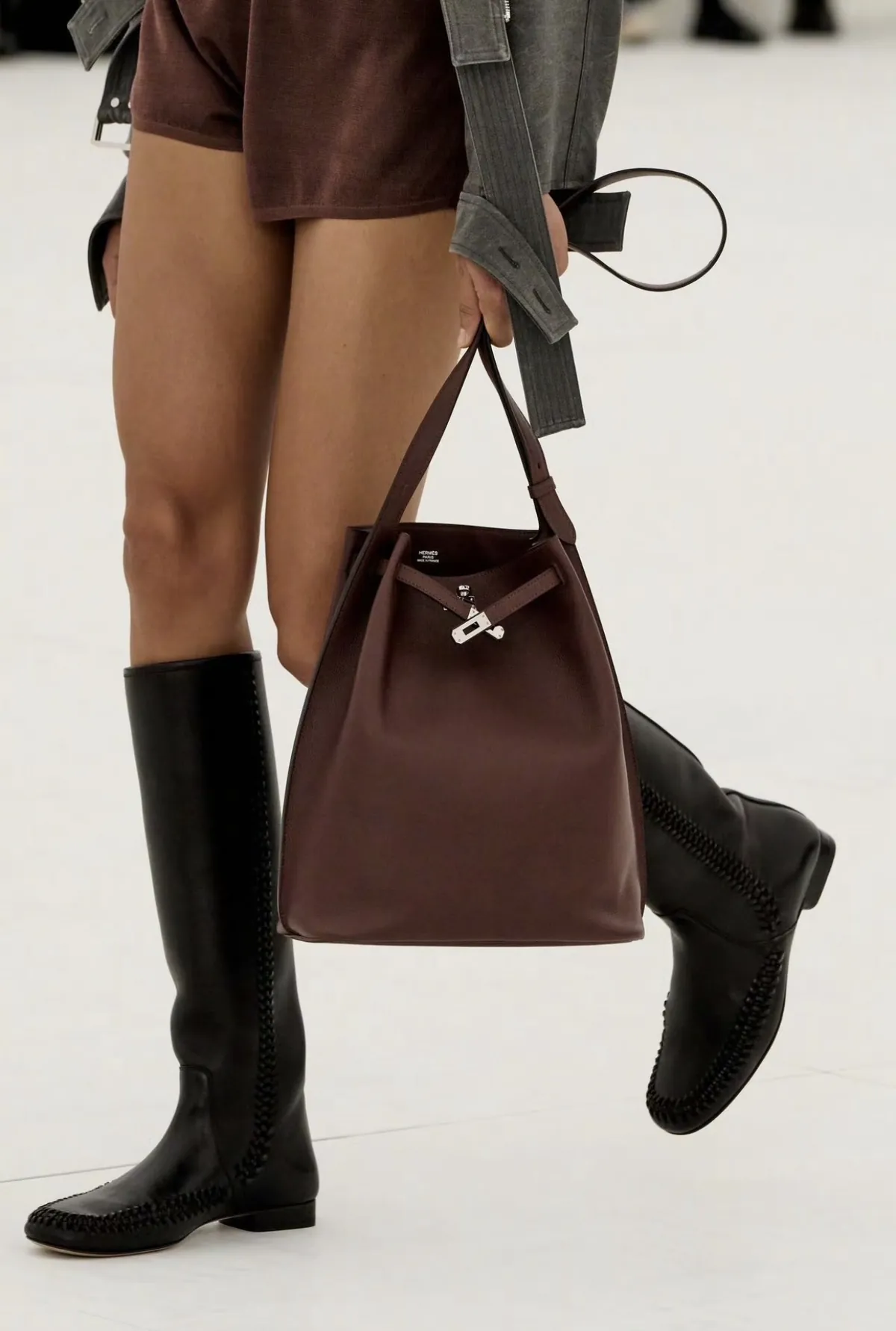
The featured image is an existing Hermès wardrobe reference, separate from the Kelly Danse looks discussed here.
PurseBop's Anna McWhirter, writing on 21 October 2023, reports the Danse with two D-rings in the back and a 62.4-inch strap, and gives the belt-bag conversion as looping the strap through the D-rings, placing the bag around the waist, looping through a second time, then buckling and adjusting. The same report describes crossbody as fully extending the strap through the D-rings and buckling at the first hole. Those are the mechanical facts. What each carry asks of a coat, waistline and layer count below is my styling reading of them, not a claim about current stock or how the strap will sit on a particular body.
Crossbody: give the diagonal one clear channel
Crossbody is the more forgiving of the two because the bag hangs in space rather than gripping the waist. In my reading, what it needs from clothing is a torso surface the strap can cross without snagging or competing. A fine-gauge knit, a smooth shirt, a fitted jersey top — these let the strap read as a single line. A chunky cable knit, a wide quilted jacket, or a coat with a heavy storm flap across the chest gives the strap several surfaces to cross and the bag a bulkier backdrop.
Outerwear is the real decision. A long open coat worn over a close layer leaves the bag hanging inside the coat opening, visible and clean; that is the version I would reach for first with a mid-length tailored coat. A zipped or buttoned jacket worn closed puts the strap over the fabric, which is fine with a smooth cloth and less so with a padded or hairy surface. The reported strap is long, so the bag can sit low; clothing with a soft, flat hip zone — straight trousers, a simple skirt, dark denim — keeps that low bag from being crowded by a pocket flap or gathered waist.
Layers should be few. A shirt plus a knit plus a coat is already three surfaces on the diagonal. If the middle knit is bulky, the strap presses into it; if it is thin, the coat does the warming and the bag hangs against a clean line. I would use one close base layer and one coat in cold weather rather than a stack.
Belt-bag wear: the waistline becomes the outfit
Worn around the waist, the Danse sits where a belt would, so clothing has to decide whether the waist is a designed feature or just a place to put a buckle. My styling reading: this carry works best when the top is tucked, cropped, or short enough that the bag's strap and D-rings land on fabric rather than on a bunched hem. An untucked voluminous shirt or a boxy knit that puddles at the hip buries the D-rings and leaves the bag perched on gathered cloth.
A dress is a useful test. A close sheath or a straight shift gives the strap a stable plane; a full, gathered or pleated skirt at the natural waist puts folds directly under the bag. If the skirt is full, the belt-bag version reads better worn a little higher or with a fitted bodice above, so the strap has a flat section of cloth. With trousers, a high waistband without a heavy belt is the cleaner host — two belts, one fabric and one bag strap, compete for the same line. Skip the belt on a belt-bag day.
Outerwear changes the answer more than it does for crossbody. A coat worn closed means the waist is under fabric and the strap has to bundle the whole coat, which in my reading distorts the garment's intended line. A cropped jacket ending at or above the waist leaves the strap clear. A long open coat can also work if the waist underneath is defined and the coat is worn open, so the band sits in the opening rather than around the coat itself.
Where the D-rings sit against a hem or belt line
The bag's two D-rings are at the back, and the belt-bag method relies on the strap passing through them. That places a hardware cluster at the centre back of the waist. Clothing with a back seam, a rear belt loop in the wrong place, or a peplum that flares immediately below is busier there than a plain waistband. I would favour a skirt or trouser with a clean back waist and no rear pocket flap or decorative seam directly under the strap. This is a placement judgment, not a claim about how the strap fits.
Removing the strap: the clutch version
McWhirter's report also lists a clutch conversion — strap off the D-rings, bag hand-carried. That version is a different clothing proposition: no diagonal, no waistband, so the outfit can carry more detail without anything competing. It suits an evening dress, a tuxedo jacket with nothing slung over it, a coat carried on the shoulders. The one thing it removes is the bag as a visible cross-body line, so if your outfit's interest is concentrated at the front neckline or the waist, the clutch version leaves that detail unobstructed.
- Crossbody first with a slim knit and an open mid-length coat.
- Belt-bag first with a tucked top, a flat waistband and no separate belt.
- Clutch when the outfit already has a focal point the strap would break.
For the crossbody strap against a wider leg, see black shoulder bag with wide-leg trousers. If the waistline question is what you are solving, Kelly Danse versus Kelly Moove covers the convertible-strap decision more broadly.