The style notebook
LilyEve Shearling Vests in Vintage Hermès Scarf Prints: Outfit Ideas
LilyEve shearling vests with vintage Hermès scarf prints: why the base layer, trousers, neckline and metal should stay plain around maximalist print.
For a LilyEve shearling vest in a psychedelic vintage Hermès scarf print, the base layer and trousers should stay plain in the strongest sense: one solid, unpatterned colour beneath, a solid trouser pulled from a colour already in the print, and nothing else patterned anywhere. The vest is the maximalist piece; the rest of the outfit is the quiet frame that lets it read as deliberate rather than noisy. Elle's Kristen Bateman, writing on 12 August 2026, reports that LilyEve sells shearling vests alongside blanket coats, cropped trench coats, silk tops, oversize tote bags and bucket hats, all upcycled from vintage Hermès blankets, scarves and beach towels, and describes the shearling vest series as “inherently maximalist, with its psychedelic prints culled from some of the French label's most extravagant scarves.” She also reports each LilyEve garment is one of a kind. Those are the reported facts; the styling judgments below are my own reading.
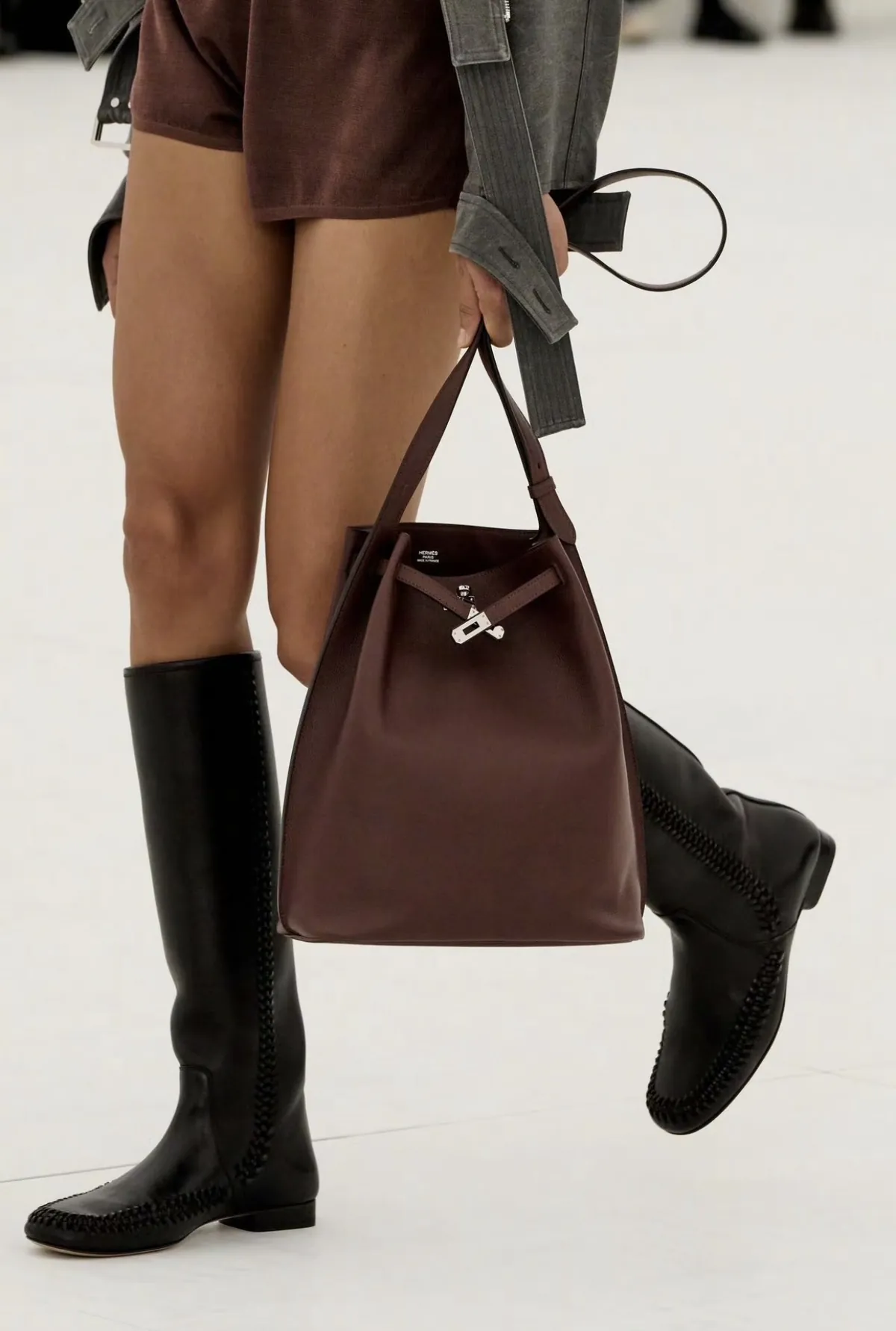
The featured image is an existing Hermès wardrobe reference, separate from the LilyEve looks discussed here.
Why the base layer has to be the calmest thing you own
A scarf print is not a neat repeat. Scarves carry large motifs, dense borders and overlapping colour, so the vest's outer surface is already busy before you add anything. A patterned blouse, a striped knit or a printed shirt underneath sets a second rhythm going at exactly the point where the eye is trying to read the first one. A plain crew, a fine-gauge roll neck or a smooth silk-free top in a single solid tone gives the print a flat ground to sit against, and keeps the open front of the vest as the thing that moves.
Choose the base colour from the scarf rather than inventing a new one: a deep tone already present in the print reads as an echo, not a competitor. Black, cream, navy or a dark brown are the safest, because they let the vest supply all the colour and none of the argument.
The neckline follows the vest's front, not the trend
Because the front length is the variable here, decide the neckline by where the vest closes. Where a vest hangs open or fastens low, a plain crew or a fine roll neck keeps an unbroken column of colour beneath the print and stops the print reaching the throat — useful when the scarf's decorative border sits near the front edge. Where the front is shorter or closes higher, a plain shirt collar or a clean round neck can sit just at the shearling's edge without competing. Either way, one detailed edge near the face is enough, and since the vest already supplies it, the layer beneath should give a clean line instead. A small plain stud or nothing at all beats a layered chain that repeats the vest's density.
Trousers, belts and where the waist sits
The trouser is the second plain place the outfit needs. Straight-leg wool, a clean tailored cut or plain dark denim all work; a check, a stripe, a floral or a heavy textured weave introduces the second surface that spoils the effect. Colour taken from the print keeps the vest as the statement and the trouser as its shadow.
At the waist, whether to belt depends on front length rather than preference. A long vest that hangs past the hip already sets the line, so a visible belt cuts the body where the vest does not — leave it off and let the vest do the work. A shorter vest finishing near the waist tolerates a slim leather belt in a quiet tone that marks the trouser's rise without adding metal or pattern near the print. If you do mark the waist, keep the bag away from it so the eye is not pulled to one crowded point; a plain shoulder bag carried higher, or a flat tote in the hand, is easier than a bag sitting at the hip. A pair of plain black shoulder bag with wide-leg trousers is a useful reference for the quiet end of that pairing.
The single accessory rule
With a scarf print on the body, the accessories should be the quiet ones: a smooth leather bag in black, brown or cream, hardware kept small, and one accessory at most near the vest — a plain belt, or a single earring, or the bag, not all three. A heavy chain, an oversized buckle or a second logo competes rather than complements. The reasoning behind a restrained finish is set out in Hermès hardware finishes, which is worth reading before adding metal near the print.
When the plain rule can loosen
If the scarf in question is genuinely quieter — a border print, a near-single-colour design — the frame can relax: a fine tonal stripe or a soft textured knit underneath adds interest without fighting the print. A roomier trouser still holds, because it shifts the mood rather than the print. And if you would rather not build the whole outfit around a maximalist vest, the demurer LilyEve pieces reported in the same interview — the blue-and-white blanket trench, for example — let the garment be quiet and the print decision disappear.