The style notebook
Loro Piana Fall 2026 Ochre Orange Tailored Coats: Embroidered Collar Outfit Ideas
Loro Piana Fall 2026 ochre-orange tailored coats with wool-embroidered paisley collars: what plain underlayers, trousers and accessories keep the collar first.
For the Loro Piana Fall 2026 ochre-orange tailored coat with a wool-embroidered paisley collar, the collar is the outfit. Everything below the neckline should be a quiet frame: a plain shirt or fine knit in a solid tone drawn from the paisley itself, trousers that continue the coat's loose tailored line without adding pattern, and accessories that stay small and matte. The instant a second paisley, a printed scarf or a busy check enters the neckline, the embroidered collar stops being the reason the coat exists. That is the decision, and it is mostly a decision about restraint rather than about buying anything new.
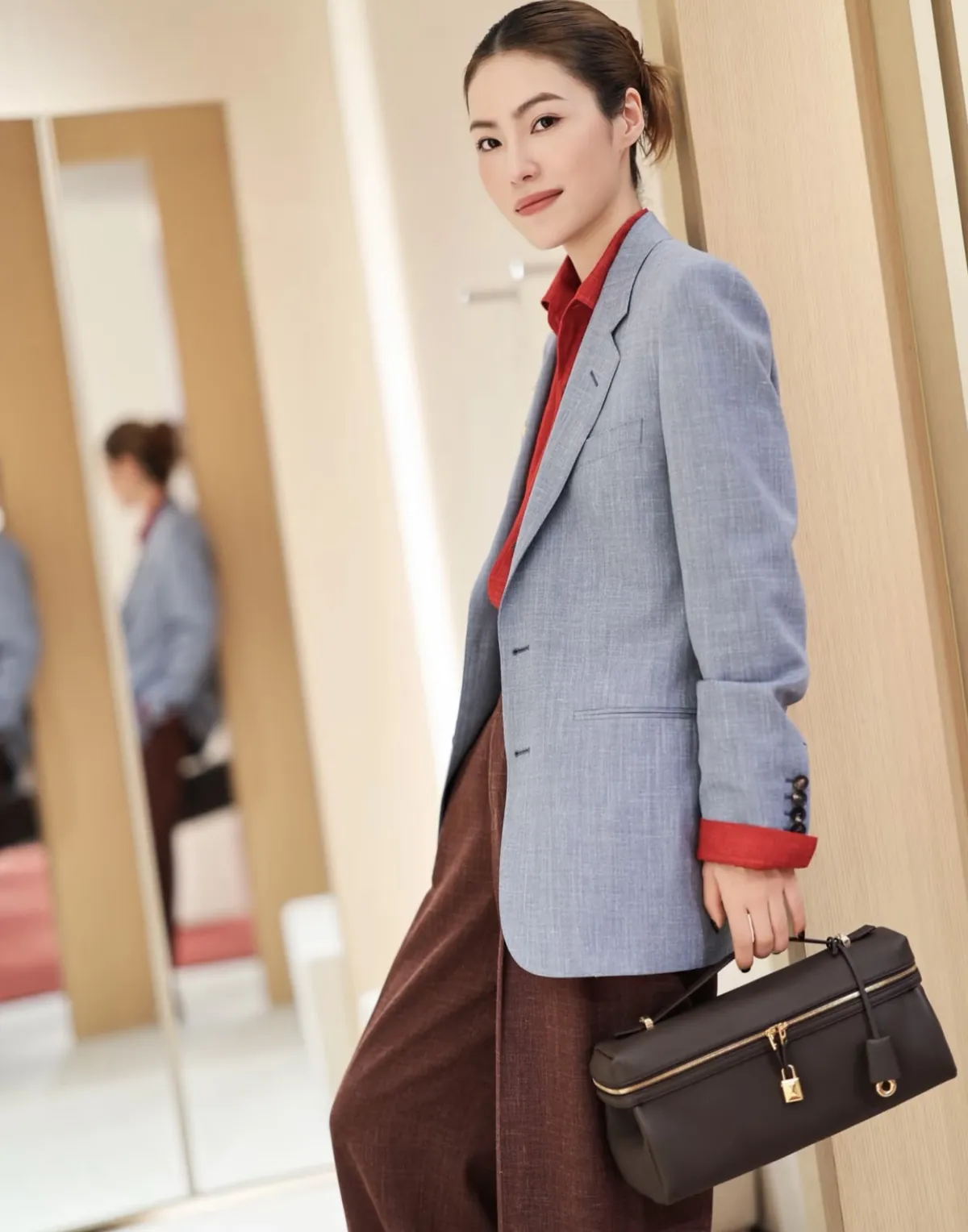
The featured image is an existing Loro Piana wardrobe reference, separate from the Fall 2026 looks discussed here.
Vogue's Luke Leitch (27 February 2026), reviewing the Fall 2026 menswear presentation built around a cross-continent train journey from Normandy to Persia, describes the coat precisely: an ochre-orange tailored coat whose collar was embroidered in wool after a Kashmir shawl, with paisley in claret, teal, ivory and saffron swirling across it. He also notes that the season's tailoring was comfortably loose, generally nostalgic and broadly midcentury, and that the house worked paisley — an ancient Persian-origin motif in its catalogue since the 1970s — through scarves, shawls and garments without becoming literal. Those are the reported facts. The layering, colour and proportion judgments here are my styling reading of how to wear a single collar-led coat well.
Treat the collar as the only paisley in the outfit
The most useful rule is also the simplest: one paisley per outfit. The collar already carries claret, teal, ivory and saffron in a swirling scale, and a wool-embroidered Kashmir-shawl motif is dense by nature. A paisley shirt, a paisley pocket square or a paisley scarf placed at the same neckline splits attention between two versions of the same idea, and the finer embroidery loses. If paisley is what you love about the coat, let the collar be the whole expression of it.
Where the coat is one piece of a wardrobe that already leans on paisley — Loro Piana's own season returned to the motif repeatedly — the cleanest separation is to move any paisley to the lower half or to an accessory far from the collar. A subdued paisley in a skirt or trouser reads as a deliberate echo only when its colours are drawn from the collar and its scale is much larger or much smaller. My preference is to skip it entirely and let the coat do the talking.
Underlayers: solid, tonal and close to the neck
The underlayer's job is to sit inside the coat opening without competing. A fine-gauge solid knit or a plain shirt in ivory, cream or a soft saffron-adjacent cream keeps the neckline calm and repeats one of the paisley's quiet colours rather than adding a new one. Claret and teal are best left in the embroidery; a solid claret shirt or a teal knit underneath turns the collar into part of a colour scheme rather than the centre of one.
Proportion matters as much as colour. Because the tailoring is loose, the layer beneath should be relatively clean at the shoulder and not bulky at the neck — a turtleneck that crowds the embroidered collar hides the detail you are wearing the coat for. A plain crew or a soft shirt collar left open gives the embroidery room. If you want warmth, add it in the sleeves or torso rather than wrapping the throat.
Trousers and shoes that continue the line
The reported season pairs loose tailoring with relaxed trousers, and that logic serves this coat. A plain trouser in a neutral — stone, taupe, dark brown or a deep navy — continues the coat's midcentury looseness without a second focal point. A subtle texture such as a fine wool flannel is welcome; a bold check or stripe is not, because it competes with the collar at the same visual weight.
Shoes stay low-key and leather. A plain boot or a simple leather shoe in brown or black keeps the hem quiet. The point is not to dress the coat down but to let its one loud feature read as intentional. When in doubt, compare the outfit to the coat alone: if the trousers and shoes would look at home under a plain camel coat too, they are probably right.
Accessories: small, matte and out of the neckline
The neck is occupied, so keep accessories away from it. A patterned scarf tied at the throat is the single most common way to ruin this coat; a heavy necklace or a busy collar pin does the same. Smaller, matte pieces — a simple leather bag, plain gloves, a low-key hat — sit outside the collar's territory and support it.
For a bag, a structured black or brown shoulder bag keeps the palette grounded and avoids introducing another print; the principles in this guide to a black shoulder bag with wide-leg trousers translate directly. If the coat is the evening piece, a simple clutch in a solid tone is the better companion than anything embroidered or patterned. The rule holds across the wardrobe: let one Kashmir-shawl collar be the only place the eye is asked to work.