The style notebook
Louis Vuitton Fall-Winter 2025 Petite Malle Slim: Strap or Clutch Outfit Ideas
Louis Vuitton Petite Malle Slim guide: when the short strap or a clutch carry works better, and how to keep the hardware from doubling as jewellery.
For the Louis Vuitton Petite Malle Slim, the strap is the minority carry, not the default. Carry it as a clutch when the hardware is the point of the outfit and you want a clean vertical line from shoulder to hem; use the short detachable strap when you need a free hand and the clothing is plain enough that an extra horizontal band at the side will not clutter the silhouette. That is the useful order of decisions. The bag is reported as a slimmed-down Petite Malle with a more hardware-intensive look, a short detachable shoulder strap and the option of wearing it with or without that strap, shown in light grey and vibrant red Epi leather with silver-toned hardware (PurseBop, Anna McWhirter, published 11 March 2025). The carry judgements below are my styling reading of those reported facts, not a claim about how the bag performs.
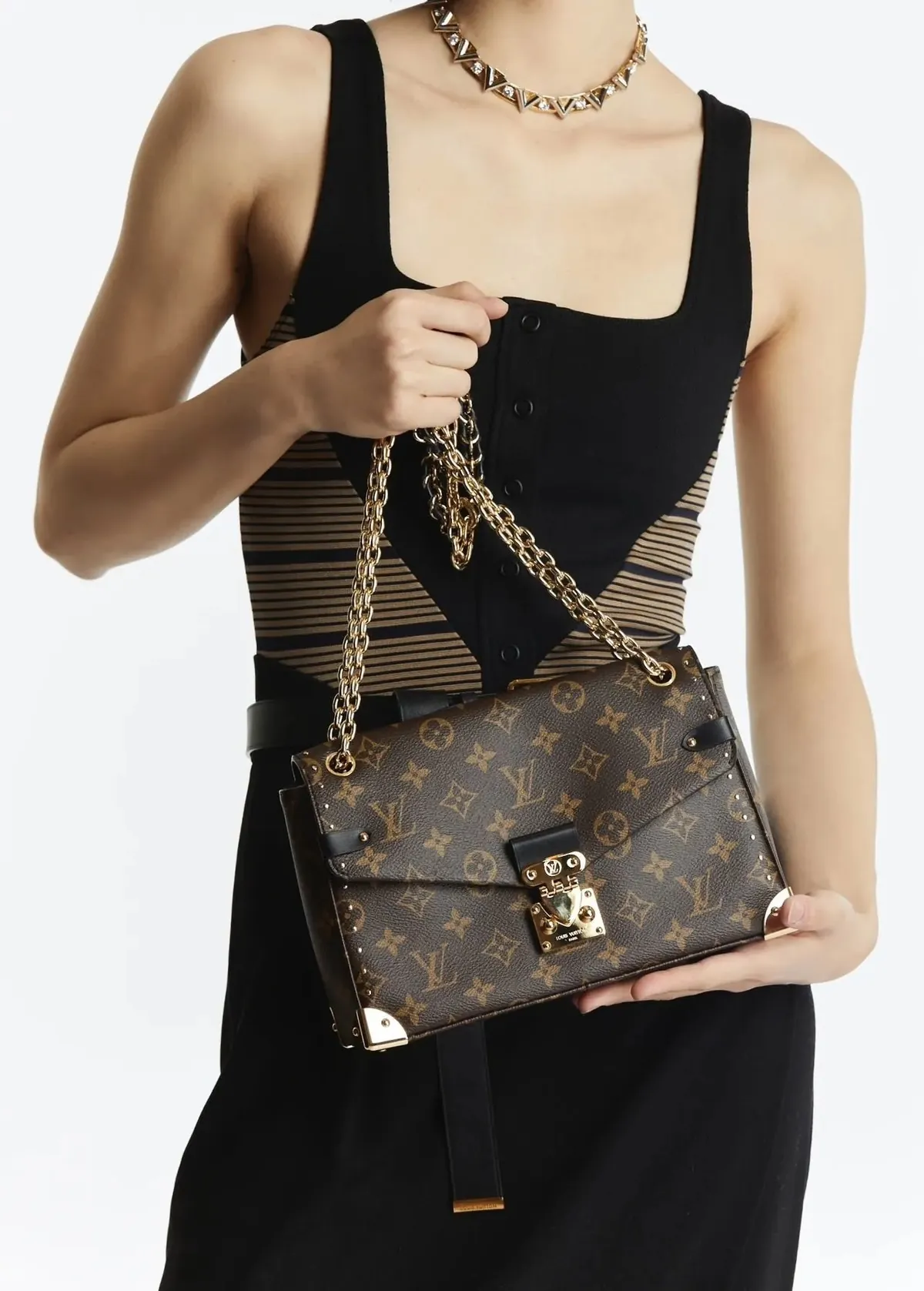
The featured image is an existing Louis Vuitton wardrobe reference, separate from the Petite Malle Slim looks discussed here.
Why a clutch carry suits this bag more often
A clutch position puts the hardware at the front of the body, at hand height, where it can be read as the outfit's main metal. A short strap, by contrast, places the bag under the arm or against the ribs, and that is a busy zone: a sleeve, a jacket lapel, a bag strap and silver hardware all compete within a small area. When the clothing is quiet, the strap is fine. When the clothing already has a strong shoulder line, a wide sleeve or a lot of texture, the clutch carry gives the eye one clear object instead of a cluster.
The slimmer body matters here. A slim, rectangular clutch reads as a line rather than a mass, so it sits well against a column of plain colour — a narrow skirt, straight trousers, a long coat worn open. The same bag on a short strap, hanging at the side, interrupts that column. That is a reason to prefer the clutch for evening dressing and for tailored, linear outfits, and a reason to reach for the strap when the outfit is soft, layered or deliberately casual.
When the short strap is the better choice
Take the strap when your hands need to be free: a reception where you are holding a glass, a shop, a walk between venues. It also helps when the outfit has volume above the waist and you want a small, defined object near the body rather than something held out in front. A cropped jacket, a knit with a soft shoulder or a coat with a wide sleeve all give the short strap somewhere to sit without swallowing the bag.
Because the strap is short, it changes where the bag sits on the torso rather than lengthening the silhouette the way a long crossbody strap would. My reading is that this makes it a side accent, not a line-maker: it adds a compact block of grey or red and silver near the waist or ribs. If your outfit already has a strong horizontal there — a wide belt, a peplum, a colour-blocked seam — the strap competes. If the area is plain, the strap supplies the interest.
Letting silver hardware lead without doubling as jewellery
The most common mistake with a hardware-heavy bag is adding more metal nearby. Silver-toned hardware on the bag already supplies shine, so earrings, a necklace, a watch, bracelet and bag all competing for the same visual job make the look noisy rather than rich. My suggestion is to choose one jewellery zone and leave the others quiet: earrings with a bare neck and wrist, or a single bracelet with studs, rather than a full set. The bag then reads as the metal in the outfit.
Clothing in matte surfaces supports this. Wool, cotton, matte leather and cashmere let the silver-toned hardware stand out; satin, sequins, metallic knits and glossy coatings give the hardware something to fight. The two Epi leathers push in different directions. Light grey is quiet and lets the silver look crisp and cool, so it suits a tonal outfit — grey, charcoal, navy, black, cream. Vibrant red is louder, and my reading is that the silver hardware and the red body already constitute two strong notes, so the clothing should supply at most one more: black, cream, grey or denim, not another saturated colour.
Clutch or strap by occasion, not by outfit formula
- Evening, seated, tailored: clutch, with a plain column of black, navy or grey and jewellery kept to one zone. The hardware is the focal point.
- Evening, standing and moving: short strap, with a cropped jacket or a soft knit so the bag sits against plain fabric rather than a busy seam.
- Day, structured tailoring: either works, but the clutch carry keeps the jacket's line intact. A wide-lapel jacket is the case for the clutch. If you want the strap, the plain-side logic in this guide to a black shoulder bag with wide-leg trousers applies: keep the trouser plain and let the bag sit at the side.
- Day, soft layers: strap. A knit, a scarf and a coat need a hand free, and a slim clutch under the arm is awkward in that stack.
If you are deciding between this and an older trunk-style bag, the difference is proportion, not function: the Petite Malle Slim is reported as slimmer and more hardware-led, so it rewards plain clothing more than a boxier trunk does. For a comparison of how a differently shaped Louis Vuitton trunk bag handles print and texture, see the Cruise 2025 Slim Trunk guide; the logic there is about a print-led bag, which is not the situation here.
Before committing a specific outfit, try the bag in both modes with the clothes you have in mind — with and without the strap, and with your own jewellery — so the carry decision reflects the actual silhouette rather than a general rule.