The style notebook
Louis Vuitton Spring-Summer 2027 Black Waistcoats: Side-Slit Sleeve Outfit Ideas
Louis Vuitton Spring-Summer 2027 black waistcoats with arms through the side slits: the base layer, hem length and wrist choices that keep it readable.
For the Louis Vuitton Spring-Summer 2027 black waistcoat worn with the arms through the side slits instead of the armholes, the base layer should be close and completely plain, the bottom half should sit high enough that the waistcoat hem stays visible as a line, and the wrists should stay bare. Those three decisions are what let the twisted arm line read as a deliberate styling move rather than a garment that has slipped.
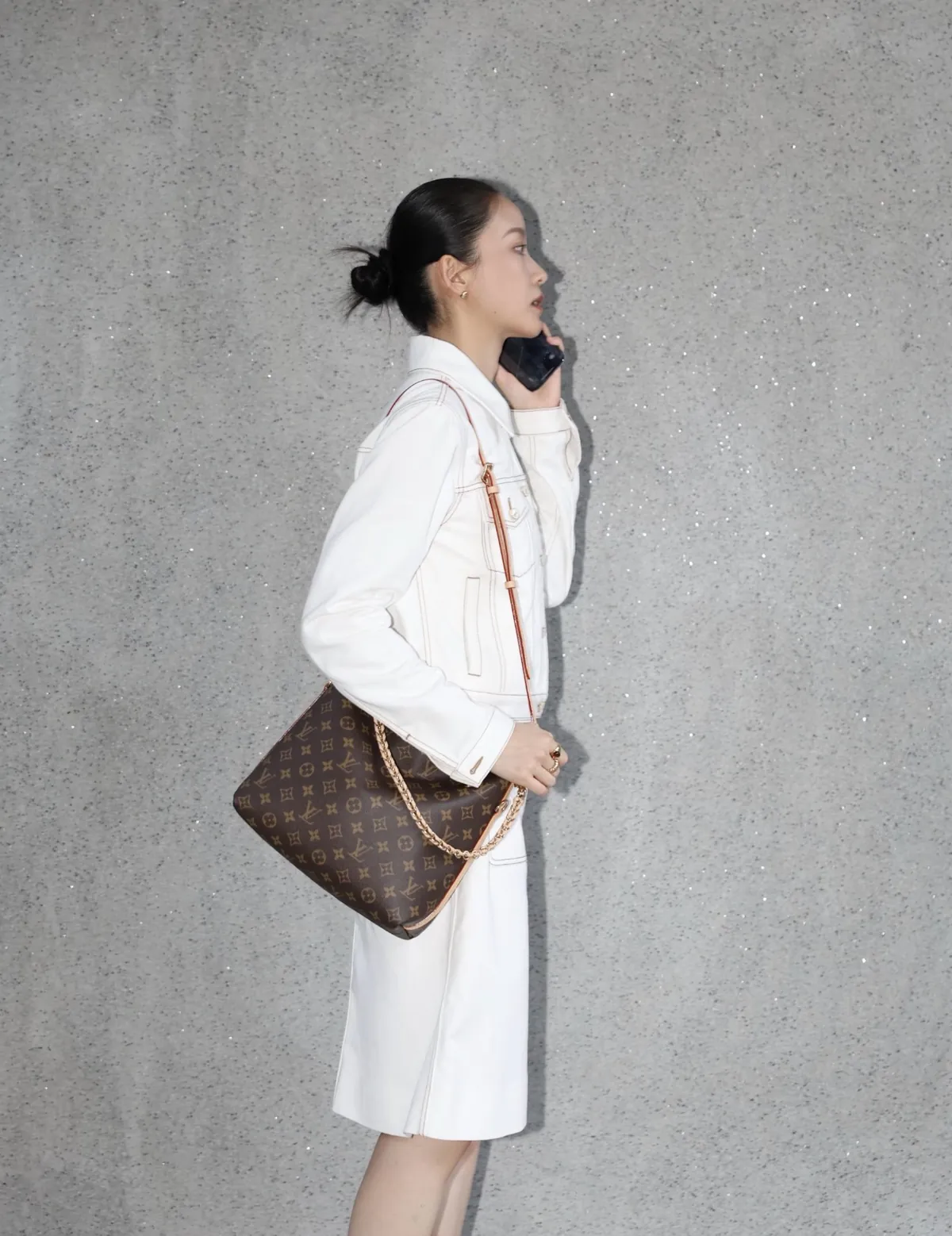
The featured image is an existing Louis Vuitton wardrobe reference, separate from the Spring-Summer 2027 looks discussed here.
ELLE Japan's Spring-Summer 2027 collection report, published 14 October 2026 and credited to Matthew Velasco and Sayaka Kishi, describes a black waistcoat with a Ghesquière-style twist: the model wore her arms through the side slits rather than the proper armholes. That is the reported detail. Everything below about base layers, hem length and accessories is my own styling reading, not a description of a complete runway outfit and not a claim about fit, fabric or how the piece behaves on a body.
Why the plain, close base comes first
Wearing a waistcoat through the side slits changes its geometry. Instead of the garment hanging from the shoulders with the armholes in their intended position, the arms enter lower and further in, so the front and back panels are pulled into a different relationship around the torso. The eye reads a crossed, slightly wrapped shape at the chest and a changed line at the arm. That is already a lot of information in one garment.
A close base layer is the useful answer because it gives that displaced shape something quiet to sit against. A fine knit vest, a plain fitted T-shirt or a simple sleeveless top in black, charcoal or a deep neutral keeps the torso line unbroken under the waistcoat. The point is not modesty; it is that a loose or patterned layer underneath competes with the twist and makes the arm placement look accidental.
Where I would choose differently: if you want the waistcoat to feel like a summer top rather than a layered piece, a bare torso under it is the cleaner choice, and it removes the base-layer problem entirely. What I would avoid is a billowing shirt or a boxy tee underneath, because both add volume exactly where the side-slit arm placement is already creating an unusual fold.
The bottom half has to clear the hem
The waistcoat's hemline is the lower boundary of the whole styling idea. If a skirt, a trouser waistband or a tucked top sits over it, the waistcoat reads as an unfinished layer rather than the main event. The most readable pairing is a bottom half that begins at or below the natural waist and stays relatively flat at the hip, so the waistcoat's own hem — and the vertical line running from it — stays visible.
A straight-leg or narrow trouser works for the same reason: it continues a clean vertical from the waistcoat down and does not introduce a competing volume at the hip. A simple midi or straight skirt does the same job. A high-waisted, wide or heavily pleated bottom is the harder pairing, because the waistband and the fullness both land in the zone where the waistcoat hem needs air. If you want that wider shape, an untucked waistcoat that ends above the hip is the version that survives it.
The report mentions silk trousers as a partner to other tailoring in the collection, but it does not state what was worn with this waistcoat. Treating a fluid trouser as a plausible partner is my styling reading, not a reported pairing.
Keep the wrists empty
The side-slit arm placement draws attention to the forearm and the wrist: the arm emerges from an unexpected point, and the sleeve or panel edge cuts across the arm higher or lower than a normal armhole would. That means the wrist is already a focal point. A stack of bracelets, a chunky watch or a cuff that bunches at that point adds a second event right where the eye is already working.
Bare wrists are the safest default. If you want jewellery, a single fine ring or one small earring keeps the attention on the garment's line. A long necklace is a different question: it runs down the centre front, where the crossed panels are, so it is best kept short or left off. The general principle is that the arm line is the talking point, and anything at the wrist is a rival to it.
Footwear and the overall register
Because the waistcoat is black, tailored in form and slightly subverted in how it is worn, the shoes can go either way without much risk. A flat, simple shoe keeps the outfit in day territory; a pointed or heeled shoe lifts it toward evening. The choice matters less than the base and hem decisions above, and that is worth saying plainly — this is not an outfit where the shoes carry the look. If you are building the outfit around the waistcoat, resolve the layer and the hem first and let the shoes follow. For a wider-trouser pairing that needs a bit more grounding, this guide to a black shoulder bag with wide-leg trousers covers the proportions from the other direction.
The one-question test
Before committing, ask whether the waistcoat is the most interesting thing in the outfit. If a patterned base, a statement belt or a loaded wrist is pulling rank, remove one of them. The side-slit arm placement is a quiet joke rather than a loud one, and it only lands when the rest of the look gives it room. A close plain base, a bottom half that clears the hem and empty wrists are the three moves that keep it legible.