The style notebook
Prada Buckle Bag: Novelty Leather Bag Outfit Ideas with Plain Tailoring
How the Prada Buckle Bag, a named leather goods novelty, works with plain tailoring: clothing choices that let a hardware-forward buckle bag lead.
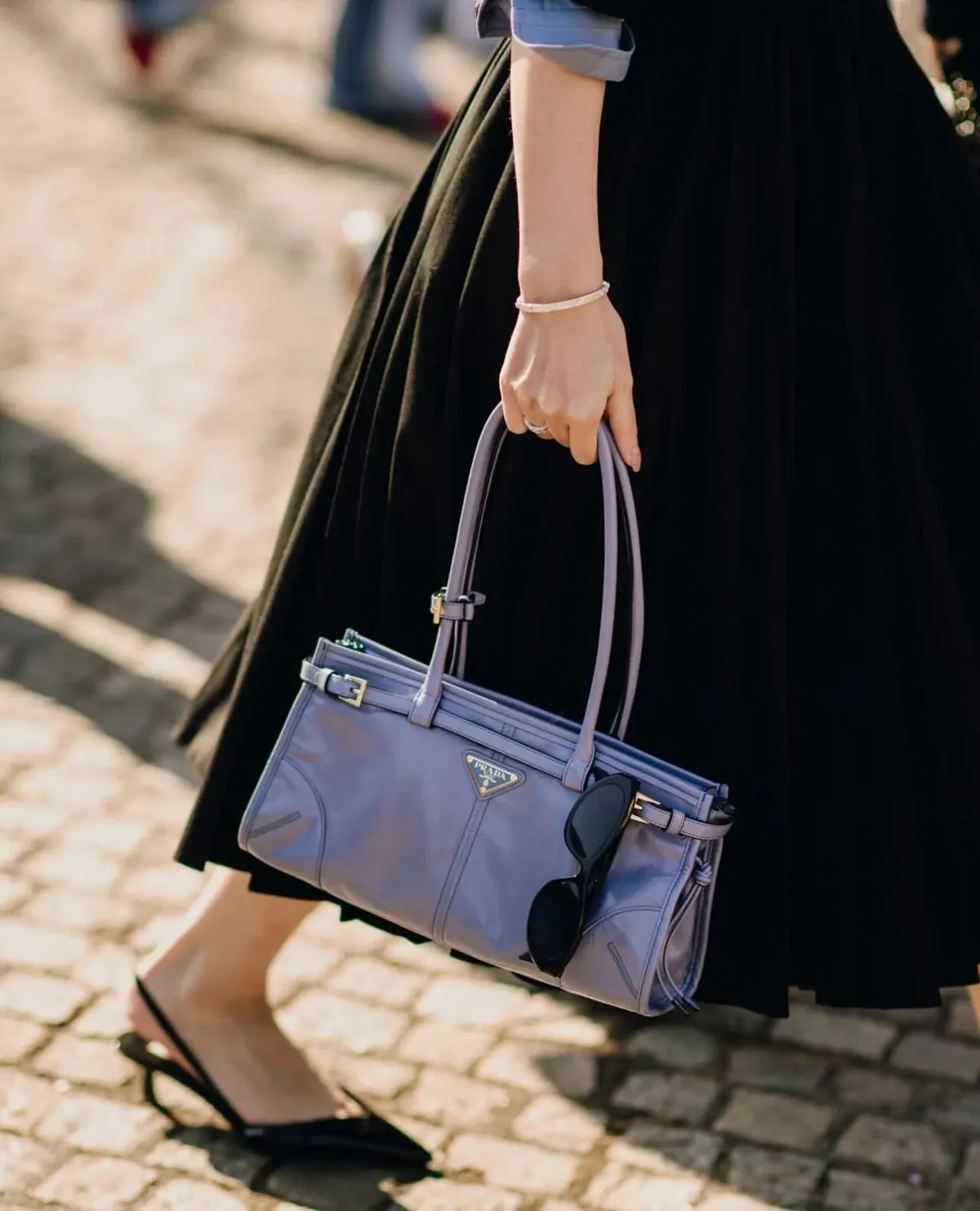
The Prada Buckle Bag earns a place in a plain-tailoring wardrobe by being the one deliberate interruption: the clothing stays quiet and the buckle does the talking. Prada Group's Q1 statement, published 24 April 2024, lists the Buckle Bag among "Leather Goods novelties" that enriched the category "alongside the ongoing reinterpretation of icons." The statement presents a new novelty and a reworked icon as two ways of enriching the same wardrobe, not as rivals where one must win — so the real question is which job your plain clothes need filled.
The featured image is an existing Prada wardrobe reference, separate from the Buckle Bag looks discussed here.
Novelty or icon: what actually differs for plain clothes
The statement does not describe the Buckle Bag's shape, materials, size or hardware beyond the name. It dates the bag's mention to a Q1 2024 trading update, not to a launch, and it says nothing about what is currently available. So the useful distinction here is the one the name and the category already imply: a buckle-forward leather novelty introduces a visible piece of metal on the bag, while an icon relies on a recognised silhouette. In a wardrobe of quiet tailoring, both can work, but they pull the eye differently.
This is my styling reading, not a product claim: hardware draws attention at the point where the bag closes, so the Buckle Bag wants clothing that leaves a clear field around it. An icon often draws attention through shape and proportion instead, which gives you more room to use texture and detail in the clothes. If your tailoring is genuinely plain — flat wool, cotton poplin, a clean knit, no print, minimal jewellery — the novelty has space to register. If your plain clothes already carry a strong line (a sharp shoulder, a wide trouser, a long coat), the icon and the outfit can share the work without either becoming decoration.
Plain clothing formulas that keep a buckle legible
The first formula is a straight-leg or gently wide wool trouser in a mid-to-dark neutral with a plain shirt tucked in. The tuck matters because it creates a clean torso line above the waistband, so the bag at hip or hand level is read against uninterrupted cloth rather than a loose hem and a bunched shirt. A black shoulder bag with wide-leg trousers shows how much of this depends on the trouser line, and the same logic applies here: the wider the leg, the more the bag should sit clear of the fabric.
The second is a plain knee-length or midi skirt with a fine knit or a simple blouse, no belt, no scarf. Skirts give a hardware bag more air around it than trousers do when you carry it by hand, because the fabric falls away from the body. Choose a skirt with a clean waistband and skip anything with a prominent buckle of its own — a second buckle at the waist competes with the bag's, and the outfit stops reading as plain.
The third is a tailored coat worn open over a plain base. A coat in a flat neutral with a simple lapel and no epaulettes, storm flap or oversized buttons keeps the outer layer calm. The bag then appears at the opening of the coat when carried in hand, or below the hem if worn on the shoulder. Avoid outerwear with lots of metal of its own: zips, D-rings and snap hardware all repeat the buckle idea and dilute it.
Where the icon is the better anchor
There is a real case for choosing a reinterpreted icon instead. If your plain wardrobe is built around one coat, one jacket and two trousers, a bag with a recognisable silhouette does more work across outfits because it reads as a shape first and a detail second. A hardware-led novelty is strongest when you rotate clothes often enough that the buckle stays a surprise. If you wear the same two tailoring formulas most days, an icon will feel less repetitive.
The novelty suits a wardrobe where the clothing is plain but not uniform — different collar shapes, different trouser widths, a skirt some days and trousers on others. It also suits someone who wants the bag to be the single decorative element and is willing to keep jewellery, belts and scarves minimal. That restraint is not a rule about the bag; it is how plain tailoring and a visible buckle avoid arguing.
Whichever you pick, test the proportion rather than assuming it: carry your usual clothes past a mirror with the bag in the position you would actually hold it, and check whether the buckle sits against plain cloth or against a competing detail. That check is yours to run, not a claim about how the bag performs.