The style notebook
Prada Fall 2026 Long Black Coats: Scarf and Remove-a-Layer Outfit Ideas
Prada Fall 2026 long black coat layering: the hand-knit scarf comes off first, and a chunky zip sweater that works bare keeps the coat-off outfit finished.
In the Prada Fall 2026 long black coat, the scarf comes off first, not the sweater. That ordering is the practical answer to the question this guide takes on: the scarf is the piece that reads as worn-for-outside, while the chunky zip sweater underneath has to be capable of carrying the outfit on its own. Vogue's Nicole Phelps, reporting on 26 February 2026, describes the show's opening look on Julia Nobis as a long black coat “not unlike the shrunken styles Prada and Simons showed at men's,” with a hand-knit scarf “wrapped neatly around her neck.” When Nobis reemerged, Phelps reports, “the coat had come off and we saw her chunky zip sweater.” Those are the reported facts. The layering judgements below are my own reading of them, not a prescription from Prada or Simons.
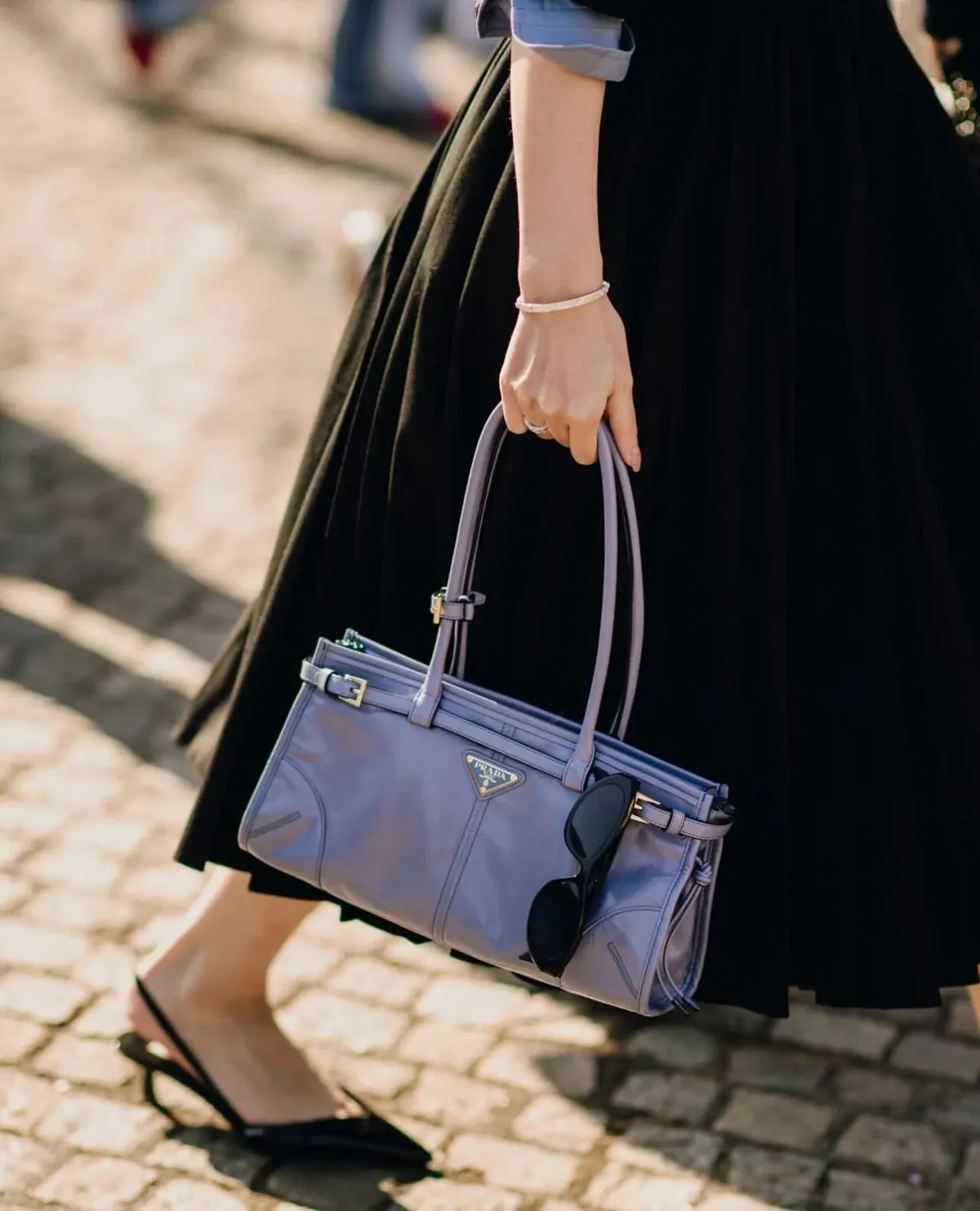
The featured image is an existing Prada wardrobe reference, separate from the Fall 2026 looks discussed here.
Why the scarf goes first
The scarf is the one element that has no job once you are indoors. It was wrapped neatly at the neck, which tells you its role was a finished, deliberate outer detail rather than an improvised bulk-up. Removing it early preserves the neatness of the neckline: a scarf that has been loosened and re-knotted through an evening starts to look like a leftover. The sweater, by contrast, is the piece the runway reveals as a state in its own right — Phelps only mentions it once the coat is gone, which suggests it was meant to be seen. So the sequence worth building toward is coat-and-scarf outside, coat alone for the transitional moment (a warm car, a cold hallway, a long dinner), then sweater-and-skirt or sweater-and-dress indoors.
What makes the sweater work bare
Phelps's phrase is specific: a chunky zip sweater. The zip is the useful detail here, because it gives you a way to change the neckline without adding or removing anything. Zipped high, it reads as a closed, warm layer under the coat. Opened a few inches once the scarf is gone, it creates a collar-like frame and stops the sweater looking like underwear that got promoted. The chunk matters too: a dense knit holds its own shape when worn alone in a way a thin merino does not.
Practically, I would choose a sweater that already looks intentional at the neck with nothing over it, and treat the scarf as an accessory to that neckline rather than a cover for it. A sweater that only works with something wrapped around the throat will fail at the second state.
The scarf: neat and light rather than enveloping
The reported scarf was wrapped neatly, which is a proportion clue. A hand-knit scarf that sits close to the neck, in a modest width, leaves the coat's own line visible and can be unwound and stowed without leaving a bulky mass in your bag. A very long, very thick scarf may look generous outdoors, but removing it changes the whole shoulder line of the coat, and it is awkward to carry. If you want the knit texture Phelps describes, let it come from a fine-to-medium gauge hand-knit rather than a heavy blanket scarf. That also keeps the coat-and-scarf state from looking padded at the chest.
Trousers, dress and the rest of the outfit
Phelps's account of Nobis continues past the sweater: “sweater-less her skirt was actually a dress,” and beneath that a diaphanous shift with “modest, almost old-fashioned underthings.” That is a runway construction, and it establishes how many layers the collection was willing to stack. For your own version, the plain-trouser route is the most reliable: one flat, unpatterned trouser in black, grey or navy means every removal state leaves the lower half unchanged and finished. If you prefer a skirt or dress, keep the sweater short enough that the waist stays visible once the coat is off, so the outfit still has a defined proportion rather than a knit block floating over fabric.
The same logic applies to footwear and accessories: quiet shoes and one bag keep the changing upper layers as the only event. For a wider discussion of plain black bases, see how a black shoulder bag sits with wide-leg trousers.
The three states, in order
- Coat plus scarf: the scarf wrapped close and tidily, the coat worn long enough that it skims rather than crops — the clearest match to the reported opening look.
- Coat alone: scarf off and stowed, the sweater neckline still hidden, the outfit reading as a clean coat over a plain base.
- Coat off: the zip sweater as the top layer, opened or closed at the neck, over trousers, a skirt or a dress that can stand without the coat.
The test before you leave the house is simple: try the outfit with the coat and scarf on, then with only the sweater. If the sweater state looks unfinished, the base is doing too little work and the coat is doing too much. Build so that the coat-off version could walk into a room on its own, and the removals become a sequence rather than a retreat.