The style notebook
Prada Re-Nylon Shopping Tote vs Belt Bag: Practical Carry Choices
Prada Re-Nylon shopping tote or belt bag? A capacity-versus-free-hands guide to the medium and large totes, the roomy belt bag and the belt with detachable pouch.
When practicality decides, the Prada Re-Nylon shopping tote wins on capacity and the Prada Re-Nylon belt bag wins on free hands. The question is not which is the better bag but which constraint your day imposes: a load you need to set down and reach into, or two hands you need for everything else. Both belong to the Re-Nylon collection that PurseBop's Olivia Elliot covered on 14 October 2020, and both are described there in plain functional terms. Her report is the source for the garment-level design facts below; the styling judgements are my own.
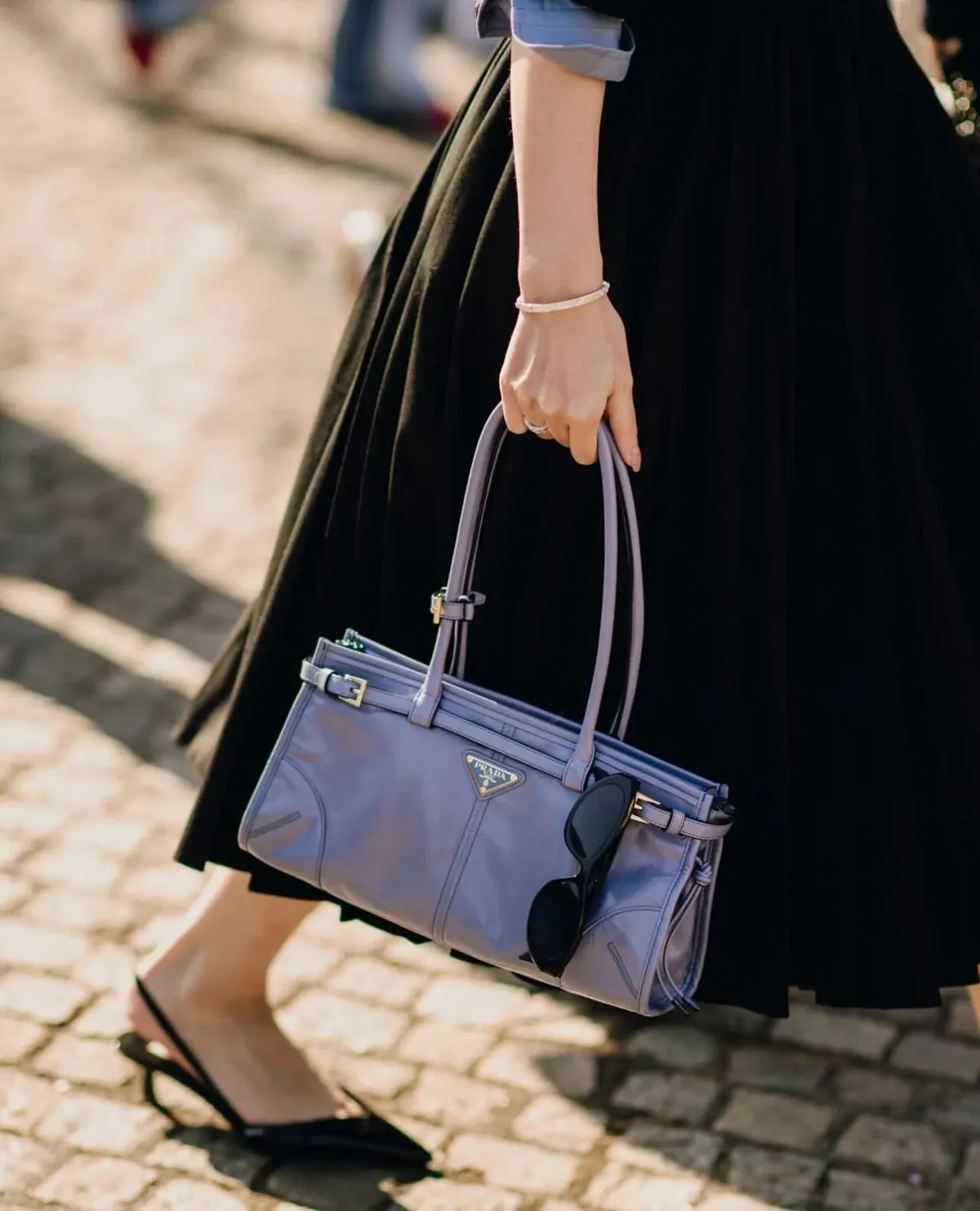
The featured image is an existing Prada wardrobe reference, separate from the Re-Nylon looks discussed here.
The tote is a capacity decision first
Elliot's description of the Shopping Tote is short and useful: few bags are as practical as a shopping tote, and the Re-Nylon version comes in medium and large sizes. That is the whole design brief, and it should drive the choice. The medium is the version I would treat as the everyday option when the tote has to hold more than a phone and a cardholder, because a shopping-tote silhouette carries its volume openly rather than in compartments. The large is a different proposition: it is the size to reach for when the bag is genuinely doing the carrying — a workday with a laptop and a change of shoes, a market run, a day trip where a second bag would be an annoyance. Because the collection's bags are described as all black and functional, the tote reads as quiet and utilitarian rather than decorative, which is exactly what you want from a bag that has a job.
The trade is obvious and worth stating plainly: an open shopping tote occupies a hand or a shoulder and asks you to manage it when you need both arms. If your day involves stairs, a coffee, a phone and a door code at the same time, the tote's capacity becomes a liability you are carrying rather than a benefit.
The belt bag is a free-hands decision
Elliot describes the Belt Bag as one of several belt bag styles in the collection, a roomy piece with one large compartment, and calls it ideal for hands-free style. Two details matter for the decision. "Roomy" and "one large compartment" mean it is not a token belt bag that holds a lipstick; it is built to carry a real set of daily items in a single open space. And "hands-free" is the functional promise — the bag sits at the waist and leaves your arms entirely free.
That makes the belt bag the better answer for errands, festivals, travel days with luggage, and any routine where you are repeatedly reaching, lifting or holding something else. The cost is that a waist-carried bag organises nothing for you: one compartment means everything shares the same space, so small loose items need their own pouch if you want to find them quickly. The belt bag also changes the line of an outfit at the waist, which is a styling consequence rather than a performance claim.
The belt with detachable pouch is the smaller waist option
Elliot also lists a Belt with Pouch, aimed at anyone wanting something slightly smaller to wear around the waist, with a detachable pouch, both pieces in recycled nylon. This is the variant to consider if the roomy belt bag feels like more bag than your routine needs. The detachable pouch is the interesting design decision: it lets the waist piece function as a belt in its own right, with the pouch as the removable carrying element. For a reader who wants a waist-worn solution but usually carries only a few things, this is the more proportionate choice than the one-large-compartment belt bag.
Choosing by routine, not by preference
- If the day's load is the point — work, shopping, travel with extras — take the tote, and choose medium unless the load genuinely demands large.
- If movement is the point — errands, a market, a day out where you are constantly using your hands — take the belt bag.
- If you want waist-worn carry without a full belt-bag volume, the belt with detachable pouch is the middle path.
- If you want one utilitarian anchor in an outfit, either works, but the tote reads as a carried object and the belt bag as a worn one, which changes how the rest of the outfit should be built around it.
That last point is the styling half of the decision. A shopping tote is a large, quiet, black shape at your side, so it pairs naturally with simple, structured clothing that does not compete with it — a plain coat, straight trousers, a knit. The belt bag sits at the waist and becomes part of the outfit's horizontal line, so it is easier to wear with a defined waist or with clothing that is otherwise uncluttered around the middle. These are my readings of how each carry works, not descriptions of the bags' construction.
A conditional check worth doing before committing: try the size you are considering against the items you actually carry on a typical day, and try the waist piece over the layers you would really wear it with. Those checks settle capacity and fit questions that no description can answer for you.