The style notebook
Prada Spring/Summer 2026 Red and Grey Outfits: Suits, Sweaters and Inner Layers
Prada Spring/Summer 2026 red and grey: a flashed red inner versus a red sweater over a dark grey suit, with calm shoe and bag choices for each.
For a dark grey suit, the red should stay a small inner layer if the suit is doing the talking. Prada Spring/Summer 2026 is the reference here, and the styling brief from Vogue Korea, published 7 November 2025 by 하솔휘, treats grey as the civilising force and red as the energy it has to absorb. Two grey formulas are described: a grey tone-on-tone look where a red inner layer shows only slightly and “instantly brings the look to life,” and a dark grey suit with a red sweater worn over it. The first keeps the suit in charge; the second lets the knit become the visible top half. Both are legitimate, and which you want depends on how much red you can look at for a whole day rather than on any rule about the suit's cut.
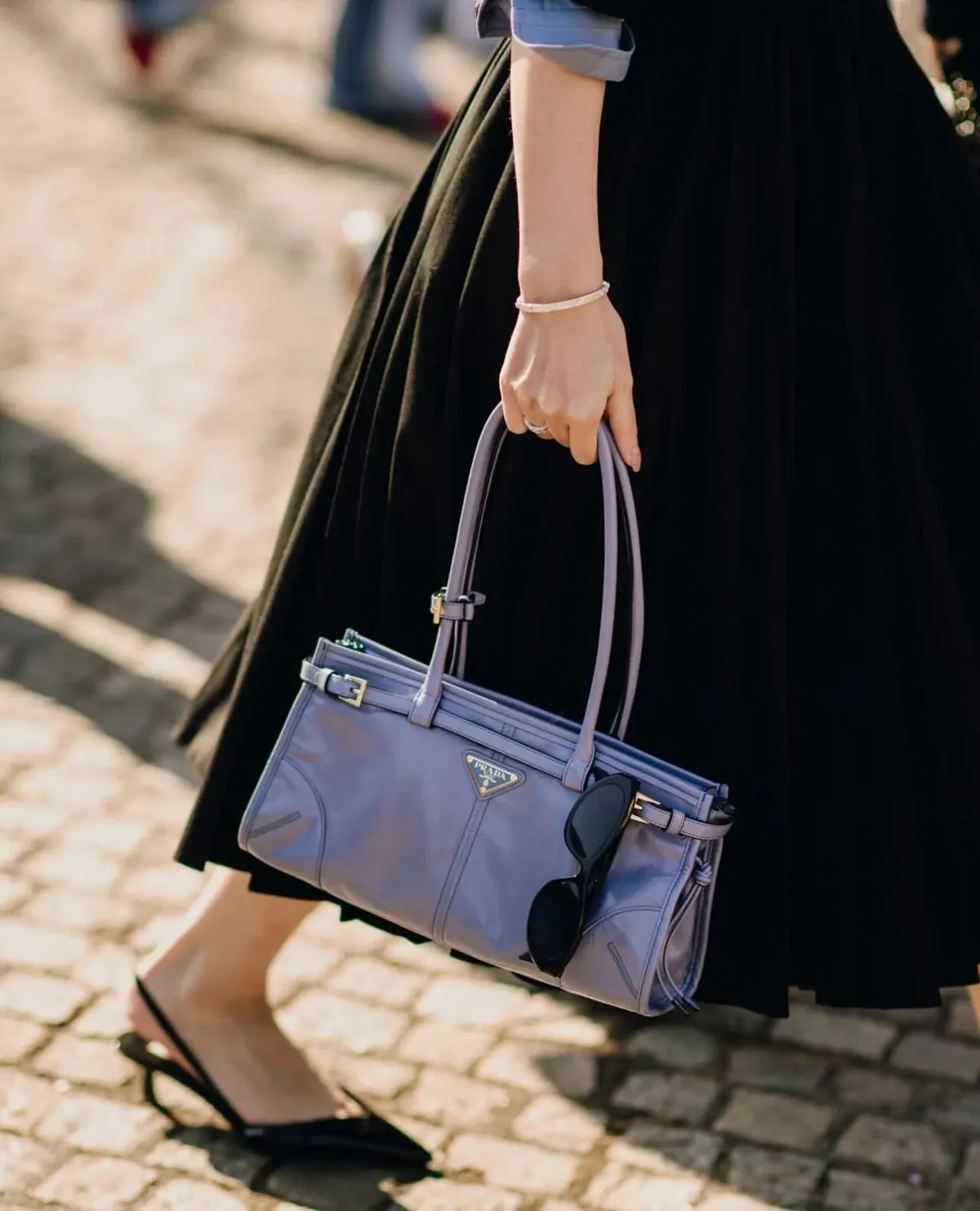
The featured image is an existing Prada wardrobe reference, separate from the Spring/Summer 2026 looks discussed here.
Formula one: the flashed inner layer
The tone-on-tone version works because the red never becomes a block. A thin red knit, a red tee or a red shirt worn under a fully buttoned grey jacket shows only at the neckline and, if you leave the jacket open, in a narrow central strip. The moment the red is a sliver, the eye reads the outfit as a grey suit with one deliberate note rather than as a colour-blocked look.
Keep the inner layer flat and close so it does not bulge under the jacket — that is my styling interpretation, not a described product property. A grey jacket that closes cleanly over the layer is what preserves the quietness the source attributes to grey. If you wear the jacket open, treat the visible red strip as a vertical line down the body; a crew-neck tee gives a wider band at the throat than a fine turtleneck or a collared shirt, so pick the neckline before the shade.
Formula two: the red sweater over the suit
The second formula is bolder than it first sounds, because a sweater worn over tailoring hides the jacket's lapels and buttons and leaves only the trouser, hem and maybe a cuff of the suit showing. That reduces the grey to a base and makes red the top half of the body. It suits someone who wants the sweater to read as the outfit's subject and the suit as its frame — a clean, direct silhouette.
Because the sweater replaces the jacket's surface, choose one with enough body to sit over the jacket without clinging. Fine-gauge knit over a structured shoulder can look lumpy; a slightly denser knit gives a smoother line. This is my reading of proportion, not an observed fit result. If you want the suit still legible, leave the jacket sleeves out at the cuff, or skip the jacket and wear the red sweater with the suit trousers only — a calmer everyday version of the same idea.
What keeps grey in charge
Accessories are where the grey-first decision is either held or lost. A black leather bag in a plain shape and a black leather shoe or boot let the red do the only colour work. The source uses leather as a way to keep black from reading too plain in the red-and-black pairing, and the same logic transfers: leather gives the quiet secondary pieces some surface interest without adding another colour.
- Shoe: a plain black leather shoe, loafer or low boot. Avoid a red shoe, which doubles the accent and turns a restrained formula into a theme.
- Bag: a black leather shoulder or top-handle bag in a simple shape. Hardware in silver or black is quieter than gold against both grey and red.
- Belt: plain black leather, or none. A red belt segments the body and competes with the inner layer.
- Metal: one tone only. Mixing silver and gold jewellery introduces a second decision the outfit does not need.
If you want a reference for restrained accessories with wide-leg tailoring, the guide to a black shoulder bag with wide-leg trousers covers the same instinct from the bag side.
Choosing between them
Take the flashed inner layer when the suit is the point — a meeting, a formal day, or any setting where you want to look composed first and colourful second. Take the red sweater over the suit when the day is more relaxed and you want one strong, simple top half; it reads more casual precisely because the jacket disappears. If you are unsure, the inner layer is the easier step: it can be removed, and the grey stays dominant even when you take the jacket off. The sweater version commits, and that commitment is what makes it the bolder of the two.