The style notebook
Prada Spring 2027 Skirts: Plain T-Shirt Top Outfit Ideas
Prada Spring 2027 skirts set the one-talker rule: keep the top a plain tee or knit, then add one accessory. Formulas for knee, A-line and wrap skirts.
The premise is simple: a Prada Spring 2027 skirt is the piece with a point of view, so the top should behave like a uniform. Miuccia Prada once described a skirt as being “like a T-shirt” — a staple that adapts without reshaping you. Treat that as a dressing rule. If the skirt is doing the talking, ask how quiet the top needs to be. The answer, in almost every case, is quieter than you think: plain knit or plain tee, one texture or one colour, and no second competing flourish. The skirt is not a costume piece to be accessorised into a full look. It is the one thing you notice.
What “plain” actually means
Plain is a decision, not a blandness. A plain top has three jobs: it frames the waistband, it lets the skirt's colour or texture read clearly, and it gives you room to add exactly one accessory if you want it. That means choosing a fine-gauge knit or a clean cotton tee in a flat, even colour, with a neckline that suits the skirt's rise. Avoid a top that already carries a slogan, a strong stripe, a lace edge or a bold button. Those are second talkers. The fastest way to dress a statement skirt well is to make the upper half feel almost forgettable.
- Plain knit: crew, scoop or short sleeve, smooth or lightly textured, tucked or half-tucked.
- Plain tee: clean neckline, no print, sleeve length that ends above or at the waistband.
- One accessory maximum: a bag, a belt or a shoe can carry the accent — not all three.
The plain-top formula for a knee-length skirt
Knee-length skirts are the most forgiving canvas because they leave the shoe and the top to do the proportion work. Prada Spring 2027 showed knee-length and mini skirts, A-line and pleated, in plain and decorated versions. For a plain knee skirt, keep the top short enough to show the waistband and simple enough that the hem line reads. A fitted plain knit tucked in, or a boxy tee half-tucked, both work; choose based on whether you want a cleaner vertical line or a more relaxed one. If the skirt has pleats, let the top sit close at the waist so the pleats fall without interference. If the skirt is a flat A-line, a slightly looser tee can balance the flare.
A-line and pleated: where the top stays close
A-line and pleated skirts add volume below the waist, so the top's job is to keep the upper half calm and close. A fine plain knit tucked fully in is the most reliable choice. A plain tee works if it is cropped or tucked; an untucked long tee will fight the skirt's shape. Avoid puff sleeves, ruffles and heavy knits here — they create a second silhouette above an already shaped one. This is the wardrobe translation of the runway idea: the skirt is the canvas, and the top is the primer. Keep the colour in the same family as the skirt, or use a neutral that does not compete, and add one accessory only if the outfit needs a focal point.
Wrapped and trimmed skirts: the smaller-top rule
Wrapped skirts with decorative fastenings — the embroidered Velcro bands, ribbons, bows and crinoline-trimmed versions shown in the collection — are the most demanding. The decoration sits at the waist or hip, right where a top ends. Here the top should be smaller and simpler: a fine knit that ends just at or above the band, a cropped plain tee, or a plain top tucked in tightly enough not to drape over the detail. Do not add a belt over a decorated waistband; it is a third layer of information. Keep the neckline simple and the sleeve short. Let the skirt's trim be the single accessory.
When the skirt is plain, the plain top still wins
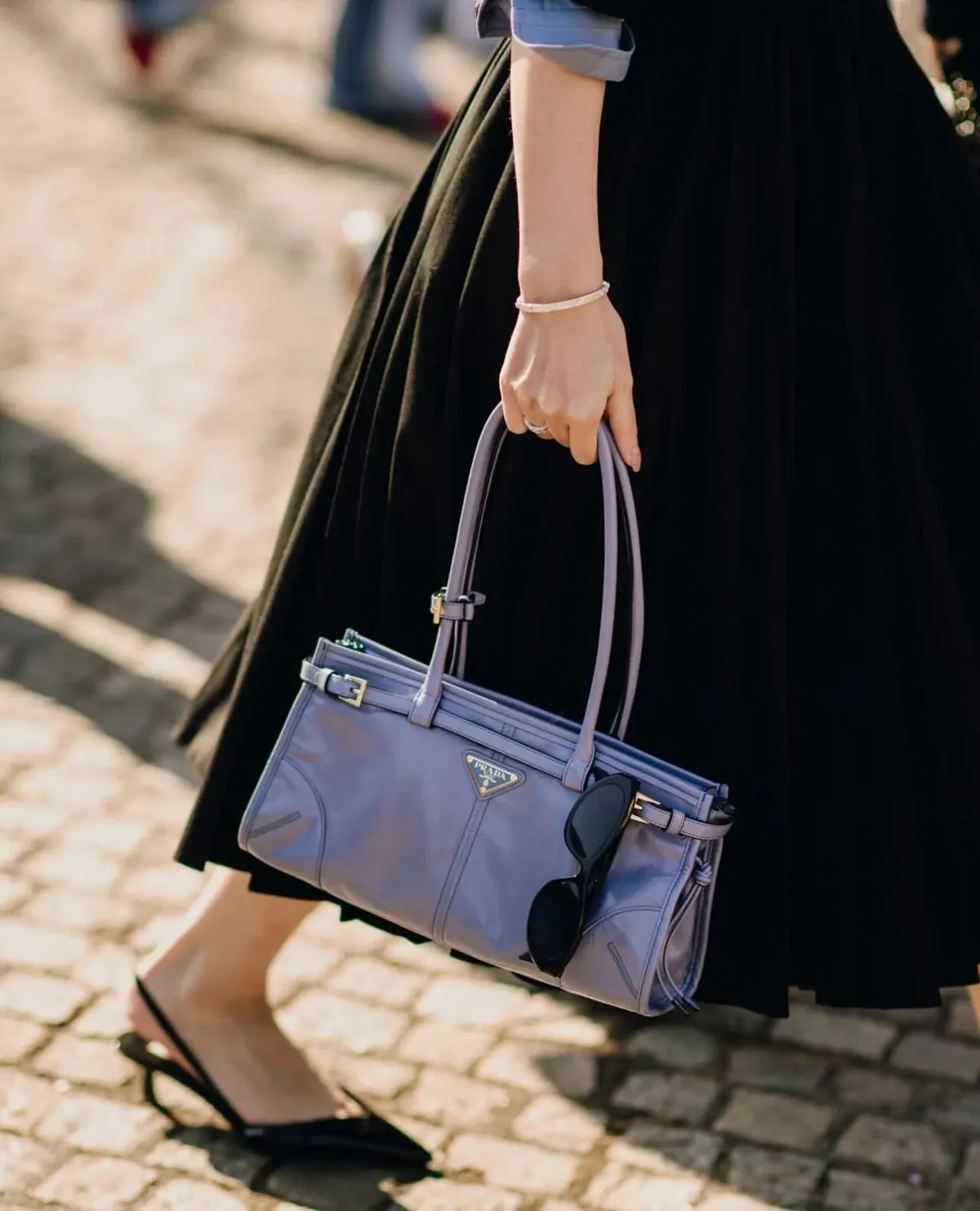
Even a plain skirt benefits from the same discipline. A plain skirt plus a plain top leaves space for one deliberate detail — a shoe in a contrasting colour, a bag with texture, or a single piece of jewellery. The reference image shows an existing Prada Bonnie bag used as a wardrobe reference, and it works in this role precisely because it is a quiet anchor, not a competing statement. If you want the outfit to feel more dressed, change the top's fabric rather than its pattern: a smooth knit instead of cotton, or a slightly finer gauge. Fabric shifts read as intention; prints read as a second focus.
Building the top half of a skirt-led rotation
A practical rotation needs three plain tops and one accent: a fine black knit, a white or cream tee, a neutral knit in a tone close to your skirt, and one accessory that can move between outfits. That is enough to dress knee, A-line, pleated and wrapped skirts without rethinking each morning. If you want to extend the idea to other wardrobe pieces, the skirt-led week rotation shows how the same logic holds across several days, and the skirt-as-T-shirt guide develops the styling principle further. For a different accessory-led approach, the black shoulder bag with wide-leg trousers shows the same one-talker thinking applied to a bag.
A short checklist before you leave the mirror
- Does the top have a print, logo or trim that competes with the skirt? If yes, swap it.
- Does the waistband or wrap detail stay visible? If not, tuck or shorten.
- Is there only one accent in the outfit — bag, belt or shoe? Remove the others.
- Does the top's fabric feel deliberate rather than accidental?
- Would the skirt still be the thing you notice from across the room?
If the answer to the last question is yes, the top is plain enough. The skirt carries the character; the top gives it room.