The style notebook
Saint Laurent Military-Inspired Coats and Shifts: Tailoring Outfit Ideas
Saint Laurent military-inspired coats and shifts: how hem coverage, a single sensual counterpoint and a quiet shoe keep the film-wardrobe look composed.
The composure in Saint Laurent's military-inspired coat-and-shift pairing comes from two decisions, not many: a coat long enough to close over the shift and cover its hem, and one deliberately soft or bare counterpoint that keeps the look from turning into a costume. Vogue's house history describes the wardrobe Yves Saint Laurent created for Catherine Deneuve as Séverine Serizy in Buñuel's 1967 Belle de Jour as "immaculately tailored military-inspired coats and shifts" that, with her controlled facade, mask the character's louche inner life. That is the reported context; the proportion and finish judgements below are my own styling reading of those garments.
The featured image is an existing Saint Laurent wardrobe reference, separate from the military-inspired coats and shifts looks discussed here.
Let the coat close over the shift
The coat is the outermost line, so it sets the silhouette. For a composed result, it should fall below the shift's hem when both are worn together, so the dress appears only as a narrow band or a flash at the opening rather than as a separate layer competing for the same edge. A shift that ends at the knee under a coat that ends mid-calf reads as one intended length; a shift that hangs lower than the coat reads as a mistake in coordination, however neatly each piece is made.
Buttoning the coat and letting it travel is the more elegant move with this pair. The shift provides the clean vertical inside the coat, and a closed military front — double-breasted, with visible buttons and a defined collar — carries the tailoring that makes the look read as uniform-adjacent rather than military fancy dress. Where I would choose differently: a shorter boxy coat worn open can work if you want a car-coat easiness, but it loses the sealed, composed effect and invites the shift to show more of itself.
Define the waist, once
Military tailoring already supplies structure at the shoulder, the collar and the front. Adding a belt over a closed coat re-cuts that structure at the waist and gives the figure a clear middle against a straight shift below. If your coat is already cut close, leave it unbelted; if it is full and straight, a belt writes the waist in. The general principle: choose one place for the eye to stop, either the coat's own cut or a belt, not both working at cross purposes. A shift worn under a belted coat should stay plain through the torso so the belt sits against fabric rather than against a lot of detail.
One sensual counterpoint, and where to put it
Vogue notes that in Saint Laurent's imagination the looks of the period carried a sensuous femininity beneath the controlled surface, so the contrast with a severe coat-and-shift should be a small, deliberate note rather than an overall softening. The easiest counterpoints are a bare leg finished with a low shoe, a glove-free hand and wrist, or an exposed neckline where the shift slips above the coat's collar or shows at an open front. Choose one. A bare leg and a low neckline and a high heel all at once turns restraint into costume.
The shift itself is the right place for this restraint because it is a single clean shape with no waist seam of its own; its smoothness is what makes the coat's tailoring legible. Where I would choose differently: at evening, a slightly deeper neckline on the shift is the more grown-up counterpoint than a shorter hem, since a short hem breaks the long coat line the outfit has been built around.
The shoe finishes the register
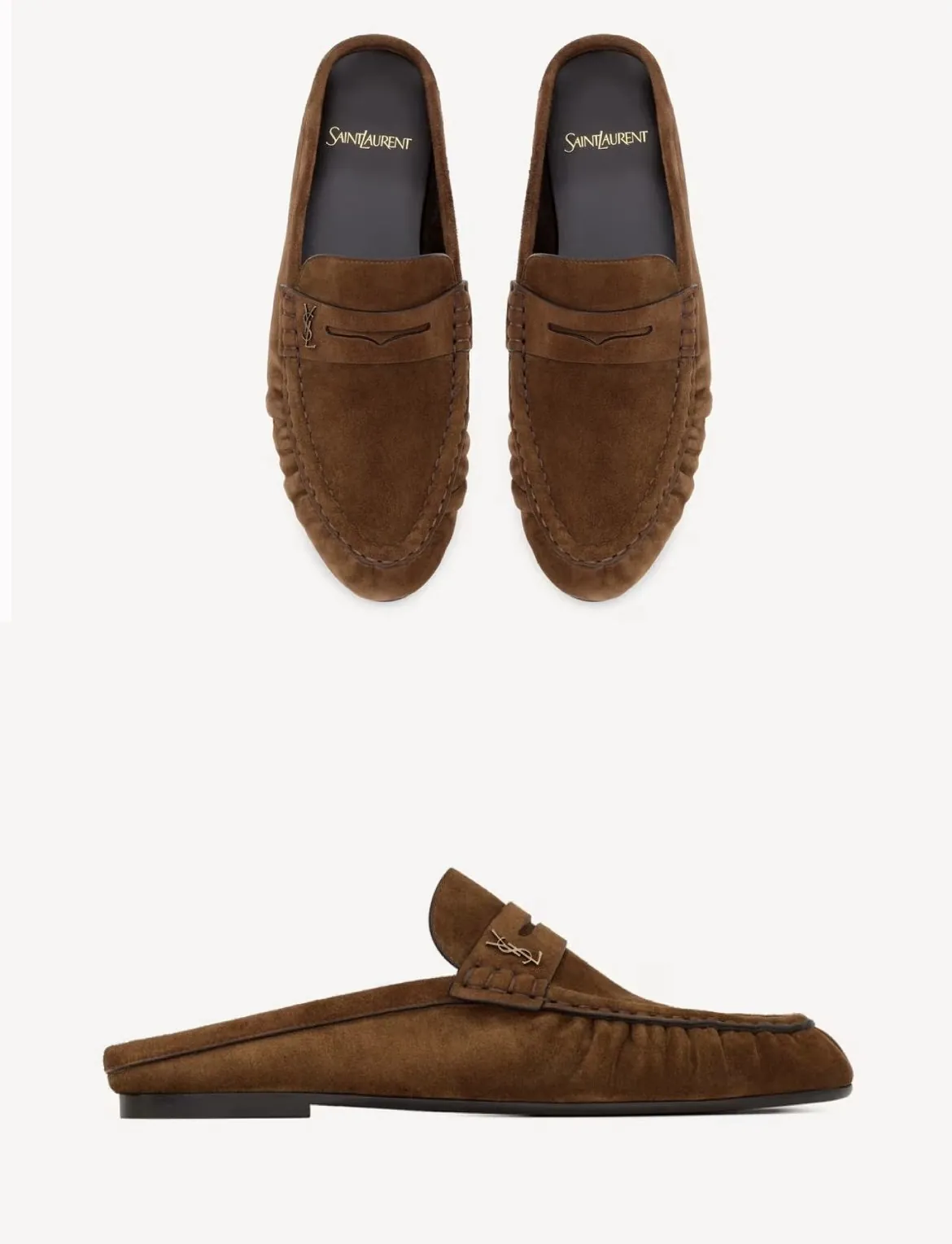
A low, fine shoe — a flat slingback, a slender pump at modest height, or a clean mule — keeps the proportion quiet and lets the coat's length speak. Military buttons plus a heavy-soled boot plus a mid-calf coat tips toward the literal, so a lighter shoe is usually the more elegant resolution. If you want warmth, opaque tights in the coat's own colour maintain the column and keep the shoe's neatness intact. Where I would choose differently: a flat boot under a longer coat looks properly Parisian rather than costume-y, and it is the better option for a wet day.
Checks before you commit to the look
- Close the coat over the shift and check the hem: the shift should sit at or above the coat's edge.
- Look at the finished line in daylight: collar, buttons and shift front all compete if each is detailed, so keep the shift's neckline simple.
- If the coat is belted, let the belt be the only horizontal gesture; skip wide lapel jewellery and scarf knots over the chest.
- Pick one exposed area, and finish with low, neat footwear.
For a more tailored Saint Laurent starting point, see the Le Smoking trouser suit guide; to contrast this controlled mood with a softer, oversized coat, the Burberry quilted coat look shows a different route to length and volume.