The style notebook
Celine Trio Flap Bag: Shoulder and Crossbody Outfit Ideas
A Celine Trio Flap bag styling guide: when the knotted strap works over one shoulder and when it earns the crossbody position.

The Celine Trio Flap is a slim, flat bag with a delicate strap attached at the sides and tied in a small knot. That knot is the whole carry mechanism: the strap is meant to be fully untied and re-tied, which is how you move it between a short shoulder position and a longer crossbody one. Anna McWhirter's PurseBop report, published 13 November 2025, describes the knotted strap and its shoulder-or-crossbody adjustment; the outfit reasoning below is my own reading of that design, not a report from the wearer.
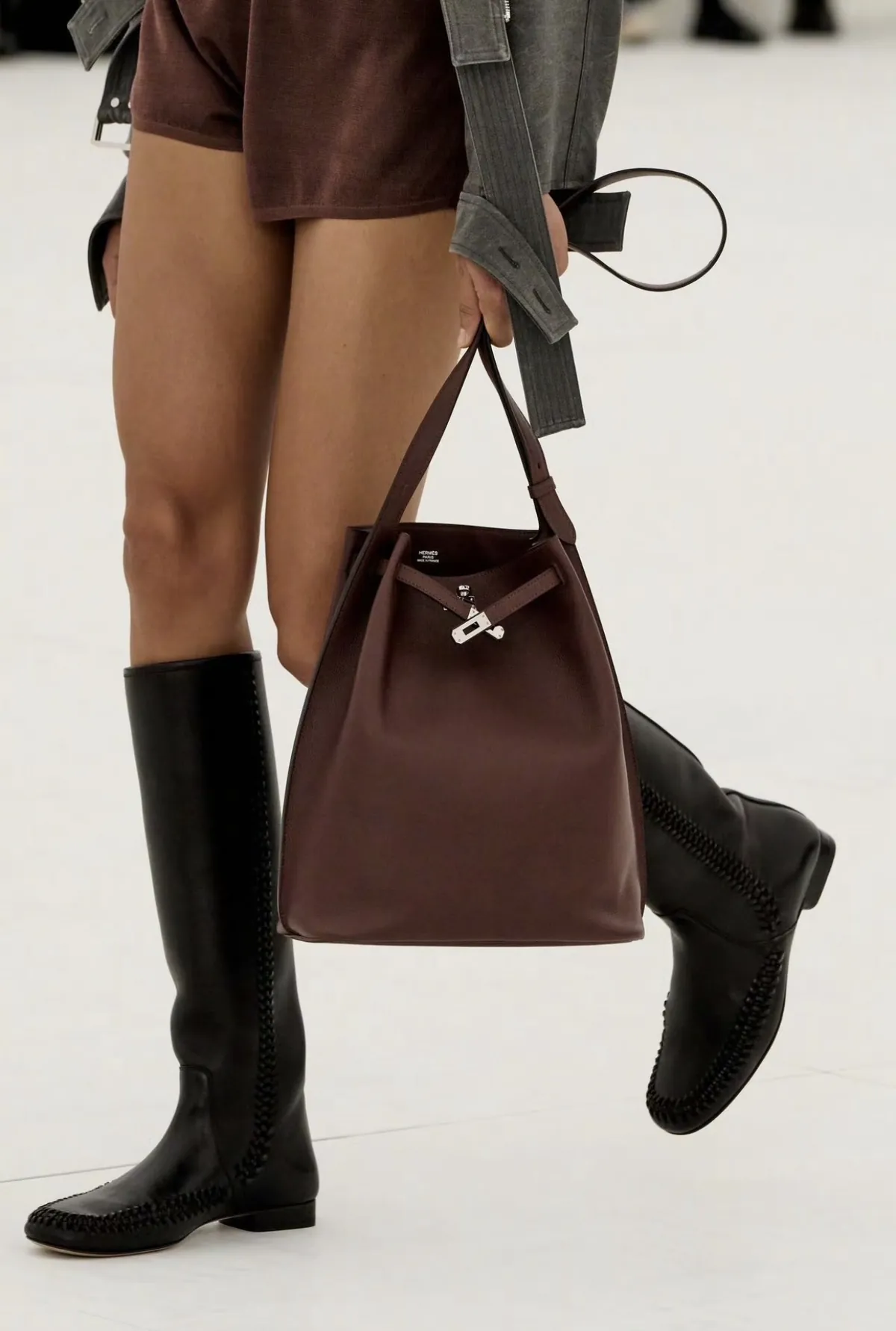
The featured image is an existing Celine wardrobe reference, separate from the Trio Flap looks discussed here.
The dimensions explain why the two positions behave so differently. At 8.9 by 5.1 by 1.4 inches, the bag has height and width but almost no depth. Over the shoulder it lies flat against the ribcage; across the body it lies flat against the hip. Neither position gives the bag volume to push against clothing, so what changes is the strap path and where the rectangle lands.
Over the shoulder: let the strap sit still
The shoulder position is the easier one to wear over a smooth layer. On a fine-gauge knit or a close-fitting long-sleeve top, the short strap path keeps the knotted attachment near the shoulder line and the bag at the side of the torso. That is where the flats of the bag meet the flats of the body, and the slim profile reads as a quiet element rather than a shape that fights the outfit.
With a tailored jacket, the question is whether the strap can sit on the shoulder without sliding. A wool blazer with a clean shoulder seam gives the strap a surface; a padded or strongly built-up shoulder pushes the strap outward and makes a short shoulder carry feel like it is perched. Tie the knot, put the jacket on, and check whether the strap stays where you set it before deciding.
Shoulder carry suits the outfit where the bag should be visible at the side and not cross the front of the body. A straight column of colour — a knit dress, a turtleneck and matching trousers — benefits from a small flat rectangle at the hip line rather than a diagonal strap cutting across it.
Across the body: when the strap earns the longer path
Crossbody is the better of the two positions when outerwear occupies the shoulder area. A long coat with a wide lapel, a cape, or a coat with a large collar leaves little clean shoulder line for a thin strap. That path takes the strap off the contested shoulder and places the bag at the opposite hip, where it lies flat.
That is also the sensible choice when both hands are needed — carrying a cup, holding a rail, managing a folder. Because the bag is thin, the crossbody position adds a line across the torso but not a bulge. On a heavy knit, the strap may sink into the surface and the bag may read as a small detail; on a smooth wool coat, the strap and the bag outline remain legible.
A structured overcoat with a strong shoulder and a straight front gives the crossbody strap a clean diagonal. A belted trench introduces horizontal and vertical lines at the waist, and the thin strap competes with them. If the belt is done up, the strap passes over it; if the coat is open, the bag sits against the inner layer, which is a different look entirely.
Two adjustments that matter more than colour
Because the strap is tied rather than buckled, length is a matter of how much you untie and where you re-tie. A short knot brings the bag high under the arm; a longer length drops it to the upper hip. The report does not give a strap drop, so the honest way to decide is to tie it at one length, put on the coat you wear most, and see where the bag sits. Length that works over a T-shirt may be wrong over a wool coat, because the coat adds thickness at the shoulder and changes the angle of the strap.
Colour is the second lever. The Trio Flap is offered in Black, Soft Tan, Citrus, Safari and Syrah, a deep burgundy, each with a contrasting lining, per the same report. That palette changes which position reads best. A Black bag over a dark coat in the shoulder position almost disappears; in the crossbody position the strap creates a visible line. Soft Tan against a navy or charcoal coat is more legible in either position. Citrus and Safari ask the bag to be an accent, and an accent is usually easier to place at the hip than high under the arm.
Dressing around the folded flap
The Trio Flap closes under a single folded flap secured with a popper, and only the central section has a zip. On the body, that means the front of the bag is a plain rectangle with one vertical fold and one small emblem. Clothing with a busy chest — a large print, a cluster of necklaces, a scarf tied high — pulls attention away from that quiet front. A plain knit, a smooth shirt, or a coat with a simple closure suits the bag better.
The bag's flatness also means it should not be asked to carry the outfit. Where a larger shoulder bag can be the single strong element, the Trio Flap works as a small conclusion: a narrow rectangle at the hip after the coat, the trousers and the shoes have done their work. If you want the bag to lead, the crossbody position on a plain background gives it the clearest line.
For a sense of how Celine's other soft, slouchy shapes compare with this flat construction, the Soft Triomphe wedge guide covers a very different relationship between bag and body. And if the small structured alternative appeals more, the Small Triomphe Frame crossbody guide deals with a boxy bag whose strap drop is specified.
How to decide for your own wardrobe
- Tie the strap at shoulder length first. Put on the coat you wear most and check whether the strap stays on the shoulder without being held.
- Untie and re-tie longer for the crossbody position. Check where the bag lands against your hip and whether the strap crosses a coat belt or a strong seam.
- Try the bag over both a knit and a structured coat. The flat profile behaves differently on each, and the report gives no drop measurement to settle it on paper.
The short answer: shoulder carry suits a close-fitting, smooth top half where the strap has a clean line to sit on; crossbody carry suits outerwear that crowds the shoulder and days when both hands are busy. The knot is the adjustment, so the decision is yours to test rather than a fixed specification.