The style notebook
Hermès Sac Bijou Blue Box Bag Charm: Leather Charm versus Arts & Crafts Bags
The Hermès Sac Bijou bag charm shows how far the blue-lined box widened: read what still marks an Arts & Crafts bag and what a leather charm asks instead.
The Hermès Sac Bijou is the clearest case of the blue-lined box widening past bags. Anna McWhirter's PurseBop article, published 1 August 2026, treats this leather bag charm as the moment the blue-lined box stopped tracking craft-led scarcity: it is not a bag, and it was not a boutique-only offer reserved for a select few. Yet it arrived in the same blue-lined packaging as the diamond-adorned Kelly II Sellier 25. That separation is worth holding onto, and it says nothing about whether the charm is well made or worth owning.
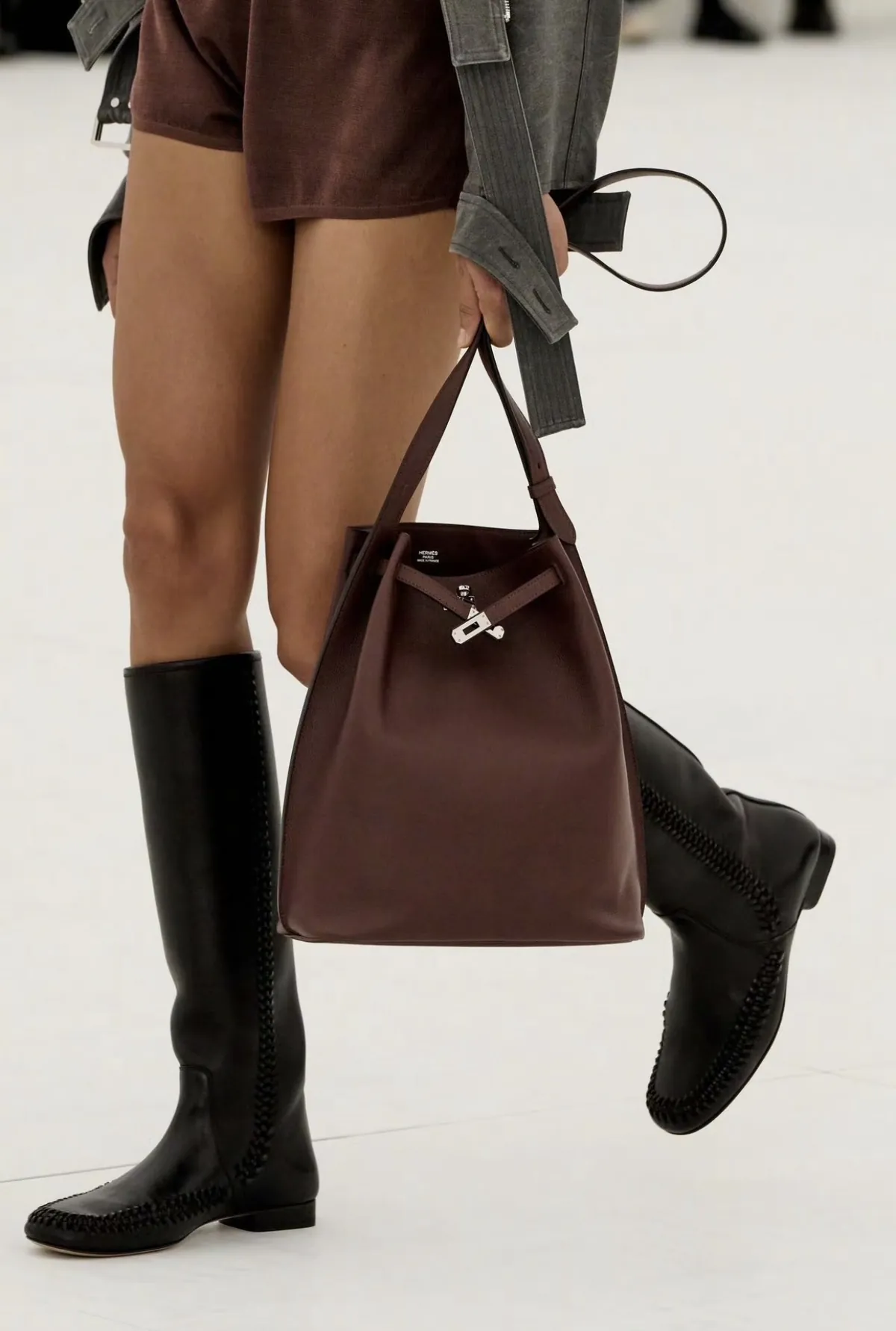
The featured image is an existing Hermès wardrobe reference, separate from the Sac Bijou looks discussed here.
What the Arts & Crafts bags share
McWhirter's list is specific: the Picnic Birkin, Rock Birkin, Kelly Doll (Quelle Idole), Constance Clouté, Birkin 20 Bouclerie Moderne Casaque, the diamond-adorned Kelly II Sellier 25 Journey to the End of the Night, and the Faubourg Birkin. She describes them as going beyond seasonal colour or leather combinations — intricate leatherwork, unexpected materials and artisanal techniques outside the core leather goods line. The bag exists because of how it was built, not because of the shade it was finished in. Wicker and leather, studs, a doll form, a house façade: the construction is the reason the piece is a collector object.
That is a structural test, and it is the one a charm cannot pass in the same way. The Blue Box Arts & Crafts explainer lays out the tier and the named pieces in more detail if you want the full list beside this comparison.
Where a charm's scope stops
A bag charm has a small job: it hangs from a handle, a strap or a clasp and changes how one bag reads. The Sac Bijou does that job in leather, and the blue-lined box frames it as a collectible object. Those are two different kinds of thing. The bag is the canvas; the charm is the accent. Judged as a charm, it competes with the bag underneath it and with the rest of the outfit. Judged as an Arts & Crafts creation, it was never in that category, because its reason for existing is decoration rather than construction.
The scope question, then, is not whether the Sac Bijou is special. It is what you are buying it for. If you want a piece that turns a plain bag into a considered one, the charm answers that. If you want a piece whose craftsmanship is the point, the Arts & Crafts bags are the better target, and the charm will not substitute for one.
Why the blue box widened
McWhirter traces the drift through the Picotins: the Fall-Winter 2025 Go Team edition in Feutre wool and Swift leather, and the Micro Picotin in matte alligator. Both sit alongside the technically ambitious pieces, but in more classic leather constructions — small numbers, a different sort of rarity. The Sac Bijou extends that logic one step further, since it is not a bag at all. Her conclusion is not that the box has lost meaning, but that it may have come to cover too many kinds of object at once.
For a buyer, that reframes the packaging. A blue-lined box tells you Hermès placed this piece in its collector category. It does not tell you the piece was built like a Picnic Birkin. The label and the object are no longer the same claim.
Putting the charm to work
If the Sac Bijou is the purchase, treat it as the one decorative note on the bag. A plain leather tote, an unfussy shoulder bag or a structured top-handle in a single colour gives the charm room; a bag that already carries a scarf, a clochette and busy hardware turns the whole thing into clutter. The guide to balancing oversized charms on plain outfits picks up that side of the decision.
Ask one question before committing: which bag in your wardrobe will it live on, and what is already hanging from that handle? A charm with no clear home tends to stay in its box. That is a straightforward test, and it matters more here than the box it arrives in.