The style notebook
Hermès 24/24 Bag: Back-Hook Strap Comfort and Carry Clothing
The Hermès 24/24 bag secures its strap to two rear hooks. Test shoulder and crossbody comfort, and pick clothing that clears the harness.
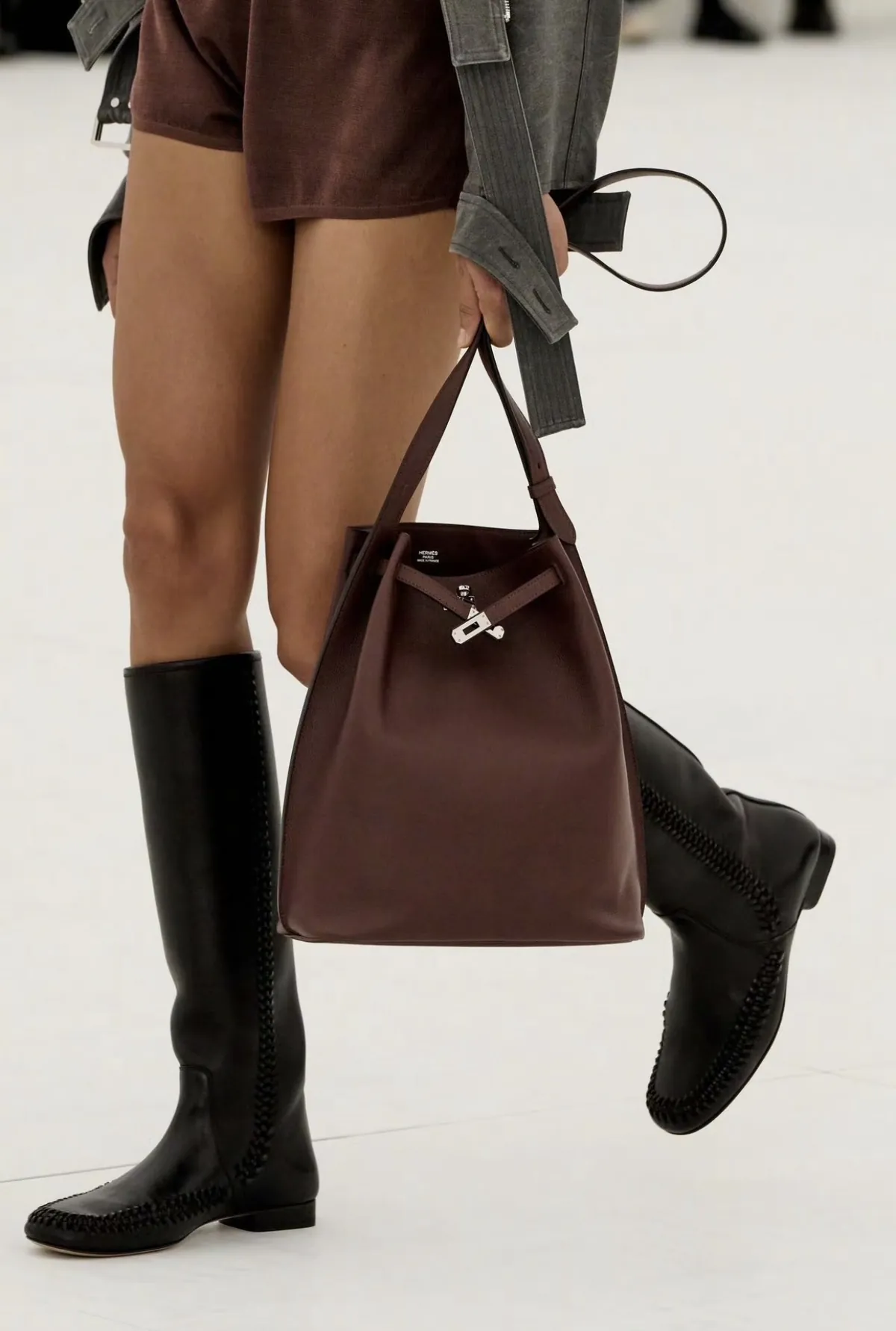
The Hermès 24/24 bag anchors its strap to two hooks at the back of the bag, and that rear placement is the practical crux of the carry. Sudha's PurseBop reference guide, published 9 August 2020, calls the arrangement out explicitly and recommends trying the bag on for comfort before buying. Clothing and layering decisions should follow from that geometry: when the strap pulls from behind, the back of your body and the back of your coat do more of the work. The design facts below are Sudha's; the wardrobe reasoning is my own reading.
The featured image is an existing Hermès wardrobe reference, separate from the 24/24 looks discussed here.
What the rear hooks change, and what they don't
Most shoulder bags attach at the sides or top, so the strap falls forward over the shoulder and the bag hangs in front of the hip or armpit. The 24/24's hooks sit behind the bag body, which means the strap is under less forward tension and the bag tends to sit closer to your side and slightly behind you. In shoulder carry, that can feel more like a bag tucked under the arm than one swinging out in front.
The one confirmed split between sizes is carry mode: Sudha writes that the 29 can be worn crossbody during the day and shifted to a tote-style carry, while the 35 does not come with a crossbody option. Crossbody on the 29 puts the strap diagonally across your back and chest, which is where the rear hooks most visibly change the feel. That diagonal path is worth testing with the outer layer you actually wear.
Crossbody on the 29: what to wear on the diagonal
A crossbody strap under a coat tends to sit against the fabric of the back and shoulder. With the 29, the strap runs from your shoulder across your back toward the hip. Smooth wool, poplin shirting and fine-gauge knits give the strap a clean line to settle on; a chunky cable knit or a coat with a prominent back yoke or storm flap adds ridges the strap has to cross. That is an observation about surface texture, not a claim about friction or durability.
Short jackets on the 29 crossbody are the harder case. A cropped jacket ends near the hip, exactly where a rear-anchored strap wants to travel, so the strap has to negotiate the hem instead of lying over a continuous coat panel. A longer coat or a tunic that clears the hip gives the strap an uninterrupted run on the diagonal.
Shoulder carry on the 35: the back of the outfit matters
The 35 is described by Sudha as the roomier, slouchier option aimed at a working day, with an extra rear pocket for frequently reached essentials. Because the rear hooks pull from behind, the back of your jacket or coat gets the most contact with the strap. A structured wool coat or a tailored blazer with a flat back panel gives a steadier line than a quilted puffer, which compresses and shifts. If the 35 is normally carried on one shoulder, the shoulder seam is the other decision point: raglan and dropped shoulders leave a smooth surface for the strap, while a sharp padded set-in seam creates a shelf the strap must sit above. I would try both over the outerwear I actually wear most.
Clothing that clears the hooks rather than competes with them
- Backs with a clean yoke: a flat shirt or fine knit passes under the strap without adding ridges.
- Outerwear with a plain back panel: a wool coat or blazer is simpler than a jacket with a deep back pleat or storm flap.
- Layers that end below the hip: a longer coat or tunic gives the strap room to run.
- Scarves kept away from the shoulder line: a scarf knotted thickly at the back neck adds bulk where the strap passes.
None of these is a rule; they are the layer choices that make the rear-hook geometry easier to evaluate.
A try-on sequence that answers the comfort question
Sudha's advice to try the bag on for comfort before buying is the one instruction worth following literally. Wear the coat or jacket you carry most, not a light shirt. With the 29, try shoulder carry and crossbody back to back; with the 35, try shoulder and hand carry. Load the bag as you would on a normal day, move around, reach forward, turn your torso, and see where the strap settles. The rear hooks will show whether the bag sits close to your body or drifts.
For size proportions, see the 29 versus 35 carry comparison; for leather behavior in slouchier versus structured shells, the Togo, Clemence and Epsom leather guide is the useful next read.