The style notebook
Hermès Ancrage: Men's Bag Heritage and the Nautical Chaine d'Ancre Detail
The Hermès Ancrage puts the Chaine d'Ancre on a men's bag for the first time. What that nautical buckle means for a men's wardrobe choice.
The Hermès Ancrage bag is the first men's bag to carry the Chaine d'Ancre motif, and that single fact should shape your decision more than any styling rule. Anna McWhirter's PurseBop article, published 29 September 2025, places the bag in the Spring-Summer 2025 men's lineup and sets it against the HAC and the Garden Party Voyage — men's bags she describes as having vast silhouettes and commanding presence. Her Ancrage is minimalist and effortlessly practical, and its Chaine d'Ancre appears as a palladium-plated buckle on an adjustable webbing shoulder strap. The motif had already appeared on women's bags including the In-the-Loop, and on Hermès jewelry, small leather goods and belts. The Ancrage is its first men's bag outing. Those design observations are McWhirter's; the wardrobe reasoning below is mine.
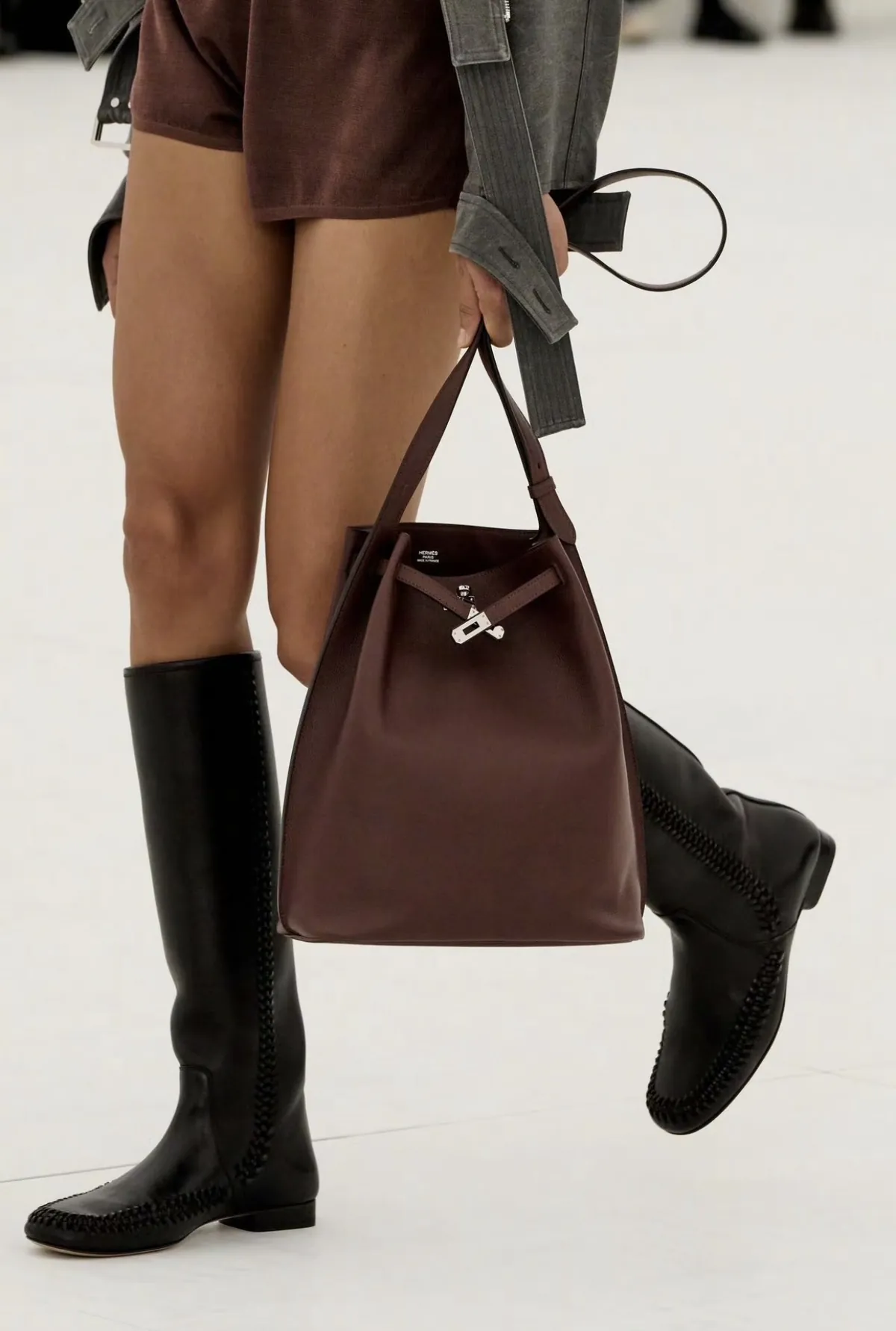
The featured image is an existing Hermès wardrobe reference, separate from the Ancrage looks discussed here.
The hardware has a job, and that changes what it asks of you
A house motif crossing into a new category can arrive as a front-and-centre logo or as working hardware. On the Ancrage it is the second. The Chaine d'Ancre is the strap's buckle, adjusting the webbing, and McWhirter describes it as highlighting the leather while nodding to the bag's nautical inspiration. The name Ancrage, or anchoring, is read as an homage to that motif.
For a men's wardrobe this placement is the argument. The metal sits at your shoulder or across your chest rather than on the face of the bag, so how much is seen depends on how you wear it and how you set the webbing. A bag with a statement front clasp asks the outfit to answer for it every time. The Ancrage asks you, mostly, to leave the strap line alone. If you want hardware that functions as jewellery on the front of a bag, this is not that bag; if you want a working buckle with a story, it carries one quietly.
Nautical is a register, not a costume
The anchoring idea is easy to overplay. A Breton stripe, a sailing jacket and rope-sole shoes around the chain buckle turn the bag into a prop. McWhirter's language — minimalist, pared-back, clean lines, a subtly elongated profile and slightly curved bottom — points the other way. The webbing strap already supplies a casual, technical note against the Togo calfskin, so the clothing can be plainer than you might expect: oxford shirting, a fine-gauge knit, wool trousers, a plain mac, a chore jacket.
My reading is that you let the buckle be the only nautical signal. A navy cotton overshirt with pale trousers on a weekend near water gives the bag the context it was designed for without literal sailing gear. In the city, nothing about it requires maritime clothing at all. McWhirter reports the bag in noir, which keeps it neutral against almost any base. Nautical here means the anchor-chain reference, not a dress code.
Restraint is what separates the Ancrage from the HAC and Garden Party Voyage
McWhirter sets the Ancrage against those two bags, whose vast silhouettes and commanding presence she describes. The useful distinction is posture, not quality. A commanding bag asks the outfit to hold its own against volume. The Ancrage's clean lines and slightly curved bottom ask for a quieter base. If your wardrobe is built around generous tailoring — wide trousers, oversized coats — the HAC language may suit you better. If you want a bag that settles into an already busy outfit, the Ancrage's restraint is the reason to pick it.
McWhirter also compares the silhouette with an oversized Evelyne. That resemblance is familiar as a casual shoulder bag; the Ancrage takes it in a longer, flatter direction with an open top closed by a leather tab. If you are weighing hand-held options, the HAC, Kelly and Birkin hand-carry guide covers that end of the range. The direct shoulder-carry gift choice is handled in the men's shoulder carry comparison.
Dress the strap and the open top
The buckle lives on the strap, so the clothing nearest the strap decides how the hardware reads. A heavy collar, a thick scarf or a shoulder seam landing under the webbing crowds it. Set-in sleeves and a clean coat shoulder let the strap sit without competition. The open top, closed by a leather tab, suits a relaxed look: an open shirt, a knit without a scarf, an unbuttoned jacket. It reads as a clean finish rather than a secure seal, so I would treat the Ancrage as a smart-casual and travel bag first.
For the buckle specifically, the Chaine d'Ancre restraint guide and the minimalist shoulder and crossbody guide go further. Leather choice is a separate question, covered in the Togo, Clemence and Epsom guide.
Try it on over your own coat
McWhirter gives external dimensions of 11 x 15 x 3 inches, an interior back pocket, a slim profile, and notes the bag can be worn over the shoulder or across the body. Those outside measurements alone leave the personal fit question open. Try the bag over the coat you wear most, set the webbing where you like it, and look at where the buckle lands. That tells you more about whether the Ancrage suits your carry than any styling rule.