The style notebook
Hermès Barenia and Box Calf Bags: Patina, Scratches and Everyday Carry Choices
Hermès Barenia and Box Calf compared for a daily hand-carried bag: how each handles water, scratches and patina, and which carry habits it rewards.
For a bag carried daily by hand, Hermès Barenia is the more workable of the two, but only if you can accept a leather that marks and then softens those marks into a record of use. Box Calf is the more exacting option: Anna McWhirter's PurseBop leather guide, published 28 February 2025, describes its smooth surface as scratching very easily and notes that owners may find themselves babying it. Her Barenia section describes a leather built to take the day and let the evidence fade. Both are smooth heritage calfskins, and that is where the resemblance largely ends.
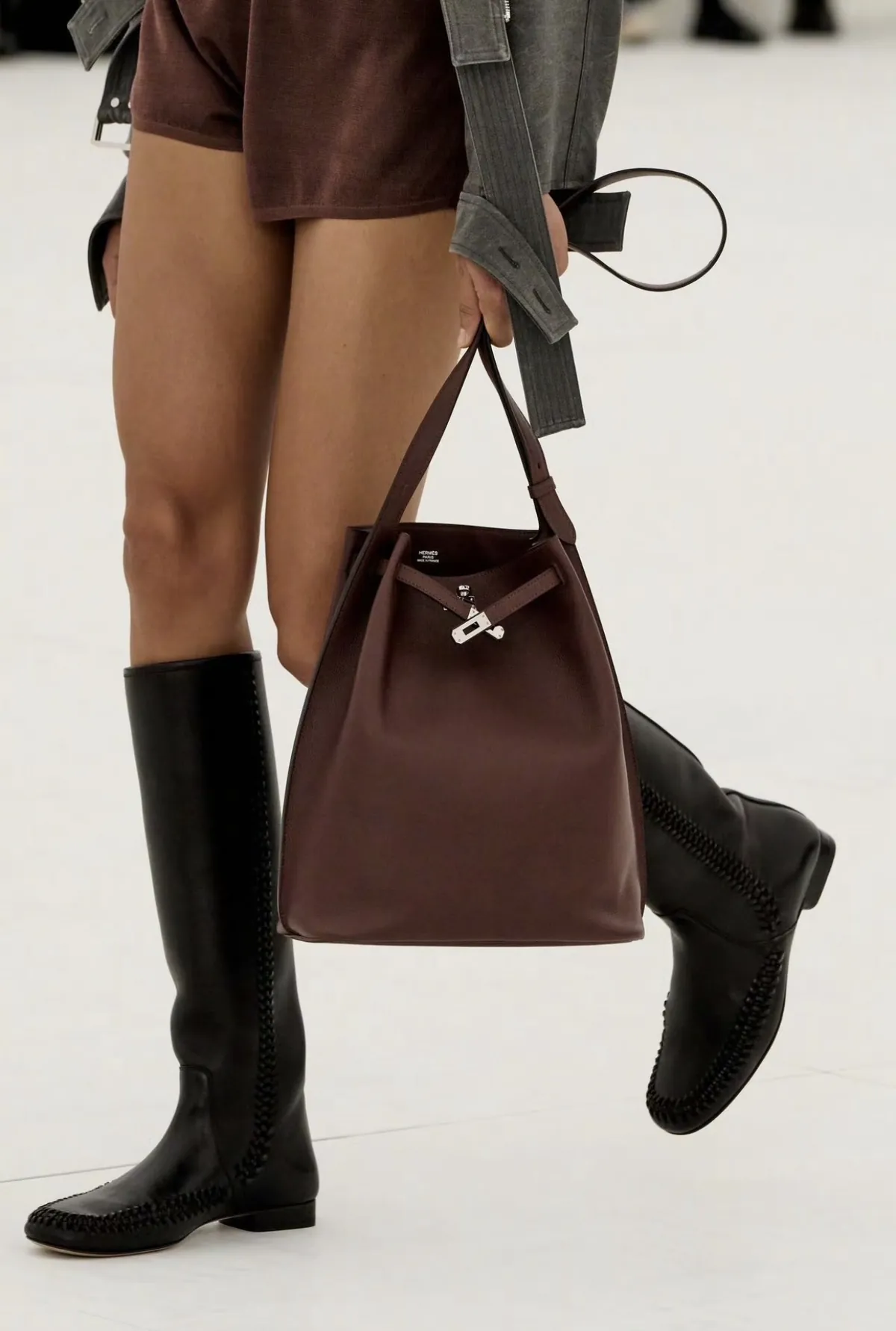
The featured image is an existing Hermès wardrobe reference, separate from the Barenia looks discussed here.
The leather descriptions below come from McWhirter's guide. The carry judgements are my reading of those descriptions, not a claim about how any particular bag will perform.
What each leather does under daily hand carry
Barenia began in saddle making, and Hermès brought it into handbags in the 1970s; McWhirter calls it a Heritage leather, made through a time-consuming process of double tanning with chrome and vegetable dyes followed by a five-week oil soak. She describes it as smooth, durable and water resistant. Her care guidance sets out the behaviour that matters most: rain leaves noticeable water droplets, but the marks disappear as the leather dries. Light scratches can be buffed, and deeper ones will blend into the leather over time. It develops a rich patina, which the guide treats as part of the leather working as intended.
Box Calf is Hermès' oldest leather, in production since the 1890s and named after the 19th-century English shoemaker Joseph Box. It has a smooth, semi-glossy finish with a fine grain, and a rigid, "boardy" feel that McWhirter ties to structured bags such as the Kelly Sellier. Her care section is the reason to pause before choosing it for a daily bag: the smooth surface scratches very easily, wet conditions should be avoided to prevent blistering, light scratches can be buffed with a clean dry cloth, and deeper ones may need professional attention. It too develops a patina over time, which she encourages you to embrace.
The deciding difference is not which leather is better. It is what kind of evidence you are willing to carry. Box Calf records each contact as a crisp mark against its sheen. Barenia records contact too, but its surface is described as absorbing and redistributing it.
Hand-carry habits Barenia rewards
A bag held in the hand passes through more surfaces than a shoulder bag: door frames, table edges, the crook of an arm, the back of a chair. If that is your routine, Barenia's buffing and blending behaviour matches it. A few working habits follow from the source:
- Let a caught shower dry naturally rather than rubbing hard; McWhirter says the droplets vanish as the leather dries.
- Keep loose cosmetics, perfume and pens out of the bag, or inside a pouch. Her Barenia section warns that spills can leave permanent stains — the one Barenia weakness that does not fade.
- Use a handbag hook rather than the floor, her general maintenance advice, since rough surfaces are the main source of marks.
- Expect the patina, and treat an even deepening of tone as the leather doing what it is meant to do.
Under hand carry, the exposed areas of a top-handle bag are the face and the base. Barenia's smooth finish makes those areas look softer with handling, while Box Calf's gloss makes every new mark more legible.
Where Box Calf still earns its place
Box Calf suits the bag that is carried for a defined purpose rather than all day: a structured Kelly Sellier taken to a meeting, a piece that lives in its dust bag between occasions, or a wardrobe where the bag is the polished note in a plain outfit. The semi-gloss finish and fine grain are the reason. Paired with matte tailoring — a wool suit, a crisp shirt, a flat-finished coat — the leather reads as deliberate and formal. If your days involve a desk, a car and a short walk, its scratch sensitivity is manageable. If your days involve public transport, weather and juggling, Barenia is the more forgiving partner.
The shapes each leather is described with matter here too. Box Calf's stiffness is tied to Sellier construction, which keeps a sharp architectural outline; that outline is best served by clothing with equally clean lines. Barenia's heritage is saddlery, so it sits more naturally with the softer end of a wardrobe — a plain knit, an unstructured coat, a flat leather shoe.
Storage and the quietest form of care
The general storage advice in McWhirter's guide applies to both smooth leathers: keep the bag in a cool, dry place away from direct sunlight and moisture, stuff it with tissue to hold shape without overstuffing, and skip anti-humidity sachets, which can dry the leather over time. For a daily bag, rotation is the quietest form of care — giving each bag a rest spreads wear across the collection rather than concentrating it on one piece.
If you are weighing other smooth-leather Hermès options, our Togo, Clemence and Epsom comparison covers the grained alternatives. For the clothing side of a hand-carried structured bag, our HAC 40 hand-carry guide covers outfit choices, and the Retourne versus Sellier guide explains how construction changes the silhouette.
The decision, reduced
Choose Barenia for daily hand carry if you want a leather that absorbs the day and improves visually as it does, and you can keep spills away from it. Choose Box Calf if the bag is occasion-led, the outfit is tailored and matte, and you are content to handle it carefully and buff light marks promptly. If neither quite fits, a grained leather such as Togo or Epsom is the pragmatic third answer for a bag that genuinely goes everywhere.