The style notebook
Hermès Birkin 20, 25 or 30: Which Bag Fits Your Day?
Hermès Birkin 20 for a cardholder-and-phone day, Birkin 25 for wallet errands, Birkin 30 when a planner comes too: a carry guide to choosing by your load.
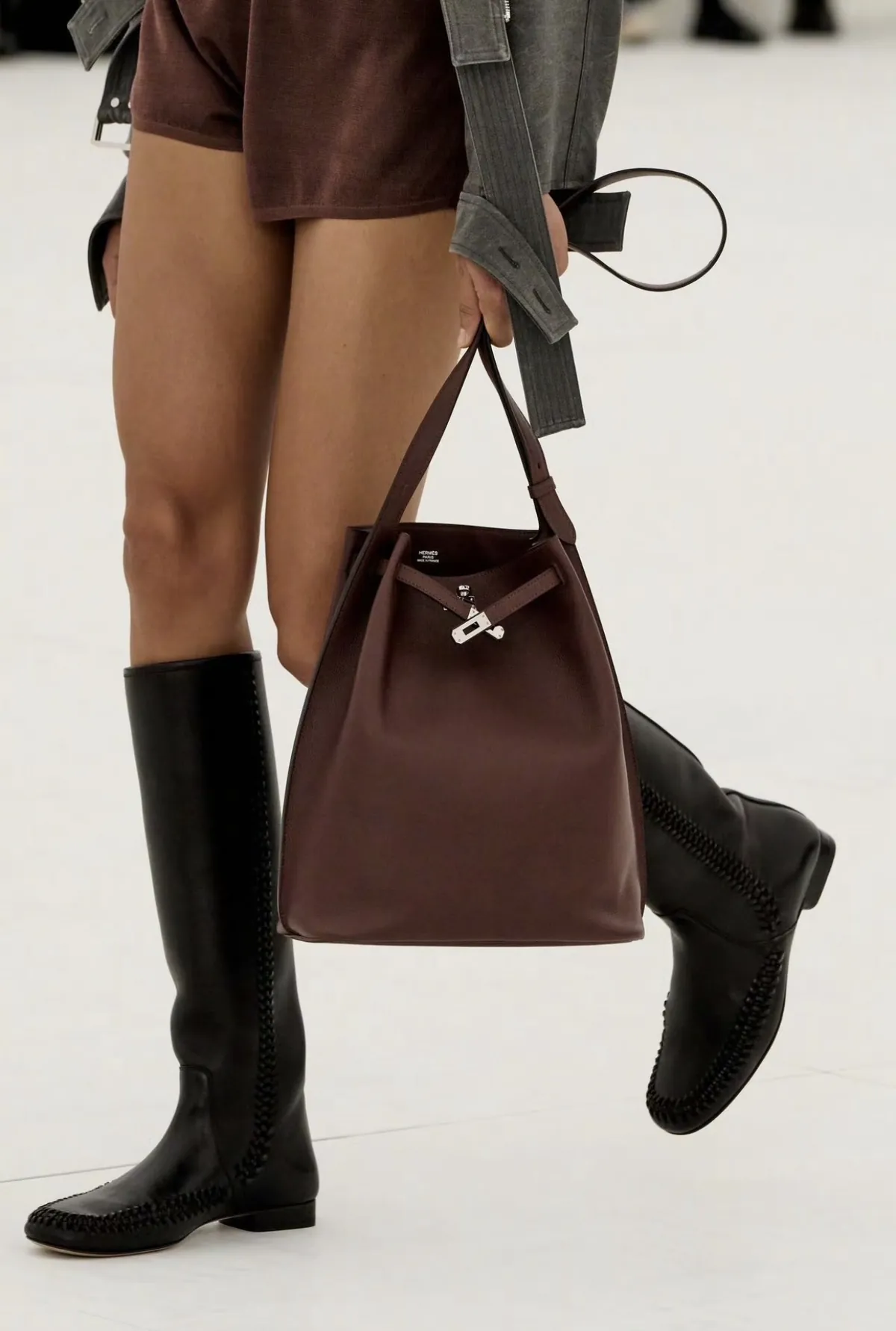
The Hermès Birkin 20 matches a cardholder-and-phone day; the Birkin 25 suits regular errands carrying a proper wallet; the Birkin 30 is the one to consider on days when a planner comes with you. That is the short answer, and it follows the three rows PurseBop published in its size table. The longer answer is that those rows describe three different loads, not three versions of one load, so the bag choice begins with naming what you actually pull out of your pockets on an ordinary morning.
The featured image is an existing Hermès wardrobe reference, separate from the Birkin 20 looks discussed here.
What the three size-table rows establish
PurseBop lists the Birkin 20 at 7.9 x 5.9 x 3.9 inches (20 x 15 x 10 cm), described as a “petite powerhouse for evenings or minimalist days” carrying a cardholder, phone, keys and “a touch of lipstick.” The Birkin 25 is given as 9.8 x 7.8 x 5 inches (25 x 20 x 13 cm), a “compact day-to-night bag” for a wallet, phone, keys and small accessories. The Birkin 30 measures 11.8 x 9.4 x 6.3 inches (30 x 24 x 16 cm) and is called a “versatile companion,” holding a small iPad or laptop, wallet, phone, planner, sunglasses and a makeup bag.
Those are the reported facts. What follows is my reading of how to use them, and the physical checks are things to try with your own belongings rather than claims about how any size will perform.
Cardholder versus wallet is the real dividing line
The 20 and the 25 differ by a couple of inches in each direction, which sounds modest on paper. The more telling difference is the word PurseBop chooses for each: the 20 takes a cardholder, the 25 takes a wallet. A cardholder is a flat stack of cards; a wallet is a folded, thicker object that uses depth. The 20's 3.9-inch depth is the tightest of the three, and its list stays deliberately thin — cards, phone, keys, lipstick. If your routine includes a long wallet, a coin section and folded notes, you are describing the 25's list, not the 20's.
So the choice is less about phone size than about your small-leather-goods habit. Carry cards loose or in a slim holder and the Birkin 20 is coherent with your day. Carry a full wallet and the Birkin 25 becomes the honest answer, because it is the row that names the wallet first.
When the Birkin 20 is the right bag and when it is a second bag
PurseBop frames the 20 around evenings and minimalist days, which is a useful frame. A dinner, a short appointment, a walk where phone and keys are the whole errand: these are days when a small bag is the correct tool rather than a compromise. At roughly 7.9 inches wide it reads as a small, dense object in the hand rather than a scaled-down tote, so it sits well against a narrow, clean line where a larger bag would drag the silhouette down.
I would choose differently on any day with a paper notebook, a water bottle or sunglasses in a hard case. None of those appear in the 20's list, and the source keeps it to a cardholder, phone, keys and lipstick. If your “minimalist day” still includes a sunglasses case, treat the Birkin 20 as a second bag rather than the day's only one.
The Birkin 30 earns its size when the planner travels with you
The 30's row is the only one that mentions a planner, and it also names a small iPad or laptop, sunglasses and a makeup bag. That is a genuinely different day. If your work involves a paper planner, a tablet or a change of accessories across the afternoon, the 30 is the size the source associates with that load. At 11.8 inches wide it is also the row where the bag begins to read as a carried object with presence, so it suits a coat, a tailored jacket or a wider trouser line more readily than a narrow shift dress.
If your planner is digital and lives on your phone, the 30's main advantage disappears and the 25 covers the same errands with less bag. I would not size up to the 30 for the occasional notebook; I would size up when the planner, sunglasses and makeup bag travel together often enough that repacking each morning becomes a chore.
Between the 25 and the 30, the outfit test is scale. Hold the 25 against a short jacket and the 30 against the same jacket in a mirror; the smaller bag keeps the line crisp, while the 30 adds a horizontal note at the hip. Neither is wrong — the question is whether you want the bag to sit quietly inside the outfit or to anchor it. That is an editorial reading of proportion, not a claim about how the bags wear.
Testing each size against your own things
PurseBop's dimensions are enough to build a simple check. Lay your cardholder or wallet, phone, keys and any extras on a table and compare the footprint with the listed width and depth of each size. Then, with the bag in hand, place the same items inside and close it the way you would on a normal day. That tells you whether your particular phone and wallet leave room for keys and lipstick, which no table can answer for you.
Do the same with clothing. A Birkin 20 held against a long coat shows whether the small scale reads as deliberate or lost; a Birkin 30 with a slim, short jacket shows whether the width overwhelms the line. Try both on in a mirror rather than deciding from the numbers, since the result depends on your proportions and the clothes you actually wear.
The decision comes down to which list matches your ordinary day: the cardholder day, the wallet day or the planner day. Pick the row that describes most of your week rather than the one that covers a rare occasion. If two rows describe you equally, the smaller bag is usually the better everyday companion, with the larger one reserved for the days its list genuinely appears.