The style notebook
Hermès Birkin versus Kelly Bags: Outfit Ideas for Two Hand-Carry Codes
Hermès Birkin versus Kelly: how the softer Birkin register and the Kelly's clearer tailoring change what you wear and how you hand-carry each bag.
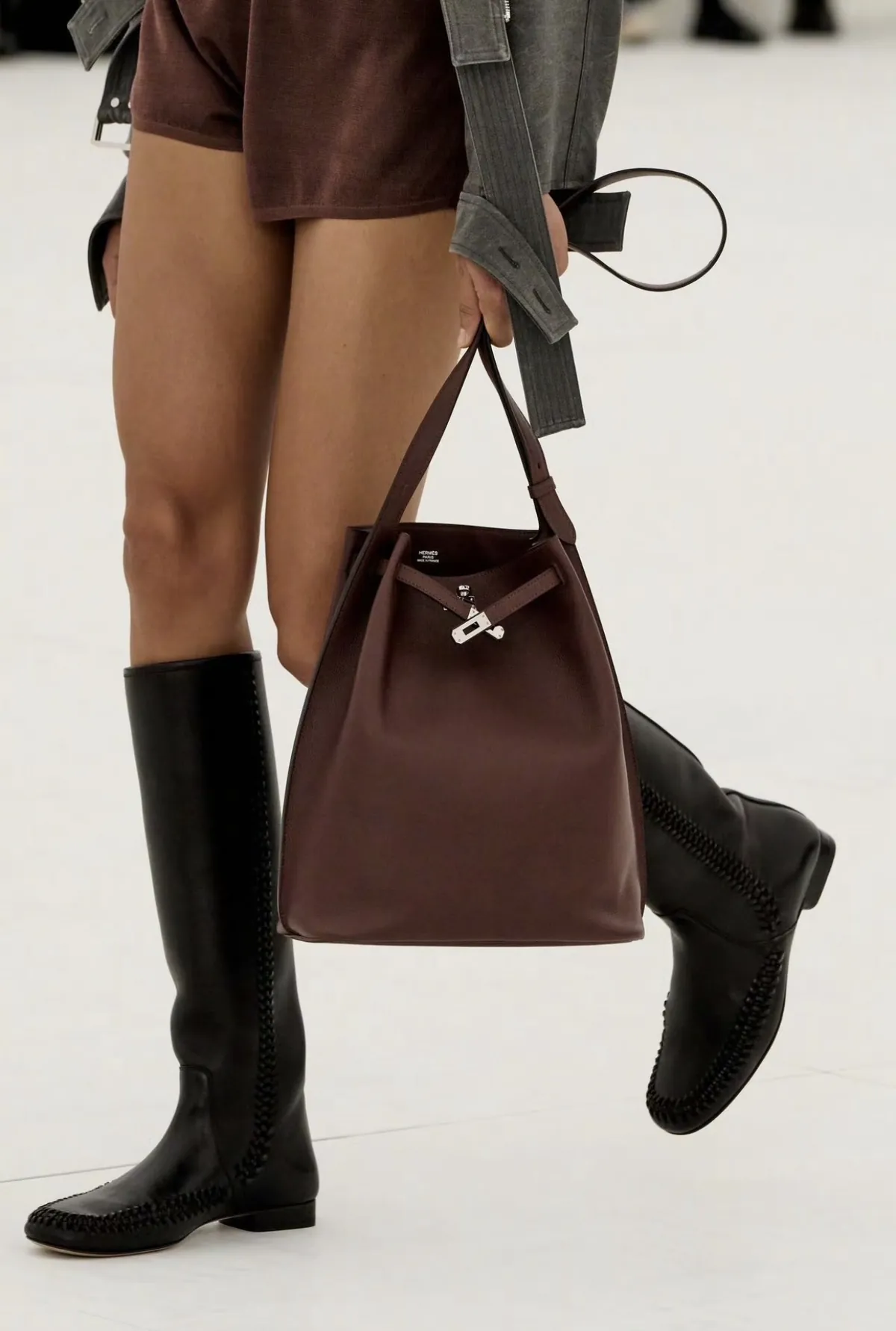
The Hermès Birkin and Kelly are the same decision only on paper. Both are top-handle bags, and both are held in the hand rather than slung across the body, but they ask for different clothes underneath. Treat the Birkin as the softer, more everyday register and the Kelly as the cleaner tailored one, and the wardrobe question answers itself: which of your outfits wants a relaxed handbag and which wants a crisp one. Olivia Elliot's PurseBop report, published 29 March 2021, ranks the Birkin first and the Kelly second in an OnBuy study of hashtagged posts. That places them side by side as the two most photographed Hermès shapes; it says nothing about which you should carry with a suit. The split below is a styling reading of two carry codes, not a claim about the bags' construction.
The featured image is an existing Hermès wardrobe reference, separate from the Birkin looks discussed here.
Softening the Birkin's register
The Birkin sits best when the clothing has some give. That does not mean shapeless — it means cloth that moves with the body rather than drawing a hard line around it. A relaxed wool trouser with a soft break, a knit with a little weight, a shirt worn open over a tee, a long coat that hangs from the shoulder without a sharp shoulder pad. The bag reads as part of a lived-in outfit rather than a trophy placed on top of tailoring.
Texture is the tool that keeps the soft register from turning sloppy. One generous texture at a time: a chunky rib knit, a brushed wool, a suede jacket, a linen shirt with visible weave. The Birkin's own leather already supplies a smooth, rounded surface, so the clothes around it can afford to be rougher, and the contrast keeps the outfit from looking flat. Two heavy textures together — a cable knit under a shearling — start to compete with the bag.
Colour can stay close and quiet here. Tonal dressing in cream, camel or grey lets the bag carry the outfit, which suits a bag that photographs well in plain surroundings. A soft register also tolerates a lower shoe: a flat, a loafer, a soft ankle boot. Keep the silhouette relaxed from shoulder to hem rather than tight on top and loose below, which makes the hand-carry look accidental.
Building the Kelly's cleaner tailoring
The Kelly wants a line. Tailored trousers with a crease, a jacket with a defined shoulder, a shirt tucked with a clean waistband, a coat cut straight and close. Where the Birkin outfit can afford a rumpled sleeve, the Kelly outfit is better with a finished cuff. The bag's upright shape reads as purposeful next to clothes that are also purposeful, and the two reinforce each other.
This is also where a sharper shoe earns its place: a pointed flat, a slingback, a structured ankle boot. Not because the shoe is more formal, but because a clean line at the hem matches the clean line at the hand. A soft, slouchy shoe under a sharp trouser pulls the outfit back toward the Birkin register, and the Kelly then looks slightly overdressed for its own clothes.
Pattern is possible here in a way it is not with the softer look. A fine check, a pinstripe, a small geometric print all hold their edge beside an upright bag, because tailoring keeps the pattern from sprawling. Keep the palette narrow and let one pattern do the work; two competing prints reduce the bag to furniture.
Where the two registers cross over
Some outfits sit between the two codes, and that is useful rather than confusing. A navy blazer over a soft knit and a relaxed trouser can take either bag, because the jacket supplies the line and the knit supplies the give. A plain white shirt and dark trousers is the same: polished enough for the Kelly, plain enough not to fight the Birkin.
The choice then comes down to the occasion inside the outfit. A lunch, a weekend errand, a day with people who dress loosely — the softer cut of the Birkin's register fits. A meeting, a presentation, a day built around a jacket — the Kelly's cleaner tailoring does the job. If you own one bag, decide which register you dress for most often, then adjust the outfit at the edges rather than rebuilding the whole wardrobe.
Hand-carry and the rest of the look
Both bags are held at the hand, so the hand and forearm stay visible and the sleeve matters. A sleeve that ends at the wrist leaves a clean line between cuff and handle; a very full sleeve bunches against the bag and makes the carry awkward. A watch or a single cuff detail gives the hand something to do in photographs of either bag. The other arm is free, so a coat carried over it, or a folded scarf, keeps the outfit from looking stiff.
For the Birkin, a slightly longer coat or an open jacket over a simple base is enough. For the Kelly, keep the outer layer closed or cleanly open, with the collar sitting flat. Both benefit from a plain base layer, because the bag is the accessory. If you want more guidance on how the two carry codes differ from a third, older Hermès shape, the HAC, Kelly and Birkin hand-carry guide sets the three side by side. And if your question is really about leather rather than clothing, Togo, Clemence and Epsom for Birkin and Kelly covers that decision separately.
When you are between the two, hold each bag against the clothes you are actually wearing and look at the line from shoulder to hem. If the outfit is soft, the Birkin's register wins. If the outfit is sharp, the Kelly's does. Neither bag needs a different wardrobe; it needs the right half of the one you own.