The style notebook
Hermès HAC, Kelly and Birkin Bags: Hand-Carry Outfit Ideas from Three Origins
Hermès HAC, Kelly and Birkin hand-carry outfit ideas: how the saddle-carrier, structured handbag and softer everyday shape each change the clothing beside them.
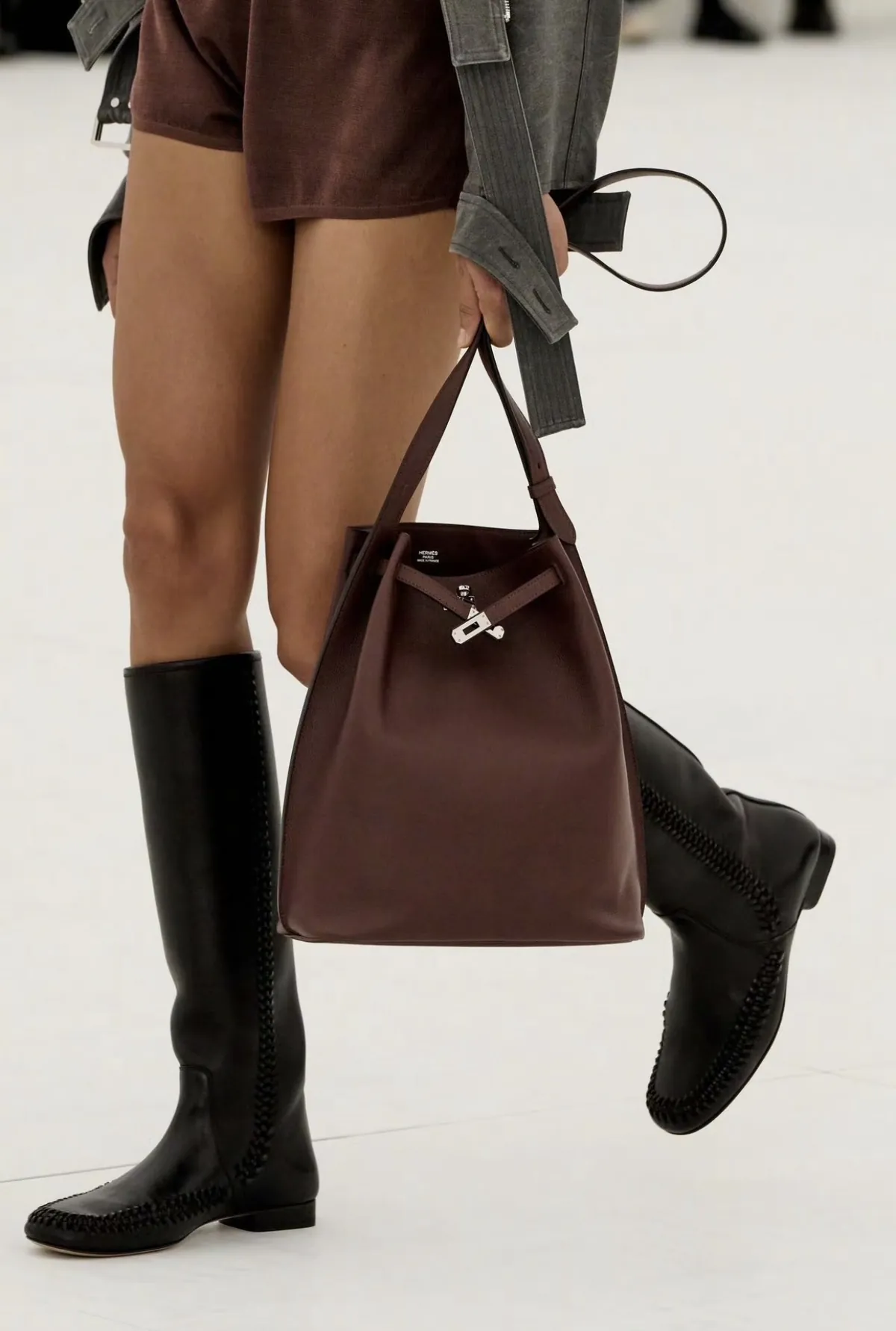
For an Hermès HAC, the clothing should serve a bag built around carrying equipment rather than finishing a look; for the Kelly, the structured handbag role tightens the outfit around tailoring; and for the Birkin, the HAC-derived shape relaxes that same formality. The three bags share a hand-carry gesture, but the historical brief behind each one sets a different clothing register. Anna McWhirter's PurseBop guide, published 28 February 2025, gives the lineage facts: Hermès unveiled the Haut à Courroies (HAC) in 1892, originally designed to carry saddles and riding equipment; the Kelly followed in 1953 as the Maison's first true luxury handbag; and the original HAC inspired the Birkin in 1984. That is context for the work each shape does beside clothing — not a claim about size, price or what is currently offered.
The featured image is an existing Hermès wardrobe reference, separate from the HAC looks discussed here.
HAC: dress for a bag that was made to carry tack
The HAC began as an equestrian carrier, and that origin shows up usefully in styling as a demand for clothes that look as though they can handle a task. That calls for utilitarian and sporting cloth: a crisp cotton shirt, a wool or cotton drill trouser with a clean line, a flat boot or a substantial loafer, a simple canvas or waxed overshirt as the outer layer. The bag sits beside workmanlike fabrics rather than delicate ones, and the clothing should not look fussier than the thing it accompanies.
Where I would choose differently: reserve the HAC for days with a purpose — travel, appointments, errands that involve real carrying of papers or kit. An outfit built only for decoration fights the bag's premise. If the day is purely social and delicate, the Kelly is the easier partner.
Kelly: the first true luxury handbag asks for clearer tailoring
McWhirter calls the 1953 Kelly Hermès' first true luxury handbag, and that framing is the styling clue. A bag positioned as a luxury handbag pairs best with clothing that has a finished, deliberate line: a structured jacket with a defined shoulder, a straight skirt or a pressed trouser, a narrow shoe, a shirt with a proper collar. The outfit reads as assembled rather than thrown together, and the bag becomes the finishing element rather than the working one.
A belted coat over a slim knit, or a straight-leg trouser with a fine-gauge roll-neck, gives the Kelly a calm field to sit against. Busy prints compete with the hardware and flap, so I would keep pattern to one small accessory or none.
This is also where the leather section of McWhirter's guide matters for texture, not for claims about the bag's construction. She describes Box Calf as Hermès' oldest leather, dating to the 1890s, with a rigid, boardy feel suited to structured bags, and Epsom as an embossed, crosshatched calfskin whose rigid structure keeps its shape. For a Kelly in a crisp Sellier-style frame, those smooth or pressed surfaces pair naturally with matte wool and cotton; a slouchier leather reads better with softer clothing. For more on how the leathers split, see the Togo, Clemence and Epsom comparison.
Birkin: the HAC-derived shape wants a softer everyday register
The Birkin came from the original HAC in 1984, so it inherits the utilitarian scale but was conceived as a handbag. That double identity is why it works with clothing that is relaxed but still put together: a fine knit and wide-leg trouser, a shirt-dress with a flat sandal, a soft blazer over a plain tee. The bag can carry more visual weight than the Kelly, so the clothing can loosen without becoming sloppy.
My rule is to keep the fabric honest — cotton, wool, linen, denim — and let the shape of the clothes be the only statement. A roomy trouser or a generous coat balances the Birkin's presence; a very tight, very short silhouette can make the bag look borrowed. If you are deciding between constructions rather than outfits, the Retourne versus Sellier guide explains how much structure the bag itself brings.
Choosing between the three by the day, not the hierarchy
- HAC: practical, task-led days. Utilitarian cloth, flat shoes, minimal jewellery.
- Kelly: tailored, finished days. Defined shoulder, pressed line, one clean accessory.
- Birkin: everyday days that still want polish. Soft natural fabrics, relaxed but balanced proportions.
The hand-carry habit itself is common to all three: the bag occupies one hand and part of the forearm, so sleeves and cuffs should stay clear. A narrow cuff or a pushed-up sleeve keeps the wrist free; a heavy bracelet on the carrying arm is friction rather than decoration. A coat carried over that same arm competes with the bag, so I would wear the outer layer rather than drape it there.
If you want to test a look before committing, try the bag against the coat and sleeve you would actually wear that day, and check that the clothing line stays visible around it. That is a practical check, not a claim about how any bag will perform. For a closer look at the hand-carry version of the largest shape, see the HAC 40 hand-carry guide.
The narrowed answer
Let the origin decide the clothing register: the HAC pairs with workmanlike cloth, the Kelly with finished tailoring, and the Birkin with relaxed natural fabrics that still look composed. The shared hand-carry gesture then dictates the details — clear cuffs, nothing competing on the carrying arm, and an outer layer worn rather than draped.