The style notebook
Hermès Cab’H Tote Men’s Work Outfit Ideas: Strap Carry with the ‘H’ Pockets
Hermès Cab’H Tote work outfits: shoulder and crossbody clothing lines that keep the stitched ‘H’ front pockets clear and the slip-pocket back against the body.
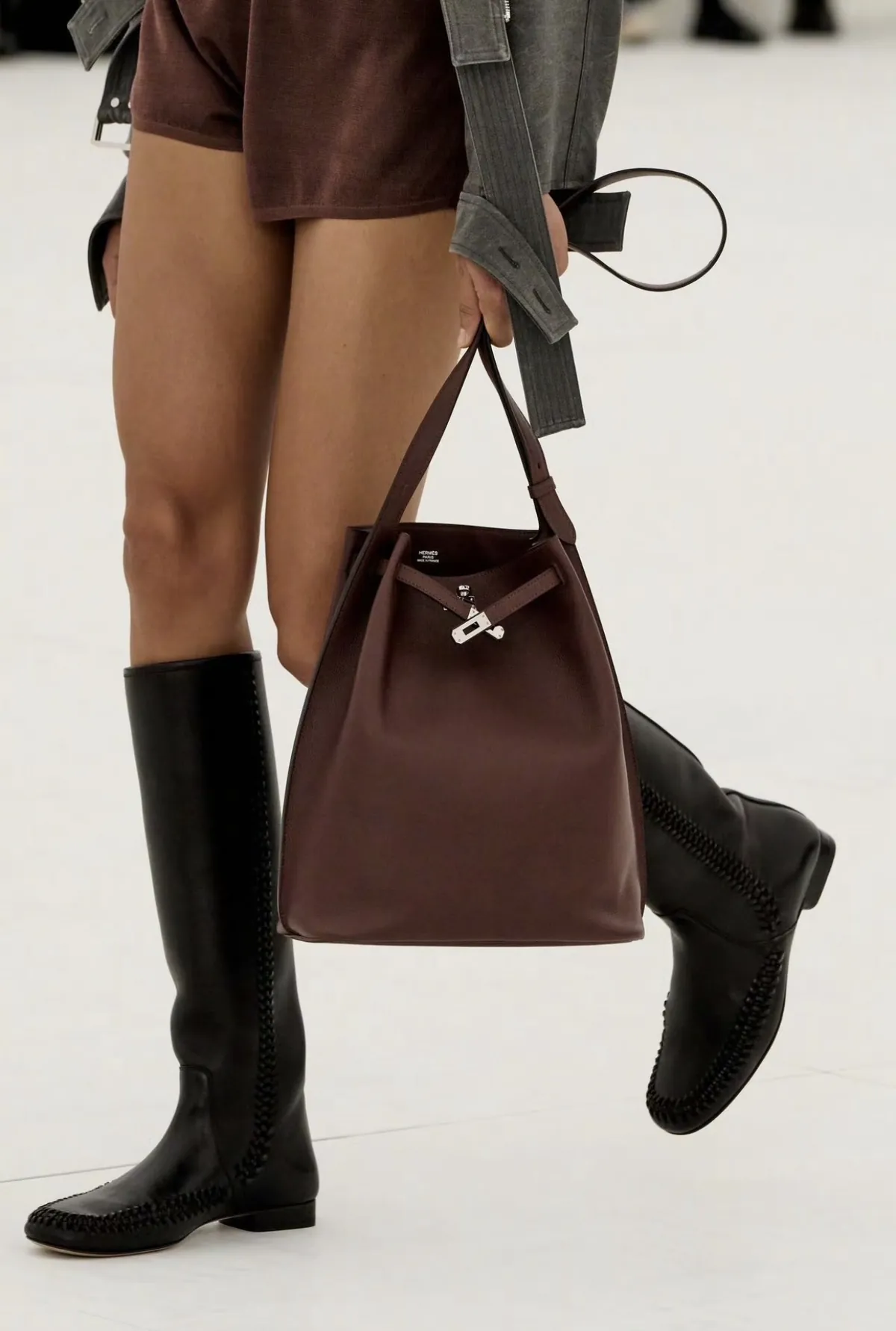
The Hermès Cab’H Tote gives you one firm rule for a workday wardrobe: keep the stitched front legible. PurseBop’s Anna McWhirter, writing on 21 June 2026, describes a clean rectangular tote whose two front pockets form an ‘H’ motif through precise stitching. The reverse side drops the logo effect for a single large slip pocket, and palladium Clou de Selle snap closures finish the piece. That split is the whole basis for the clothing advice below: the stitched ‘H’ faces outward and needs a calm field around it.
The featured image is an existing Hermès wardrobe reference, separate from the Cab’H Tote looks discussed here.
McWhirter gives the proportions as 11 x 13.3 x 3.9 inches and describes an adjustable shoulder strap secured with an Étrivière buckle that allows shoulder or crossbody wear. Everything that follows about hems, seams, diagonals and trouser lines is styling interpretation built around those described features, not a claim about how the bag performs in use.
Shoulder carry: set the jacket hem against the bag’s top edge
On the shoulder, the strap crosses the shoulder line, so that seam decides how clean the top of the outfit reads. A set-in shoulder seam gives the strap a defined path. A dropped shoulder or heavy padding puts bulk exactly where the strap sits and makes the top half look busier than the bag.
Jacket length matters more than most men allow for. A hip-length bomber or blazer ends close to the bag’s upper edge, so hem and bag compete on the same horizontal line and the stitched ‘H’ pockets lose their background. I would choose a jacket that ends clearly above the bag, around the waist, or clearly below it, at mid-thigh or longer. Either choice leaves the front pockets sitting against an uninterrupted run of trouser rather than behind a hem.
Sleeves are the quieter variable. A sleeve ending at the wrist keeps the forearm free; a bulky turn-up or a pushed-up cuff near the strap crowds the same zone. Where I would choose differently: a cropped blouson over a tucked shirt works if the strap is set so the bag sits below the jacket hem. That is a positioning question to settle with the actual strap, not something the source decides.
Crossbody: one diagonal, and a trouser front that stays plain
Across the body, the strap runs from one shoulder to the opposite hip and the bag lands around the waist or lower. The diagonal is what the stitched ‘H’ has to survive. A wide peak lapel, a second bag strap, a scarf knotted at the chest or a shirt with a strong diagonal print all set up a competing line before the eye reaches the front pockets.
Plain knitwear, a fine-gauge crew neck, a tieless shirt or a smooth overshirt keeps that diagonal singular. If you wear a tie, keep it narrow and vertical so the strap reads as the only diagonal in the outfit. Below the waist, a straight or gently tapered trouser with a flat front gives the bag a still background. Heavy pleats, hip-level cargo pockets or a bold check put movement right where the front pockets sit.
A hem that breaks cleanly on the shoe without a wide flare keeps the silhouette from widening at bag height. The wide-leg trouser and loafer hem check is a useful reference if you prefer a fuller leg.
The back slip pocket is the side against your clothes
Because the single large slip pocket is on the reverse, the body-side requirement is simply a smooth surface: a tucked shirt, a flat-front trouser and a coat that does not bunch at the waist let the back sit flush. The stitched ‘H’ then stays the outward face of the bag wherever the strap puts it.
My working formula is one graphic element per outfit. Plain navy, charcoal, stone or black tailoring, at most one visible texture, and no second logo or large print near the bag’s front. That is editorial judgment rather than a product claim.
- Shoulder route: set-in shoulder seam, jacket ending above the waist or below mid-thigh, sleeve at the wrist.
- Crossbody route: plain chest, one diagonal only, flat-front trouser, clean shoe break.
- Either route: smooth back against the body, stitched ‘H’ front left uncovered.
Before fixing a strap setting, put the actual bag over the jacket and knitwear you plan to wear and look at where the front pockets fall against your clothing lines. Treat that as a fitting step rather than a promise about how it will sit.