The style notebook
Hermès Cargo Birkin 35 Indigo Denim: Outfit Ideas with Black Swift Accents
How to frame the Hermès Cargo Birkin 35 in indigo denim with Black Swift accents: separate the bag's blue from your own denim and set a neutral base.
For the Hermès Cargo Birkin 35 in indigo Japanese-style denim with Black Swift leather accents, the clothing question is less about matching blue than about making one blue read as the bag. Any indigo you wear near the body competes with the denim bag for the same signal, so the cleanest outfit gives the bag the only deep-blue surface in the frame and builds the rest of the look from white, cream, camel, grey and black. The Cargo Birkin is a hand-carried bag, and that gives you control: the front of the body is the bag's stage, not its camouflage.
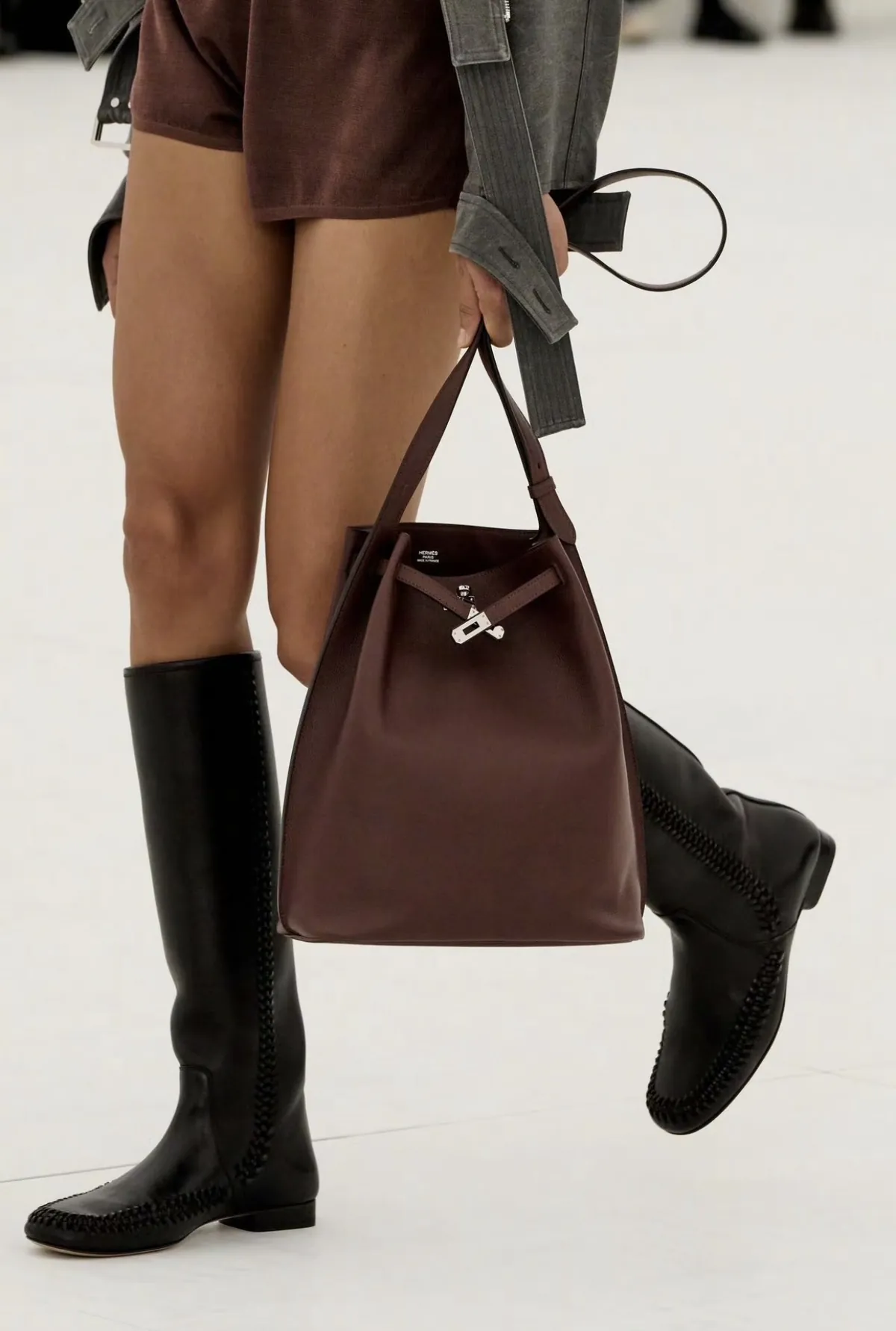
The featured image is an existing Hermès wardrobe reference, separate from the Cargo Birkin looks discussed here.
Anna McWhirter's PurseBop report, published 29 September 2024, describes the Cargo Birkin as shown in the 35 cm size at the Hermès Objects Presentation, reimagined in "on-trend indigo Japanese-style denim" rather than the regular toile-and-leather fabrication, with sleek Black Swift leather accents. Those are the verified design points. The styling judgments below are my own reading of them.
Why the bag's denim wants to stand alone
Indigo denim reads as casual, workwear-adjacent, worn-in. When the bag itself supplies that read, a second pair of jeans in the same frame flattens the distinction between the object and the outfit. The eye stops seeing a denim Birkin and starts seeing a denim total.
The Black Swift accents add a second element to manage. Swift is a smooth, fine-grained leather, and as a trim against indigo it works like an outline: it sharpens the bag's edges and hardware zones. In styling terms, that means black in the outfit can echo the trim usefully, but black placed at the same visual weight as the bag can make the whole look read as one dark mass with a blue patch inside it.
Separating the indigo from your own denim
The direct answer to the pairing question: avoid jeans, denim jackets and chambray shirts in the same outfit as this bag. That is not a rule about denim's formality; it is about giving the bag a unique surface.
- Trousers instead of jeans. Cream or ecru wide-leg wool trousers, stone cotton chinos, charcoal tailored trousers, or a pale grey flannel keep the leg neutral and let the bag's blue sit alone at hip level. Black trousers work if the top half is light, so the look doesn't collapse into darkness.
- A dress as a single neutral field. A plain white poplin shirt-dress, a camel shift, or a grey wool midi gives the hand-carried bag a clean backdrop with no competing seam lines at the hip.
- If you want a blue note, shift the hue. A pale blue oxford shirt is a different value and a different fabric from indigo denim, so it reads as a separate idea rather than a repeat. Keep it light and crisp rather than washed and textured.
Where I would choose differently: if the outfit is deliberately denim-on-denim as a statement, a jacket in a much lighter wash than the bag, worn open, creates contrast through value rather than hue. That is a harder look to control, and it needs the bag to be the darkest element in the frame.
Framing Black Swift against the clothing palette
The bag's black leather reads as a graphic edge, so treat black in the outfit as an accent rather than a base. A black belt, black loafers, or a black fine-knit under a cream blazer lets the Black Swift trim feel connected to the rest of the look without swallowing it.
For the clothing itself, favour smooth, matte surfaces: fine wool, cotton poplin, silk-cotton, clean knitwear. Textured tweed, heavy cable knits, or raw-edge fraying around the hand and hip repeat the denim's texture in a way that muddies both. The bag's cargo construction and denim make their own textural argument; the clothing only needs to stay quiet enough for that to register.
Sleeves matter for a hand-carried bag. A set-in sleeve that ends above the wrist, or a knit pushed to the forearm, keeps the top handles and the front face of the bag clear when your hand is on them. A wide, floppy cuff falling over the handles turns the bag's details into fabric.
Trying it against your own wardrobe
The 35 cm size is a large hand-carried bag, and how it sits against a coat or a jacket depends on your own frame and the outerwear you actually wear. Before committing to a look, try the bag over the coat you reach for most and check that the handles are comfortable in your hand at that point. If you carry a laptop or a folder, test whether it fits and whether the bag closes over it; the source describes the size and fabrication, not the interior capacity.
If you want more context on how a hand-carried Birkin-family bag differs from a shoulder bag, the HAC, Kelly and Birkin hand-carry guide sets out the three origins. For the leather question behind the trim, the Togo, Clemence and Epsom comparison covers how Hermès leathers differ in surface and behaviour.