The style notebook
Hermès Fall-Winter 2026 Sac à Dépêches Shoulder Bag: Plain Tailoring Outfit Ideas
The Hermès Sac à Dépêches Shoulder Bag works over plain tailoring: a trouser column for hand carry, a shorter jacket for shoulder carry.
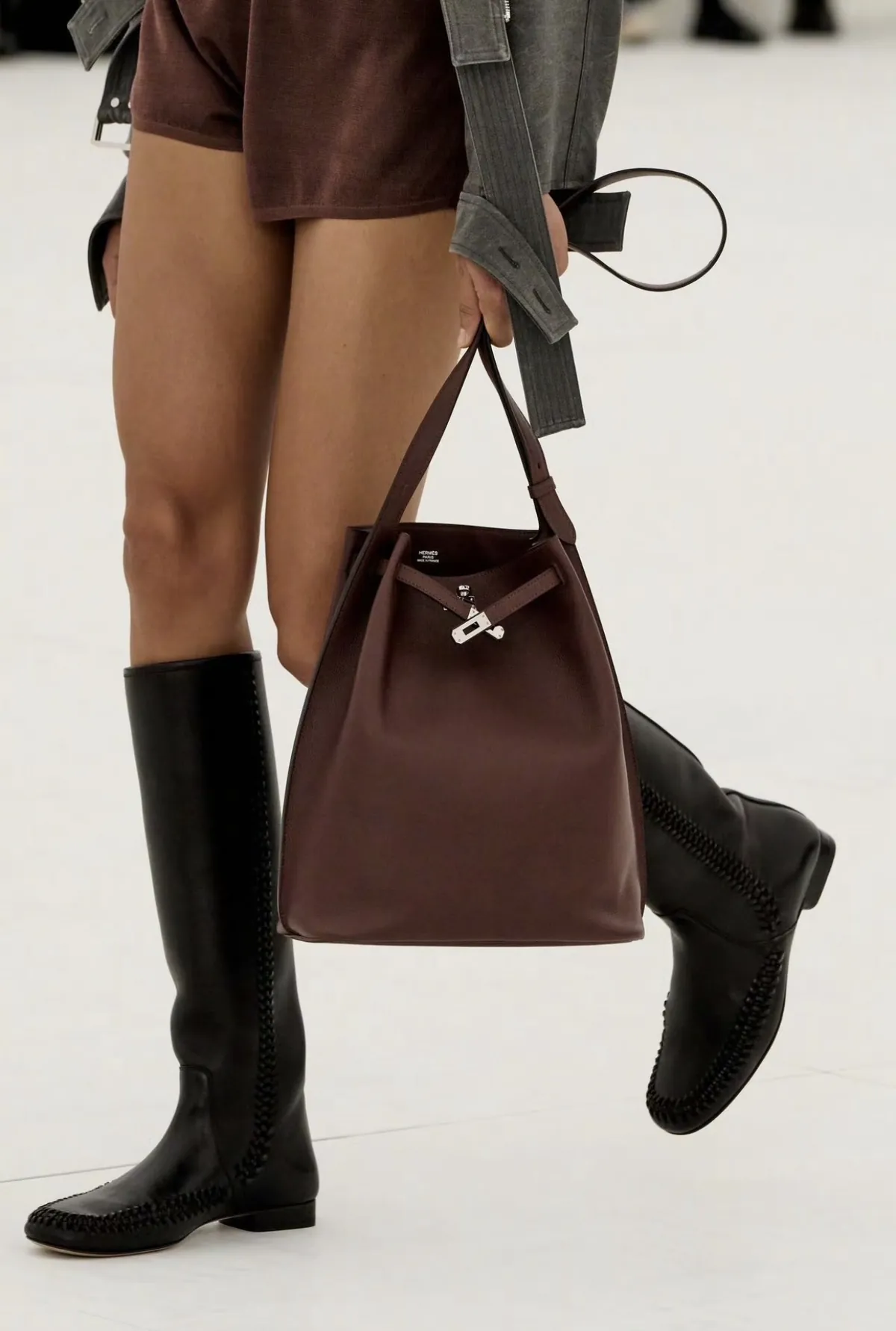
Carry the Hermès Sac à Dépêches Shoulder Bag by hand over tailoring when you want the tapered base to do the talking, and on the shoulder when a cropped or short jacket leaves the strap and front pocket exposed. The bag itself is quiet; the outfit decision is really about where the hem of your top layer ends and whether the trouser follows the bag down or pulls against it.
The featured image is an existing Hermès wardrobe reference, separate from the Sac à Dépêches Shoulder Bag looks discussed here.
PurseBop's Anna McWhirter, writing on 5 June 2026 about the Fall-Winter 2026 Chapter Two show in Los Angeles, reports the Sac à Dépêches Shoulder Bag in what appears to be Swift calfskin in Black, with a structured rectangular base that tapers to create a subtle slouch. A front pocket reworks the nearly century-old Sac à Dépêches heritage detail in a pared-back, tone-on-tone finish. The bag is described as void of heavy hardware, with an 'H' buckle on its adjustable shoulder strap, and it was carried by hand on the runway. Those are the reported design facts; the outfit judgements below are my own styling reading.
What the tapered base asks of the clothing
The shape is the deciding feature. A rectangular base that narrows toward the top gives the bag a slight A-line in reverse: firm at the bottom, softer above. My reading is that a straight or gently tapered trouser echoing that downward line keeps the silhouette legible, while a very full or heavily gathered trouser competes with the bag's own narrowing. A plain wool column in a mid-to-dark tone lets the tone-on-tone pocket read as texture rather than as a competing focal point. If you want a reference for how a black shoulder bag sits against a wide-leg trouser, the wide-leg trouser and black shoulder bag guide covers the proportion question well.
Hand carry over a trouser column
Hand carry is the simplest route with tailoring, and the runway showed it that way. Held in the hand, the bag hangs beside the thigh, so the trouser leg beside it becomes a visual partner. A clean, flat-front trouser with a defined waist and a straight fall to the shoe gives the bag a calm vertical neighbour. Keep the jacket or blazer single-breasted and reasonably plain at the waist; a belt with a large buckle near where the bag sits in the hand adds a second point of interest the bag does not need. A tucked shirt or fine knit keeps the waist smooth. Where I would choose differently: a long, full coat worn open over the same trouser can swallow the bag at hand level, so shortening the coat, or carrying the bag slightly forward of the body, keeps its tapered base visible.
Shoulder carry needs a shorter jacket
The adjustable strap with the 'H' buckle is the reason shoulder carry belongs in the conversation, even though the runway put the bag in the hand. On the shoulder, the bag sits at roughly hip or waist height and pulls the eye to the front pocket. My reading is that a cropped jacket, a jacket that ends at or above the waist, or a short cardigan clears the strap and lets the pocket show below the hem. A long, boxy coat worn closed hides both the strap and the pocket, which is where the bag's quiet detailing gets lost. A plain, low neckline and minimal jewellery keep the hardware count low, since the bag itself is described as void of heavy hardware and only the 'H' buckle draws the eye.
Where hardware minimalism matters
Because the front is pared back and the tone-on-tone pocket recedes, the outfit can afford one soft texture rather than several competing ones. A fine-gauge knit, a smooth wool or a matte shirt sits comfortably against the reported calfskin. If you are building around a plain base, the plain coat and trouser wardrobe guide offers a useful parallel for keeping the clothing restrained so a single bag detail leads.
Before committing, try the bag by hand and on the shoulder with the jacket you plan to wear most, and check the strap at the length you would actually use; that is a practical check, not a claim about how it will feel or wear.