The style notebook
Hermès Farandole and Silk Scarf: Halterneck Top Outfit Ideas
Hermès Farandole clasping a silk scarf as a halterneck top: which scarves, shoulder layers and jewellery to skip, and plain lower halves that keep the clasp focal.
Keep the neck, ears and shoulders clear and let the Hermès Farandole do the fastening. When the necklace secures a silk scarf as a halterneck top, the T-bar clasp is both the closure and the ornament, so the rest of the outfit should avoid adding a second neckline event. Anna McWhirter's PurseBop article of 5 June 2025 describes the scarf-and-necklace halter as one of the Farandole's more inventive uses: the necklace is used to secure the scarf at the neckline, acting as both a functional clasp and a focal point. That garment idea changes what belongs around the throat and what should stay on the lower half.
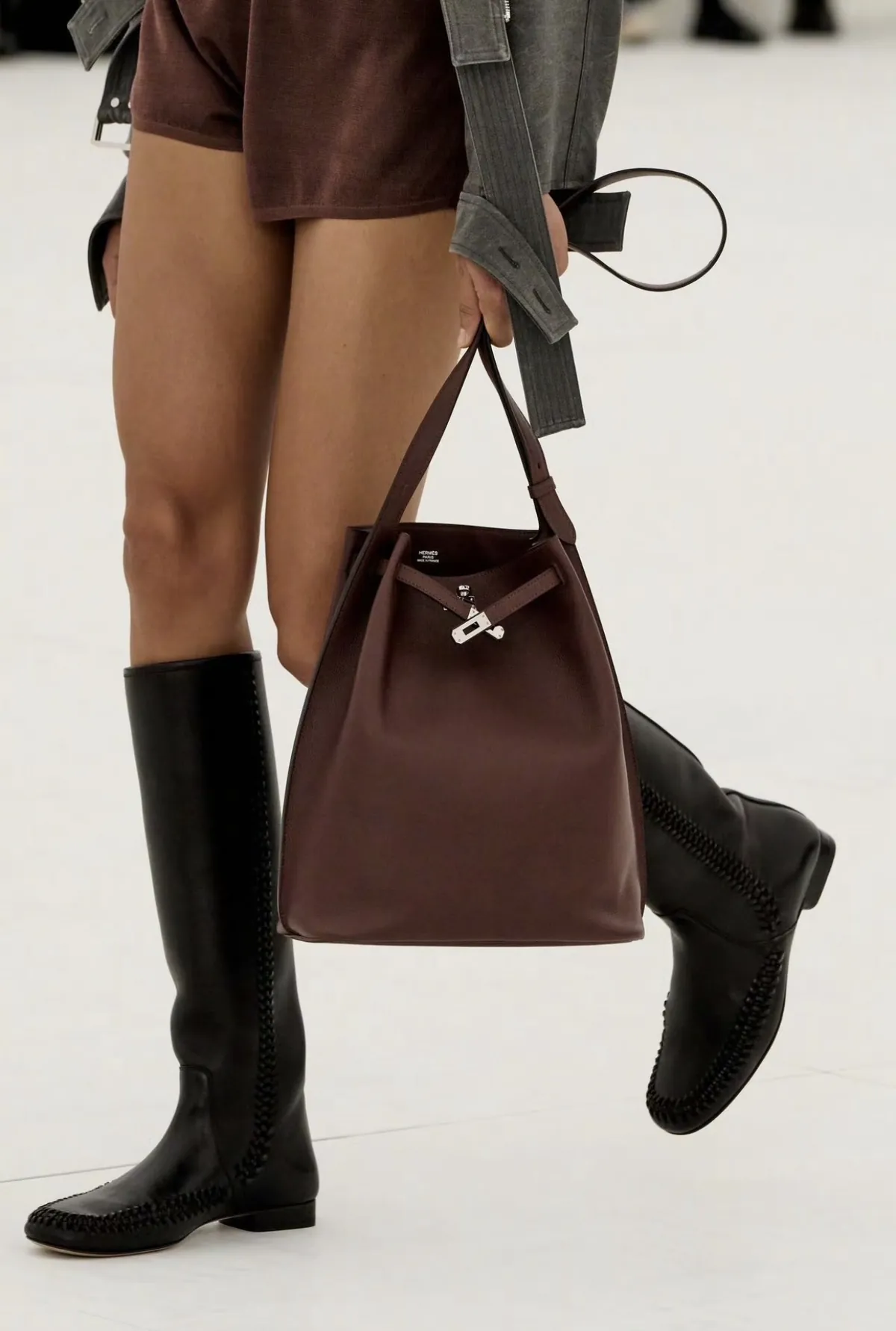
The featured image is an existing Hermès wardrobe reference, separate from the Farandole looks discussed here.
The scarf and the clasp are the top
The source is clear that the scarf is held by the necklace at the neckline rather than worked into a conventional halter with its own ties. McWhirter frames this as a way to pair two Hermès icons for a summer look. She gives no knot diagram, no scarf size, no silk weight, no instructions on how many links fall where, and no statement about how the scarf behaves when worn. So start with a check: fold and tie the scarf with your own Farandole and see where the clasp lands before you plan anything else around it. The clasp needs to sit visibly at the front of the neckline, not buried under a fold or dragged sideways. If the knot hides it, the outfit loses its reason.
A scarf with a strong contrast border is easier to read here than a busy all-over print, because the border can frame the neckline while the chain cuts a clean metal line down the centre. That is my interpretation, not something the article says. The source notes only that a silk scarf is used and that the clasp serves as the focal point. A quieter scarf lets the gold or palladium of the Farandole register against silk; a dense print competes with it for the same small area. McWhirter's separate point that the Farandole can be reversed to let the T-bar clasp become a focal point supports treating the clasp as an intentional centrepiece rather than a hidden practical detail.
What to leave off the upper body
Earrings are the first thing to skip. The necklace already draws the eye to the throat and jaw, and a drop earring or a large hoop adds a second bright shape at almost the same level. Small studs or nothing at all let the clasp own that zone. This is my styling judgement, not a claim in the source.
Forget a second necklace. Layering another chain under the scarf is invisible and pointless; layering one over the scarf adds a competing line on top of the very clasp you want seen. The Farandole is doing the necklace job, so it should be the only one.
Shoulder-covering layers are the harder question. A plain cardigan or a jacket worn open leaves the halter and its clasp visible and gives the bare arms and shoulders a frame. Anything that closes at the throat, such as a buttoned shirt collar, a high-neck knit or a scarf tied at the neck, crowds the neckline the halter already occupies. For a cool evening, an open overshirt, a loose jacket worn off the shoulders or a light layer that hangs away from the chest works better than a pullover. The article does not discuss layers, so treat this as a way to preserve the halter's function rather than a reported styling rule.
Plain below, textured at the neck
The upper body is already busy: bare skin, printed silk and metal chain all sit in the same zone. The lower half should not add a fourth idea. Plain wide-leg trousers or a simple skirt keep the silhouette calm and let the halter read as the outfit's one designed element. If the scarf is printed, keep the trousers or skirt in a solid neutral; if you want more print, put it far away from the neck, for example in a bag or a shoe, not in a competing top layer.
Two practical points belong with this decision. First, the halter leaves the shoulders bare, so the back and upper arms are part of the outfit; check the scarf's coverage when you tie it. Second, a bare neckline plus metal can feel formal for daytime, and a plain linen or cotton lower half pulls it back. The necklace has three lengths, 80 cm, 120 cm and 160 cm, per McWhirter, and the amount of chain left hanging after the clasp is set will differ across them. The source does not say which length suits the halter best, so test your own necklace rather than assuming.
For a closely related read on using the Farandole elsewhere, see the chain-as-bag-strap guide. This halter idea and that one should not be worn at the same time: the clasp can be a neckline or a bag strap, not both.