The style notebook
Hermès Farandole Necklace: Chain as Bag Strap and Waist Belt Outfit Ideas
The Hermès Farandole in 160 cm: choose waist belt or bag strap per outing, and keep the clothing plain so the chain stays the single focal point.
For the 160 cm Hermès Farandole, the cleanest decision is to let the bag have the chain and keep the waist bare. A 160 cm length wraps, doubles and overlaps in several ways, so wearing it at the waist while also threading it onto a Kelly Pochette splits one gleam between two places. Anna McWhirter's PurseBop article of 5 June 2025 frames the Farandole as a necklace offered in 80 cm, 120 cm and 160 cm lengths, and demonstrates the longer version working through belt loops, slung low over a dress, and acting as a shoulder strap or short crossbody for a Kelly Pochette or a Constance or Roulis slim wallet. Her framing is the useful starting point: one accessory, several jobs, one job per outing.
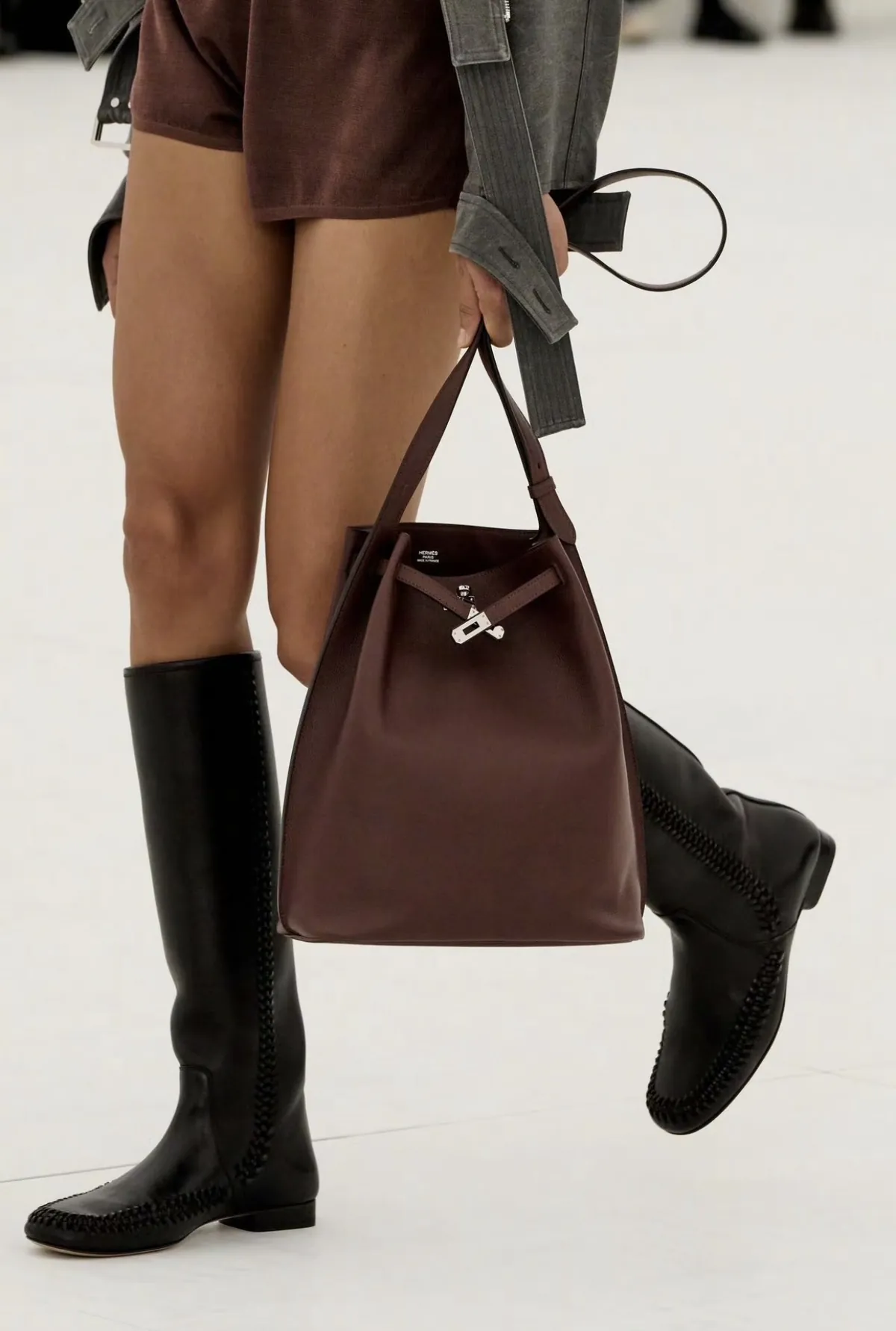
The featured image is an existing Hermès wardrobe reference, separate from the Farandole looks discussed here.
Why the waist is the harder job for the 160 cm
McWhirter writes that the longer Farandole, especially the 160 cm, "transforms into the most elegant of waist accessories" when looped through belt loops or slung low over a dress. She also notes that it can be wrapped twice for a layered double-chain effect or worn full-length so the extra length drapes.
That double-duty range is exactly why the waist is less forgiving. Through belt loops, the chain's length has a fixed channel and reads as a belt with a clasp. Slung low over a dress, nothing holds the length except the chain itself, so the dress fabric and the dress waistline have to carry the visual weight without pulling. A crisp shirt with belt loops gives a clean answer; a fluid silk column lets the chain lie and drape. My styling reading is that a dropped-waist dress, a gathered waistband with a lot of fabric at the hip, or a belted trench with its own buckle all compete with the chain at the same point and make the result look cluttered rather than shaped.
The 160 cm also gives more chain than most single belt loops need. Wrapped twice, it becomes a denser band; worn long, it hangs past the hip. Decide which of those two effects you want before you put it on, because a half-measure — one loop, leftover tail disappearing — is the version that looks accidental.
Giving the Kelly Pochette the chain
For the Kelly Pochette, the Farandole does a genuinely different job. McWhirter describes wrapping the chain around the pochette as part charm, part functional chain shoulder strap, and separately recommends transforming the "handheld-only" pochette into a functional shoulder strap. Both statements sit in her bag section, so treat them as styling functions rather than a fixed attachment method.
The practical consequence for clothing is narrower than it sounds. The chain now sits at shoulder height and crosses the top of the bag, which is where the eye goes first. A plain shirt, a fine-knit crew neck, a smooth leather jacket or a simple coat keeps that junction clear. Anything with its own heavy hardware at the neckline or shoulder — a big collar clasp, a chain-strap second bag, oversized shoulder epaulettes — repeats the same trick and cancels it. I would also skip a scarf at the neck in this version; the Farandole is already doing the gleam near your face.
The slim wallets McWhirter names — the Constance or Roulis — take the chain differently again. Doubled, she describes it as a short shoulder strap; worn long, as a hands-free crossbody. These are small pieces, so the chain becomes proportionally large, and plain clothing with a clean line through the torso serves it best. A busy print or a peplum at the hip interrupts the crossbody line.
The necklace option, and where it wins
If the outfit already has a waist — a wide belt, a defined seam, a belted coat — the Farandole is stronger at the neck. McWhirter lists the long simple wear, the doubled layer, the triple wrap at 160 cm, the choker, the lariat and the reversed T-bar clasp as focal point. Each of those moves the chain up away from the waist and the bag, and that separation is the whole reason the necklace role is worth keeping in the rotation.
A long single strand against a plain column dress or an unadorned knit is the simplest test. A triple wrap needs a plainer neckline still, because the chain now covers the collarbone area densely. Reversed, the T-bar clasp becomes the one detail, which means no pendant, no second necklace beneath it and no visible bra strap or lace at the same spot.
Choosing per outing
- Waist: pick a shirt with real belt loops or a plain fluid dress; leave the Kelly Pochette at home, or carry a bag without visible hardware.
- Bag strap: wear the plainest top and coat you own, and skip neck jewellery and a neck scarf.
- Necklace: choose the outfit where the waist is already defined by clothing, then let the chain be the only metal above it.
One conditional check before the bag version: try the Farandole against the actual Kelly Pochette or slim wallet you plan to carry, since McWhirter attaches the function to the size of both the bag and the chain. That is a fit test, not a guarantee of how it will hang.
The scarf-halter idea she also describes — securing a silk scarf at the neckline with the chain — sits outside all three roles. It uses the Farandole as a clasp for a top, so it belongs with plain trousers and a bare shoulder, not with a belted dress or a shoulder-carried pochette.