The style notebook
Hermès Farandole 160 cm Worn as a Waist Belt Over a Dress: Outfit Ideas
Hermès Farandole 160 cm as a waist belt over a dress: decide between a doubled wrap and a full draped length by dress fabric, belt loops and where the excess falls.
The Hermès Farandole 160 cm worn as a waist belt over a dress works best in one of two positions: doubled twice for a compact chain band, or left full length so the excess falls in a long drop beside the waist. The first keeps the waist as the focal point. The second turns the chain into a vertical line. Which one flatters a dress depends less on the chain than on the fabric wrapped under it and whether the dress has something for the chain to catch.
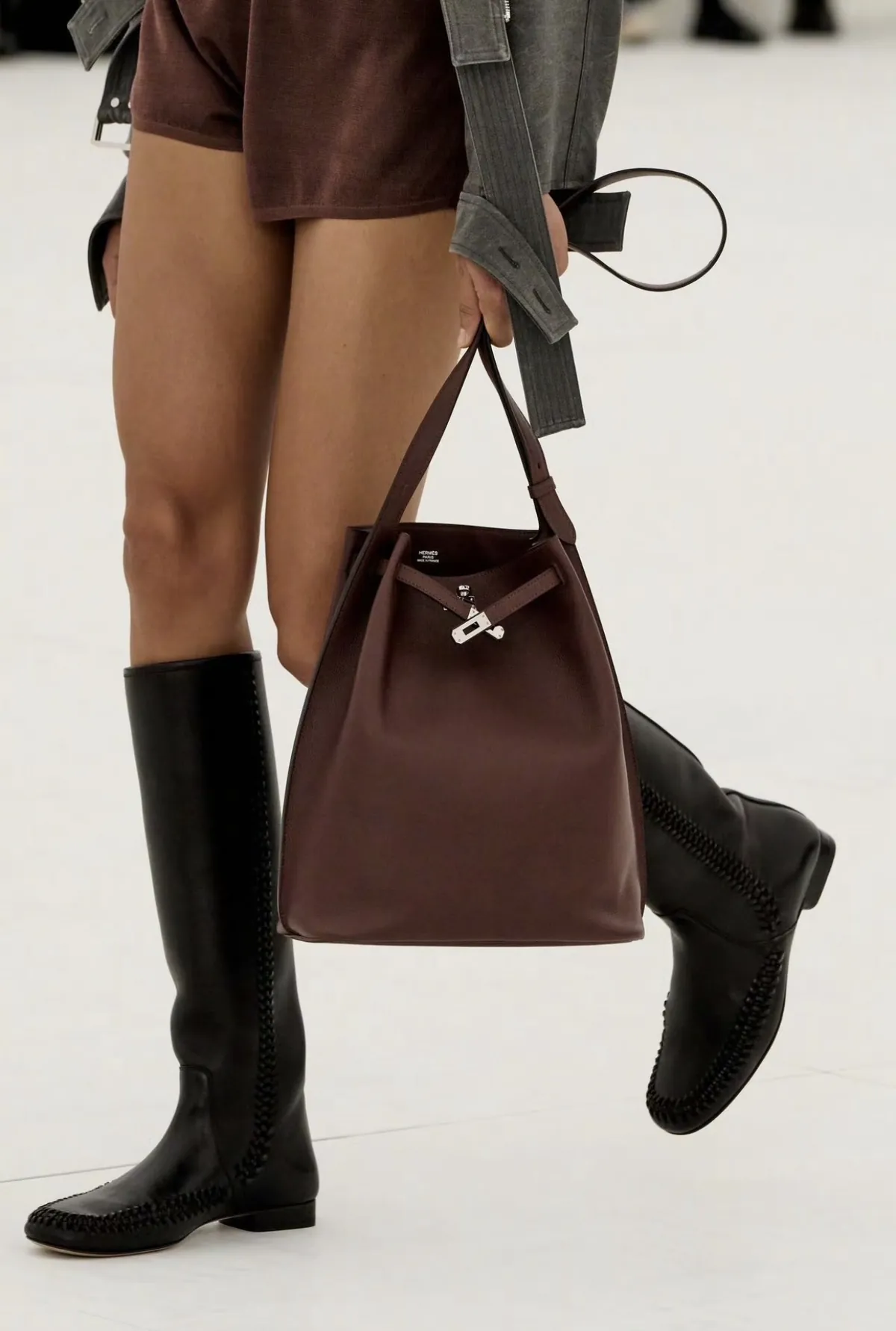
The featured image is an existing Hermès wardrobe reference, separate from the Farandole looks discussed here.
Anna McWhirter’s PurseBop article “How Do You Wear Your Hermès Farandole?” (5 June 2025) is the factual anchor. It describes the longer Farandole, especially the 160 cm, being looped through belt loops or slung low over a dress to become a waist accessory, and it names two methods: wrap twice for a layered, double-chain effect, or wear full-length and let the extra length drape. It places that waist use over “crisp shirting” and “fluid silk.” The clothing reasoning below is my own reading of those details.
The doubled wrap: a belt that holds its place
A twice-wrapped Farandole behaves like a chain belt with two parallel strands. That doubling is the practical choice over a fluid silk dress. One strand alone tends to sit and shift wherever the silk moves; two strands give the chain a wider band and a little more visual weight against a fabric that offers little friction. On a slip dress or a bias-cut silk skirt, the double wrap gives the waist a defined edge instead of a single thin line that disappears with the drape.
The trade-off is bulk near the clasp. Two passes put more metal at the point where the chain closes, so choose the doubled wrap when you want the waist to read as a deliberate, slightly heavy accessory. If the dress is loose through the waist and already has volume, the compact band helps. If the dress is fitted and clean through the middle, a double wrap can look busy.
Full length: the drape becomes the point
Left full length, the chain asks before you wear it: where does the extra length hang? Over a crisp shirt-dress or a structured cotton poplin, the excess can fall in a straight drop and read as a vertical detail against a dress that holds its shape. The chain is not trying to compress the fabric; it is running down it. That makes the full-length method the more natural partner for crisp shirting, which the source places alongside fluid silk as a waist-belt fabric.
Where I would choose the doubled wrap instead: a fluid silk dress with no waist seam. The fabric will not hold a draped tail neatly, and the extra chain will slide into folds. A full length there can look like a chain that lost its anchor. The double wrap gives silk structure at the waist, which is exactly what the fabric lacks on its own.
Belt loops change the decision
A dress with real belt loops is the simplest case. Threading the Farandole through the loops fixes the chain’s height and stops it riding up or down as you move. That height control matters more with the full-length version than with the doubled one, because the draped tail needs a stable starting point. Without loops, the chain is held by friction and balance alone, so a doubled wrap sits more predictably on a smooth dress.
If the dress has no loops and the fabric is slippery, I would start with the doubled wrap and adjust the tail so it falls to one side rather than straight down the front. A side drop disrupts the dress’s centre line less and keeps the waist, not the tail, as the first thing read.
Where the extra length should land
With the full-length method, the tail should fall past the hip, not stop at it. A short tail ending at the widest part of the hip draws the eye sideways and makes the waist look lower. A longer drop continues the vertical line downward. On a shorter dress, that may mean letting the tail hang free below the hem line; on a midi or maxi, aim for the tail to fall against a smooth, uninterrupted panel of fabric.
The doubled wrap avoids this question by keeping the excess compact at the waist. That is its advantage on a short or minimally structured dress. The waist stays the focal point because there is no competing vertical line.
A quick check in front of a mirror
Fasten the chain at the height you intend, then move your arms and sit down once. The doubled wrap should stay level; the full-length drop should not swing across the front of your body when you turn. If the tail crosses to the opposite hip as you move, the chain is too loose for the fabric, and a second wrap will hold it better. Check the clasp position too: with the T-bar reversed, it can become the focal point at the waist, which suits a plain dress but competes with a patterned or detailed bodice.
For the wider Farandole styling context, see the Farandole chain as bag strap and waist belt guide. If your alternative is a leather belt, the Kelly 18 belt guide covers a different waist decision.