The style notebook
Hermès HAC Shadow-Style 'Connect the Dots' Bag: Outfit Ideas
Plain clothing for the Hermès HAC Shadow-style 'Connect the Dots' bag: how matte surfaces and careful hand-carry keep the embossed flap and tiny numbers legible.
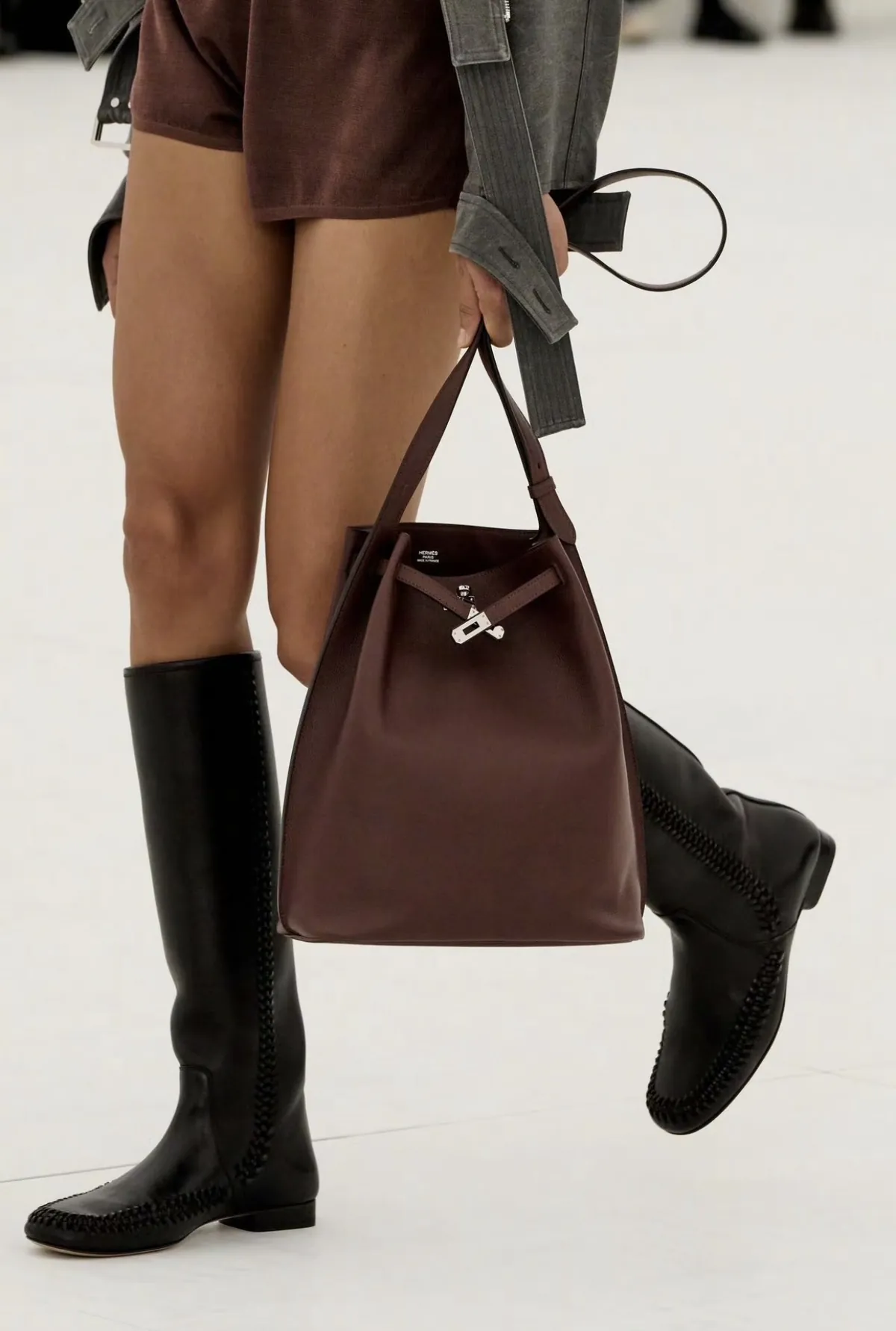
The Hermès HAC in this stripped Shadow-style form asks for clothing that stays matte, plain and free of metal. The bag forgoes the flap, sangles and signature hardware of the classic 1892 HAC; instead, an embossed pattern mimics the shape of the flap and sangles, with a white overlay and tiny numbers marking each point. The effect is a "connect the dots" design in heritage box calf, presented in black and deep brown. Because the visual information sits in a shallow emboss and small white marks rather than a shiny clasp, the outfit's job is to avoid stealing attention from that quiet surface. Anna McWhirter's PurseBop report, published 25 January 2025, describes the design; the styling reasoning below is my own reading of those details.
The featured image is an existing Hermès wardrobe reference, separate from the HAC looks discussed here.
Let the leather carry the texture
Box calf is a smooth, polished leather, and the embossed flap and sangle outlines read as subtle relief rather than pattern. Clothing with its own strong texture competes with that relief. A chunky cable knit, a heavy rib, a pressed corduroy or a fuzzy shearling jacket all introduce surface noise at the same visual scale as the embossing. The safer choice is a flat wool trouser, a smooth shirt, a fine-gauge knit or a matte coat in a solid colour. Matt surfaces leave the leather's slight sheen as the brightest thing in the lower half of the outfit, and the embossed lines stay readable against it.
Where you want warmth in winter, a smooth wool overcoat or a plain leather jacket keeps the register close to the bag without copying its embossing. A shearling jacket is the one to think twice about: it is a Hermès signature for the season, but its texture is busy enough to pull the eye away from the fine white marks on the front of the bag.
Keep the palette close to black or deep brown
The bag comes in black and deep brown heritage box calf. Both are dark, low-contrast leathers, and the white overlay is what makes the flap outline and numbers visible at all. That means the clothing around the bag should not be a brighter, more graphic element. Grey tailoring, navy wool, charcoal knitwear, stone or beige trousers and a camel coat all sit quietly beside either leather. A bright cherry red, teal or lime green top, however, will dominate the frame and the bag becomes a dark shape with barely visible lines.
If you want colour, keep it away from the bag's front. A coloured scarf, a shirt collar or socks can carry the accent while the coat and trousers stay neutral. The bag's detail is a close-up pleasure; the outfit should invite a second look rather than a first glance at something else.
Plain skirts and trousers: quiet hems and no metal
Since the HAC is a generously sized, hand-carried bag, the area around the hip and hand is where the embossed flap and numbers sit. Avoid trousers with visible hardware at the pocket or waistband: metal buttons, chain belts, large buckles and studded closures all introduce the kind of shine the bag deliberately lacks. A plain waistband, a covered closure or a simple belt in the same tonal family as the trousers keeps the hand-carry zone calm.
Skirts and dresses work on the same principle. A smooth wool midi or a plain A-line skirt leaves the bag as the textured object. Prints are the main thing to leave out: a checked trouser or a floral dress will fight the dotted marks, and the eye will not settle on either. Solid colours, subtle tonal differences between jacket and trouser, and flat fabrics are the useful choices.
Why a second metal accent should stay away
The only visible hardware on this HAC is the feet at the base, according to McWhirter. The bag's design is a deliberate removal of metal: no turnlock, no sangles with buckles, no plaque on the front. Adding a metal watch, a chain bracelet, a polished belt buckle or metallic shoes near the bag reintroduces exactly what the design leaves out. That is not a rule about jewellery in general; it is a question of proximity. A metal watch on the carry hand sits right beside the plain front panel and the tiny numbers, and it becomes the brightest point in the frame.
If you wear metal daily, keep it small and let the bag sit in the other hand. Leather, wood, enamel or fabric accessories leave the bag's quiet surface to do its work. The same logic applies to bags worn with the HAC: a second bag with a prominent clasp is best avoided.
Hand-carry against a coat
The HAC is a hand-carried shape, and the coat is the surface it sits against most often in winter. A long, plain coat in wool or a smooth leather jacket gives the bag a clean backdrop. Cropped jackets shorten the line and can make a large HAC look oversized; a longer coat lets the bag hang beside the leg and keeps the embossed front visible. If the coat is belted, a simple self-belt in the same fabric is less distracting than a metal-buckled belt at the waist.
Fit matters here too. Before you build a week of outfits around the bag, try it under the coat you wear most, checking whether the handles clear the sleeve and whether the bag sits comfortably against the body. That is a personal check rather than a claim about the bag's dimensions. The existing Hermès HAC, Kelly and Birkin hand-carry guide is a useful companion for the broader question of how a HAC sits against tailoring, while the Sac Cliquetis plain-tailoring ideas carry over well to this box calf shape.
The short version
Treat this HAC as a quiet surface with a fine white drawing on it. Matte fabrics, dark or muted colours, no competing hardware and a long, plain coat are the choices that let the embossed flap and the numbered points read. Save the texture, print and shine for a different bag.