The style notebook
Hermès Kelly II Sellier 25 Journey to the End of the Night: Diamond Kelly Collector Guide
Hermès Kelly II Sellier 25 Journey to the End of the Night: how the 172-diamond hand-carry Kelly sits against the Himalaya and Kelly Midas collector benchmarks.
The Hermès Kelly II Sellier 25 Journey to the End of the Night is not a bag you compare on leather, size or strap. Anna McWhirter's PurseBop report, published 20 January 2026, frames it as high jewellery rendered on a Kelly: 164 Perle diamonds mapped across the body like a constellation, eight more set into an 18K white gold hardware plaque in line with the nails beneath, and 40 hours of handwork behind the whole piece. The comparison that matters for a collector is not against an ordinary Sellier 25 but against the two benchmarks the report itself names: the diamond-set Kelly Himalaya and the Kelly Midas. On those terms this is a quieter object, and the report is explicit that full production is unconfirmed. That unresolved status is part of what you are deciding about, not a footnote to skip.
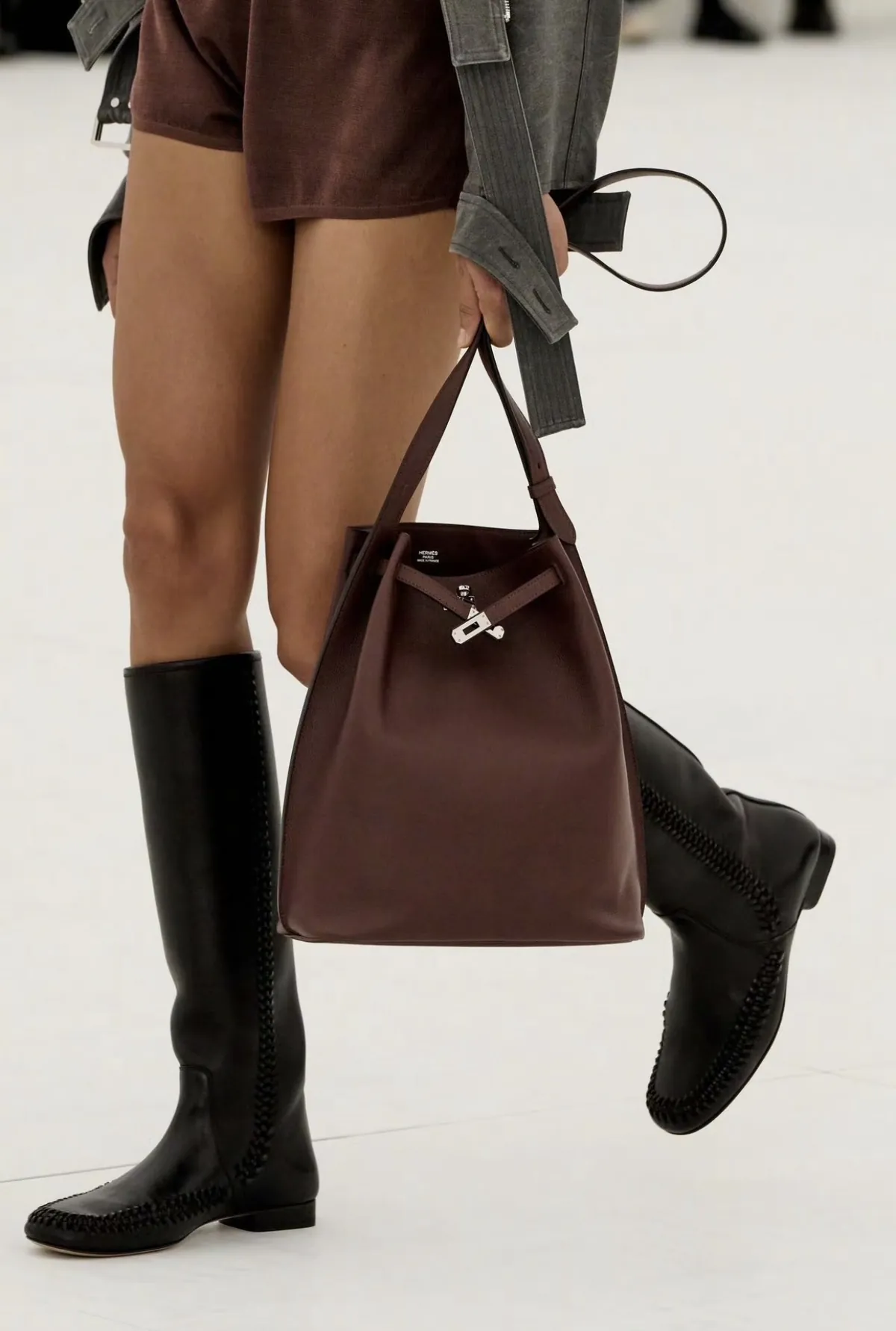
The featured image is an existing Hermès wardrobe reference, separate from the Kelly II Sellier 25 Journey to the End of the Night looks discussed here.
What the bag actually is
The star map is the defining move. Each diamond is placed to echo the natural scatter of stars rather than to follow a regular pattern, which is why the report calls the technique revolutionary and undisclosed. The 18K white gold plaque continues that logic: eight diamonds sit in line with the positions of the nails that secure the hardware, so the setting and the construction share one geometry. Forty hours of handwork is the report's own figure, offered as the reason the piece carries its name.
The carry decision follows from the jewellery. McWhirter describes the bag as hand carry only, a top-handle treatment she says Hermès has used on only the most precious diamond Kelly Himalaya and the Kelly Midas. A vintage-style ring replaces the modern D-ring, a change the report reads as protecting solid gold hardware from strap tension and reinforcing the jewel-like register. In plain terms: this is a Kelly designed to be held in the hand, with no strap provision to debate.
Against the Himalaya and the Midas
The Himalaya is the reference point most collectors already hold in their heads — an exotic Kelly whose diamond variant shares this top-handle, hand-carry code. The Journey to the End of the Night sits in that same narrow family rather than opening a new one. What separates it is where the sparkle goes: the Himalaya's identity is carried by the material itself, while this piece puts the diamonds onto an otherwise classic Kelly shape and lets a mapped pattern do the work. The Midas, the report's other named benchmark, belongs to the same rarefied top-handle group.
My reading, separate from the report's facts, is that the distinction is one of register rather than rank. A Himalaya reads as a rare skin; the Midas reads as solid gold hardware as the headline; the Journey to the End of the Night reads as a drawn constellation, with the white gold plaque as its signature detail. A collector drawn to pattern and story will find this the more interesting object. A collector who wants the recognisable exotic benchmark may still prefer the Himalaya, because its identity is legible without explanation.
Why the unconfirmed status changes the decision
McWhirter writes that only time will tell whether the edition reaches full production, and notes that Hermès first teased a similar constellation idea in 2015 without it materialising. The quiet return in 2025, a decade later, suggests refinement of both technique and vision, but it does not establish that the bag will be made in numbers or offered at all. Treat it as a concept with a design identity, not a shipping product. For a collector, that means the question is whether the idea itself earns a place in your mental benchmark set — the way the Himalaya and Midas already have — rather than whether you can plan an acquisition around it.
If the appeal is the star-mapped body and the vintage ring, that appeal survives the uncertainty; you are judging a design proposition. If the appeal is owning a recognised rarity, the Himalaya remains the safer benchmark because its standing is already settled. Neither is wrong, but they are different bets.
Where it sits beside a jewel-hardware wardrobe
Because the piece is hand carry only and built around gold and diamonds, its wardrobe logic overlaps with other jewel-hardware bags rather than with strap-carried Kellys. The Hermès Birkin 20 Diamond Parure guide covers the same problem of dressing around a bag that is already an ornament. A hand-held, heavily jewelled bag leaves the wrist and shoulder free of competing pieces, and the outfit around it can stay plain so the star map reads. That is styling judgement, not a claim about how the bag performs.
For collectors weighing hand-carry formats more broadly, the HAC, Kelly and Birkin origin comparison sets out what each shape asks of the hand. The Journey to the End of the Night belongs at the most formal end of that hand-carry spectrum. Where the report's facts end and interpretation begins: the 172 diamonds, the 40 hours, the vintage ring and the hand-carry-only brief are McWhirter's; the collector framing above is mine.