The style notebook
Hermès Picotin: Sizes 18 and 26 Carry and Outfit Ideas
Hermès Picotin 18 or 26? How each size changes hand-carry posture, sleeve and trouser proportion, with one plain outfit formula for each.
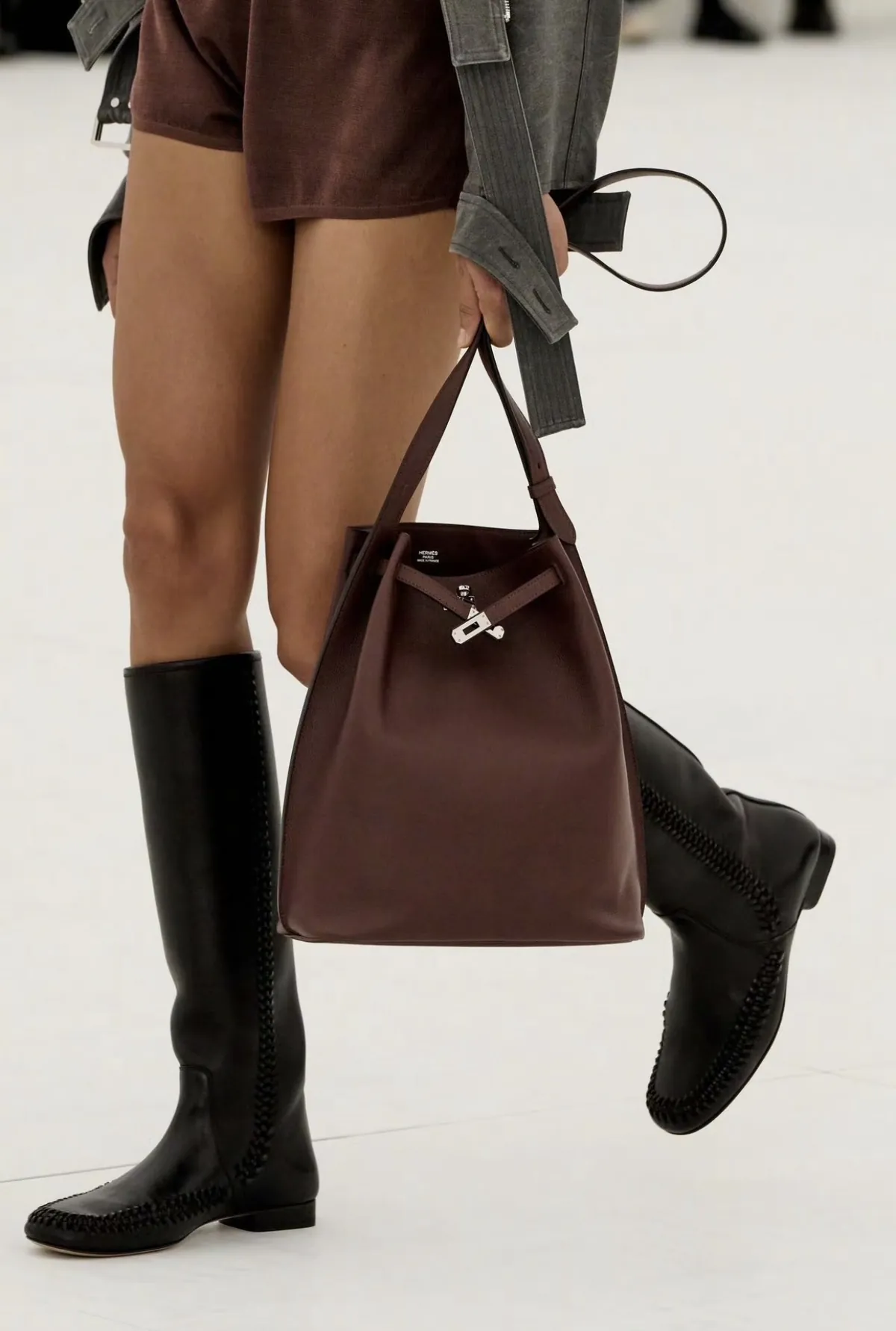
The Hermès Picotin 18 is the hand-carry choice for a neat, tailored day outfit; the Picotin 26 is the one for a looser, roomier layer that you carry in the crook of the arm or close against the body. The size gap itself changes the clothing: a small bag makes the hand the focal point and asks for a clean sleeve and a closer line, while a larger Picotin adds visual weight at the side and needs a looser garment volume to sit against without looking cramped. Anna McWhirter's PurseBop report, published 29 September 2024, places both sizes at the Spring-Summer 2025 show — the beloved Picotin returning after a four-year absence, shown in sizes from the petite 18 to the more generous 26, in various leathers including what seemed to be heritage options. That establishes the two sizes and the collection, not their exact measurements or strap drop, so the styling judgements below are mine.
The featured image is an existing Hermès wardrobe reference, separate from the Picotin looks discussed here.
What the source establishes about the two sizes
McWhirter names the petite 18 and the more generous 26 and places the Picotin 26 in Barénia leather at the Re-see, which ties the larger size to a heritage-leather look. She does not give dimensions, handle length, weight, or how either bag sits when carried. Treat the source as proof that these are the two sizes on the runway, not as a specification sheet. The carry and proportion advice here is editorial: it uses the 18-versus-26 gap, not a claim about a strap or a tested capacity.
Why the 18 suits a hand-carry day outfit
A petite top-handle bag concentrates attention at the hand and wrist. On a tailored day outfit, that means the sleeve is the first thing to resolve: a jacket or shirt sleeve that ends cleanly at the wrist leaves the handle and the hand uncluttered. My reading is that the 18 works best against a close vertical line — a straight trouser with a clean break, a simple skirt that clears the knee, a shirt or fine knit that does not balloon at the cuff. The bag is small enough that the clothing can carry the silhouette, and the leather becomes an accent at the hand rather than a mass at the side.
Why the 26 suits a roomier, shoulder-adjacent carry
The 26 is the size for days when the outfit itself has volume and the bag needs to belong to that volume. A looser coat, a wide trouser, a roomy shirt — these are the garments that give a more generous Picotin something to sit against instead of dwarfing it. McWhirter describes the larger size as more generous, and the Re-see in Barénia leather gives it a softer heritage character. My styling interpretation is that the 26 is best carried close to the body or in the crook of the arm, so the outfit's volume and the bag's volume echo each other. This is a clothing-proportion judgement; the source does not establish a shoulder strap or a carry height.
One plain formula for each
For the 18: a straight-leg wool trouser, a plain shirt buttoned to the wrist, and a single-breasted jacket with a clean cuff. The bag sits at the hand as the outfit's one leather note. Keep the trouser hem short enough to show the shoe, so the eye travels from hem to hand without interruption. If you want a reference for the long vertical line, the wide-leg trouser guide explains how a bag colour and a wide leg interact, which is useful when you swap the straight leg for a wider cut with the 26.
For the 26: a slightly oversized shirt or a soft knit with a relaxed sleeve, a wider trouser or a fuller skirt, and a roomy coat over the top. Carry the bag in the crook of the arm so the clothing's ease and the bag's size read as one decision. Plain cloth — smooth wool, crisp cotton, fine knit — keeps the heritage leather as the textured element. A garment with its own heavy texture competes with the leather and muddles the effect; a plain surface lets the Barénia tone, as reported for the Re-see, do the work.
Where the size choice goes wrong
The mistake in both directions is proportion mismatch. The 18 against a very full coat or a voluminous knit can look lost, because the clothing overwhelms the handbag at the wrist. The 26 against a very close, narrow outfit can look heavy, because the bag adds bulk at the side with nothing to balance it. Choose the 18 when your day wardrobe is mainly close-fitting tailoring and simple dresses; choose the 26 when you dress in layers, wider shapes and roomier sleeves. The Micro Picotin guide and the Picotin 18 in feutre wool and Swift note show how the smallest and the 18 formats shift that balance further, which helps if you are deciding whether the 18 is already the smallest useful size for your wardrobe.
What to check before you settle
Because the source gives no dimensions, the practical check is to try the actual bag with the clothes you would wear it with: a jacket sleeve at the wrist for the 18, a roomy coat and wide trouser for the 26. That is a conditional check, not a claim about how either bag performs. The Picotin gives you a clear size-led decision: the 18 for neat tailoring and hand focus, the 26 for relaxed layers and a roomier line. Pick the size that matches the volume of the clothing you reach for most, and let the leather finish the plain outfit rather than compete with it.