The style notebook
Hermès Fall-Winter 2026 Satin Dresses and Leather Biker Jackets: Outfit Ideas
How to balance Hermès Fall-Winter 2026 satin dresses with leather biker jackets: jacket length, sequin placement and the collar over a draped neckline.
The Hermès Fall-Winter 2026 satin dress under a leather biker jacket works best when the jacket hem lands at the hip bone or just below it — not at the waist and not down over the thigh — and when sequins sit below that hem rather than scattered across the chest and collarbone. Anna McWhirter's PurseBop report, published 5 June 2026, describes the Los Angeles Chapter Two as a departure from the body-con leather dresses and slim jodhpurs of the Paris show: flowing satin dresses paired with Hermès' signature leather biker jackets, scattered sequins adding shimmer throughout, all under the title "Silhouettes on the Horizon." Those are the collection facts; the proportion reasoning below is my own reading of them.
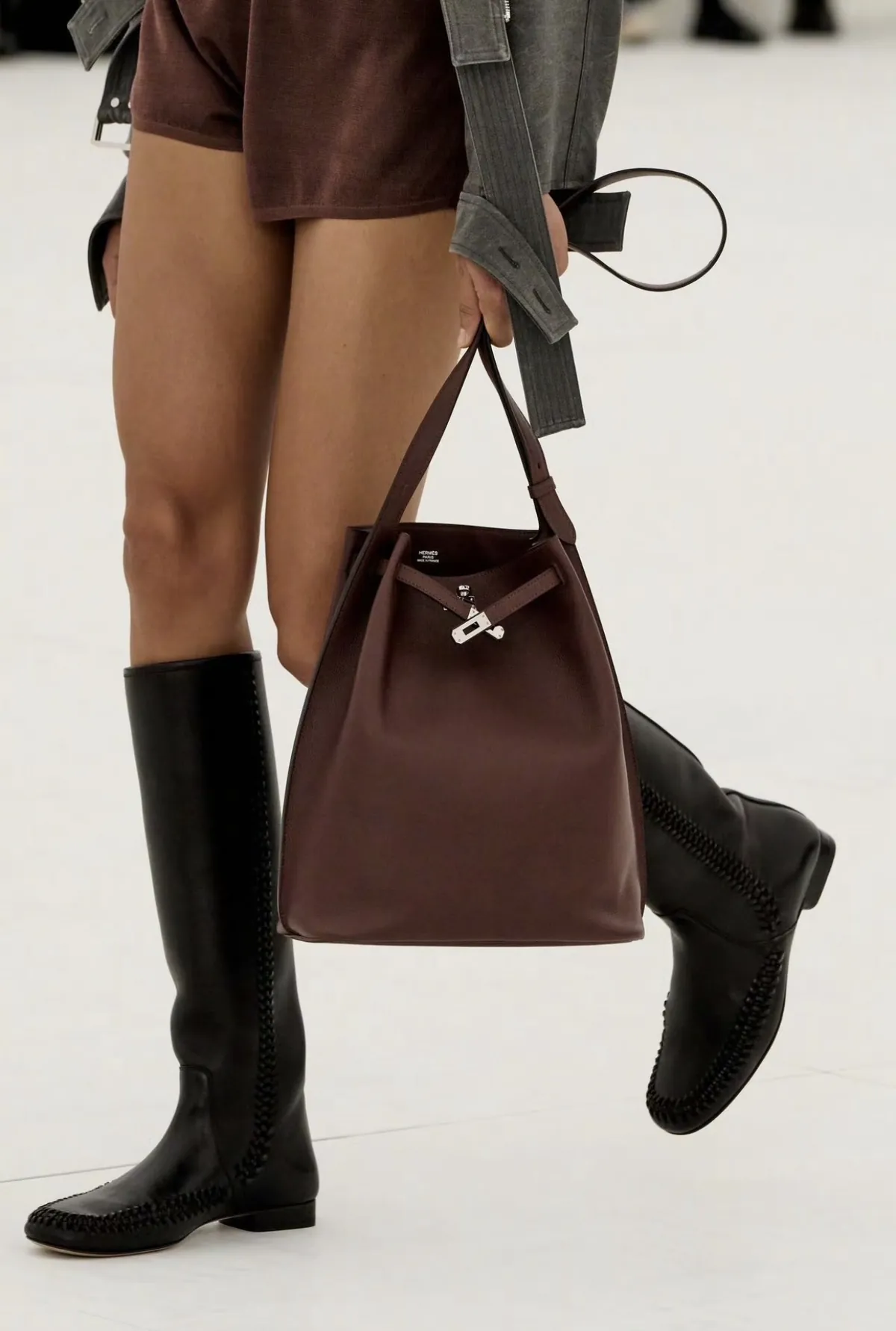
The featured image is an existing Hermès wardrobe reference, separate from the Fall-Winter 2026 looks discussed here.
The aim is a jacket that crops the dress cleanly and leaves the fluid part of the skirt to move on its own.
Why a hip-length biker is the safer pairing
A biker jacket is a short, fitted garment by design — cropped body, zip front, notched collar. Set that against a satin dress that falls and pools, and the two hems are doing opposite things. Where the jacket stops decides which one the eye reads first.
Stop the jacket at the natural waist and the dress below it becomes a single long column; on a fluid satin that can read as a skirt hanging from a bolero, and the torso disappears. Carry it down to mid-thigh and the jacket's bulk starts to crush the satin where the two meet, and the drape you came for is halved. Hip bone to just below is the useful band. The jacket keeps its own cropped shape, the satin gets a clear length to fall from, and the diagonal zip and collar stay where a biker's details are meant to sit.
If you want more jacket, choose a biker cut with a slightly longer body rather than sizing up a short one — a larger size widens the shoulders and sleeves as well, which changes the line you are trying to set.
Sequin shimmer wants to sit below the jacket hem
McWhirter records sequins as "scattered" and "throughout the collection" — a diffuse, light-catching detail rather than a concentrated panel. That wording is worth taking literally when you decide what to wear.
If the sequins on your dress fall mostly across the bust and shoulders, a closed biker collar will cover some of them and the rest will crowd the neckline. Sequins that begin lower — at the hip, along a skirt panel, scattered through the lower half — stay visible under the jacket's hem and read as a slow glitter as the satin moves. My preference: let the jacket own the upper body and let the sequins be the thing that catches light below. Two bright zones fighting at the collarbone rarely pay off.
If your dress is heavily sequined at the top, this is the moment to wear the jacket open on the shoulder or carry it rather than zip it, and let the shine sit where it was designed to.
The biker collar and the draped neckline
Vanhée's description of the dress as one "draped around the body and then becomes constructed" is the detail that should govern the collar. A draped neckline already has a soft, built-in frame. A biker's notched collar is a hard frame laid over it. That can be the whole point — leather against satin, structure against drape — provided the two frames do not fight at the same line.
Wear the collar open and pushed slightly back off the neck so the drape has room, and keep the dress neckline high enough or wide enough that it is not swallowed. A draped cowl beneath a zipped-up biker tends to disappear entirely; a straighter boat or slash neck holds its own under an open collar. Velvet, which McWhirter notes also appeared in the collection, deepens the texture contrast under leather and takes sequins with more restraint than slick satin — worth considering if you want the jacket to lead.
For a sharper shoulder line against the fluid dress, the collection's tailored coat with a chain belt is the structured alternative. If you are choosing an evening bag to finish the look, the studded Sanglons clutch keeps hardware to a minimum against satin.
A fit check on your own jacket
Before committing, put the jacket on over the dress and stand in front of a mirror with your arms relaxed. Note where the hem sits relative to your hip bone and how much satin shows below it. Then sit, and see whether the jacket rides up into a belt position. Finally, zip it and check the collar against the neckline — if the drape vanishes, wear it open. The proportions are the whole decision; the label size matters less than where the hem lands on you.